

Radon With its half-life of 3.8 days, the readily
soluble gas
222 Rn is in secular equilibrium with its
parent
226 Ra in the interior ocean. At the
boundaries of the ocean, however, inputs from
sediments and release to the atmosphere create
concentration gradients carrying useful kinetic
information. The distribution of excess
222 Rn near
the seafloor is used to quantify vertical diffusion
(see above, Figure 8) and ground-water inputs; the
depletion of
222 Rn in surface waters has been used
to quantify the air–sea gas exchange rate.
Summary
The accurate clocks provided by the uranium-thorium decay series enable us to extract rate information from the measurement of radioactive
disequilibria in the ocean. Among the wide spectrum
of available tracers, a mother–daughter pair with
appropriate reactivities and half-lives can be found
for a multitude of processes related to particle
transport, water mass transport and mixing, and gas
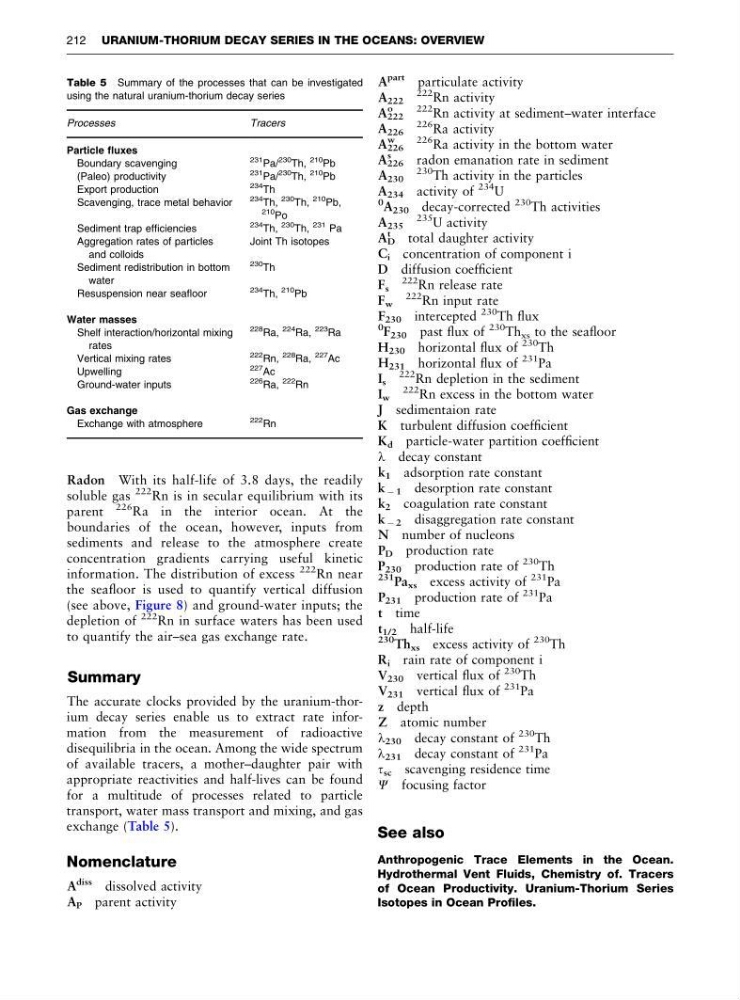
exchange (Table 5).
Nomenclature
A
diss
dissolved activity
A P parent activity
A
part
particulate activity
A 222
222
Rn activity
A 222
o
222
Rn activity at sediment–water interface
A 226
226
Ra activity
A 226
w
226
Ra activity in the bottom water
A 226
s
radon emanation rate in sediment
A 230
230
Th activity in the particles
A 234 activity of
234 U
0
A 230 decay-corrected
230
Th activities
A 235
235
U activity
A
t
D
total daughter activity
C i concentration of component i
D diffusion coefficient
F s
222
Rn release rate
F w
222 Rn input rate
F 230 intercepted
230 Th flux
0
F 230 past flux of
230 Th xs to the seafloor
H 230 horizontal flux of
230 Th
H 231 horizontal flux of
231 Pa
I s
222 Rn depletion in the sediment
I w
222 Rn excess in the bottom water
J sedimentaion rate
K turbulent diffusion coefficient
K d particle-water partition coefficient
l decay constant
k 1 adsorption rate constant
k À 1 desorption rate constant
k 2 coagulation rate constant
k À 2 disaggregation rate constant
N number of nucleons
P D production rate
P 230 production rate of
230 Th
231 Pa xs excess activity of
231 Pa
P 231 production rate of
231 Pa
t time
t 1/2 half-life
230 Th xs excess activity of
230
Th
R i rain rate of component i
V 230 vertical flux of
230 Th
V 231 vertical flux of
231 Pa
z depth
Z atomic number
l 230 decay constant of
230 Th
l 231 decay constant of
231 Pa
t sc scavenging residence time
C focusing factor
See also
Anthropogenic Trace Elements in the Ocean.
Hydrothermal Vent Fluids, Chemistry of. Tracers
of Ocean Productivity. Uranium-Thorium Series
Isotopes in Ocean Profiles.
Table 5 Summary of the processes that can be investigated
using the natural uranium-thorium decay series
Processes
Tracers
Particle fluxes
Boundary scavenging
231 Pa/
230 Th,
210
Pb
(Paleo) productivity
231 Pa/
230 Th,
210
Pb
Export production
234 Th
Scavenging, trace metal behavior
234 Th,
230 Th,
210 Pb,
210 Po
Sediment trap efficiencies
234 Th,
230 Th,
231 Pa
Aggregation rates of particles
and colloids
Joint Th isotopes
Sediment redistribution in bottom
water
230 Th
Resuspension near seafloor
234 Th,
210 Pb
Water masses
Shelf interaction/horizontal mixing
rates
228 Ra,
224
Ra,
223
Ra
Vertical mixing rates
222 Rn,
228
Ra,
227
Ac
Upwelling
227 Ac
Ground-water inputs
226 Ra,
222
Rn
Gas exchange
Exchange with atmosphere
222 Rn
212 URANIUM-THORIUM DECAY SERIES IN THE OCEANS: OVERVIEW
soluble gas
222 Rn is in secular equilibrium with its
parent
226 Ra in the interior ocean. At the
boundaries of the ocean, however, inputs from
sediments and release to the atmosphere create
concentration gradients carrying useful kinetic
information. The distribution of excess
222 Rn near
the seafloor is used to quantify vertical diffusion
(see above, Figure 8) and ground-water inputs; the
depletion of
222 Rn in surface waters has been used
to quantify the air–sea gas exchange rate.
Summary
The accurate clocks provided by the uranium-thorium decay series enable us to extract rate information from the measurement of radioactive
disequilibria in the ocean. Among the wide spectrum
of available tracers, a mother–daughter pair with
appropriate reactivities and half-lives can be found
for a multitude of processes related to particle
transport, water mass transport and mixing, and gas
exchange (Table 5).
Nomenclature
A
diss
dissolved activity
A P parent activity
A
part
particulate activity
A 222
222
Rn activity
A 222
o
222
Rn activity at sediment–water interface
A 226
226
Ra activity
A 226
w
226
Ra activity in the bottom water
A 226
s
radon emanation rate in sediment
A 230
230
Th activity in the particles
A 234 activity of
234 U
0
A 230 decay-corrected
230
Th activities
A 235
235
U activity
A
t
D
total daughter activity
C i concentration of component i
D diffusion coefficient
F s
222
Rn release rate
F w
222 Rn input rate
F 230 intercepted
230 Th flux
0
F 230 past flux of
230 Th xs to the seafloor
H 230 horizontal flux of
230 Th
H 231 horizontal flux of
231 Pa
I s
222 Rn depletion in the sediment
I w
222 Rn excess in the bottom water
J sedimentaion rate
K turbulent diffusion coefficient
K d particle-water partition coefficient
l decay constant
k 1 adsorption rate constant
k À 1 desorption rate constant
k 2 coagulation rate constant
k À 2 disaggregation rate constant
N number of nucleons
P D production rate
P 230 production rate of
230 Th
231 Pa xs excess activity of
231 Pa
P 231 production rate of
231 Pa
t time
t 1/2 half-life
230 Th xs excess activity of
230
Th
R i rain rate of component i
V 230 vertical flux of
230 Th
V 231 vertical flux of
231 Pa
z depth
Z atomic number
l 230 decay constant of
230 Th
l 231 decay constant of
231 Pa
t sc scavenging residence time
C focusing factor
See also
Anthropogenic Trace Elements in the Ocean.
Hydrothermal Vent Fluids, Chemistry of. Tracers
of Ocean Productivity. Uranium-Thorium Series
Isotopes in Ocean Profiles.
Table 5 Summary of the processes that can be investigated
using the natural uranium-thorium decay series
Processes
Tracers
Particle fluxes
Boundary scavenging
231 Pa/
230 Th,
210
Pb
(Paleo) productivity
231 Pa/
230 Th,
210
Pb
Export production
234 Th
Scavenging, trace metal behavior
234 Th,
230 Th,
210 Pb,
210 Po
Sediment trap efficiencies
234 Th,
230 Th,
231 Pa
Aggregation rates of particles
and colloids
Joint Th isotopes
Sediment redistribution in bottom
water
230 Th
Resuspension near seafloor
234 Th,
210 Pb
Water masses
Shelf interaction/horizontal mixing
rates
228 Ra,
224
Ra,
223
Ra
Vertical mixing rates
222 Rn,
228
Ra,
227
Ac
Upwelling
227 Ac
Ground-water inputs
226 Ra,
222
Rn
Gas exchange
Exchange with atmosphere
222 Rn
212 URANIUM-THORIUM DECAY SERIES IN THE OCEANS: OVERVIEW