

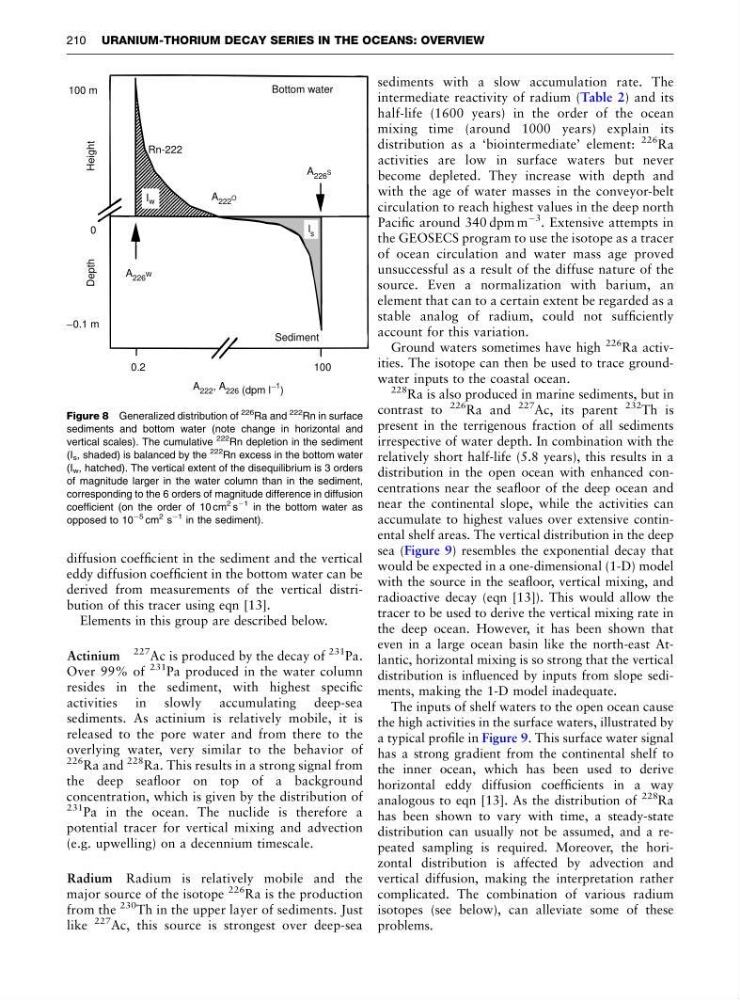
diffusion coefficient in the sediment and the vertical
eddy diffusion coefficient in the bottom water can be
derived from measurements of the vertical distribution of this tracer using eqn [13].
Elements in this group are described below.
Actinium
227 Ac is produced by the decay of
231 Pa.
Over 99% of
231 Pa produced in the water column
resides in the sediment, with highest specific
activities in slowly accumulating deep-sea
sediments. As actinium is relatively mobile, it is
released to the pore water and from there to the
overlying water, very similar to the behavior of
226 Ra and
228 Ra. This results in a strong signal from
the deep seafloor on top of a background
concentration, which is given by the distribution of
231 Pa in the ocean. The nuclide is therefore a
potential tracer for vertical mixing and advection
(e.g. upwelling) on a decennium timescale.
Radium Radium is relatively mobile and the
major source of the isotope
226 Ra is the production
from the
230 Th in the upper layer of sediments. Just
like
227 Ac, this source is strongest over deep-sea
sediments with a slow accumulation rate. The
intermediate reactivity of radium (Table 2) and its
half-life (1600 years) in the order of the ocean
mixing time (around 1000 years) explain its
distribution as a ‘biointermediate’ element:
226 Ra
activities are low in surface waters but never
become depleted. They increase with depth and
with the age of water masses in the conveyor-belt
circulation to reach highest values in the deep north
Pacific around 340 dpm m
À3 . Extensive attempts in
the GEOSECS program to use the isotope as a tracer
of ocean circulation and water mass age proved
unsuccessful as a result of the diffuse nature of the
source. Even a normalization with barium, an
element that can to a certain extent be regarded as a
stable analog of radium, could not sufficiently
account for this variation.
Ground waters sometimes have high
226 Ra activities. The isotope can then be used to trace groundwater inputs to the coastal ocean.
228 Ra is also produced in marine sediments, but in
contrast to
226 Ra and
227 Ac, its parent
232 Th is
present in the terrigenous fraction of all sediments
irrespective of water depth. In combination with the
relatively short half-life (5.8 years), this results in a
distribution in the open ocean with enhanced concentrations near the seafloor of the deep ocean and
near the continental slope, while the activities can
accumulate to highest values over extensive continental shelf areas. The vertical distribution in the deep
sea (Figure 9) resembles the exponential decay that
would be expected in a one-dimensional (1-D) model
with the source in the seafloor, vertical mixing, and
radioactive decay (eqn [13]). This would allow the
tracer to be used to derive the vertical mixing rate in
the deep ocean. However, it has been shown that
even in a large ocean basin like the north-east Atlantic, horizontal mixing is so strong that the vertical
distribution is influenced by inputs from slope sediments, making the 1-D model inadequate.
The inputs of shelf waters to the open ocean cause
the high activities in the surface waters, illustrated by
a typical profile in Figure 9. This surface water signal
has a strong gradient from the continental shelf to
the inner ocean, which has been used to derive
horizontal eddy diffusion coefficients in a way
analogous to eqn [13]. As the distribution of
228
Ra
has been shown to vary with time, a steady-state
distribution can usually not be assumed, and a repeated sampling is required. Moreover, the horizontal distribution is affected by advection and
vertical diffusion, making the interpretation rather
complicated. The combination of various radium
isotopes (see below), can alleviate some of these
problems.
Bottom water
100 m
0
_ 0.1 m
0.2
100
Height
Depth
Rn-222
A 222 , A 226 (dpm l
_ 1 )
A 222
O
A 226
S
A 226
W
Sediment
I s
I w
Figure 8 Generalized distribution of
226 Ra and
222 Rn in surface
sediments and bottom water (note change in horizontal and
vertical scales). The cumulative
222 Rn depletion in the sediment
(I s , shaded) is balanced by the
222
Rn excess in the bottom water
(I w , hatched). The vertical extent of the disequilibrium is 3 orders
of magnitude larger in the water column than in the sediment,
corresponding to the 6 orders of magnitude difference in diffusion
coefficient (on the order of 10 cm
2 s
À1 in the bottom water as
opposed to 10
À5 cm
2 s
À1 in the sediment).
210 URANIUM-THORIUM DECAY SERIES IN THE OCEANS: OVERVIEW
eddy diffusion coefficient in the bottom water can be
derived from measurements of the vertical distribution of this tracer using eqn [13].
Elements in this group are described below.
Actinium
227 Ac is produced by the decay of
231 Pa.
Over 99% of
231 Pa produced in the water column
resides in the sediment, with highest specific
activities in slowly accumulating deep-sea
sediments. As actinium is relatively mobile, it is
released to the pore water and from there to the
overlying water, very similar to the behavior of
226 Ra and
228 Ra. This results in a strong signal from
the deep seafloor on top of a background
concentration, which is given by the distribution of
231 Pa in the ocean. The nuclide is therefore a
potential tracer for vertical mixing and advection
(e.g. upwelling) on a decennium timescale.
Radium Radium is relatively mobile and the
major source of the isotope
226 Ra is the production
from the
230 Th in the upper layer of sediments. Just
like
227 Ac, this source is strongest over deep-sea
sediments with a slow accumulation rate. The
intermediate reactivity of radium (Table 2) and its
half-life (1600 years) in the order of the ocean
mixing time (around 1000 years) explain its
distribution as a ‘biointermediate’ element:
226 Ra
activities are low in surface waters but never
become depleted. They increase with depth and
with the age of water masses in the conveyor-belt
circulation to reach highest values in the deep north
Pacific around 340 dpm m
À3 . Extensive attempts in
the GEOSECS program to use the isotope as a tracer
of ocean circulation and water mass age proved
unsuccessful as a result of the diffuse nature of the
source. Even a normalization with barium, an
element that can to a certain extent be regarded as a
stable analog of radium, could not sufficiently
account for this variation.
Ground waters sometimes have high
226 Ra activities. The isotope can then be used to trace groundwater inputs to the coastal ocean.
228 Ra is also produced in marine sediments, but in
contrast to
226 Ra and
227 Ac, its parent
232 Th is
present in the terrigenous fraction of all sediments
irrespective of water depth. In combination with the
relatively short half-life (5.8 years), this results in a
distribution in the open ocean with enhanced concentrations near the seafloor of the deep ocean and
near the continental slope, while the activities can
accumulate to highest values over extensive continental shelf areas. The vertical distribution in the deep
sea (Figure 9) resembles the exponential decay that
would be expected in a one-dimensional (1-D) model
with the source in the seafloor, vertical mixing, and
radioactive decay (eqn [13]). This would allow the
tracer to be used to derive the vertical mixing rate in
the deep ocean. However, it has been shown that
even in a large ocean basin like the north-east Atlantic, horizontal mixing is so strong that the vertical
distribution is influenced by inputs from slope sediments, making the 1-D model inadequate.
The inputs of shelf waters to the open ocean cause
the high activities in the surface waters, illustrated by
a typical profile in Figure 9. This surface water signal
has a strong gradient from the continental shelf to
the inner ocean, which has been used to derive
horizontal eddy diffusion coefficients in a way
analogous to eqn [13]. As the distribution of
228
Ra
has been shown to vary with time, a steady-state
distribution can usually not be assumed, and a repeated sampling is required. Moreover, the horizontal distribution is affected by advection and
vertical diffusion, making the interpretation rather
complicated. The combination of various radium
isotopes (see below), can alleviate some of these
problems.
Bottom water
100 m
0
_ 0.1 m
0.2
100
Height
Depth
Rn-222
A 222 , A 226 (dpm l
_ 1 )
A 222
O
A 226
S
A 226
W
Sediment
I s
I w
Figure 8 Generalized distribution of
226 Ra and
222 Rn in surface
sediments and bottom water (note change in horizontal and
vertical scales). The cumulative
222 Rn depletion in the sediment
(I s , shaded) is balanced by the
222
Rn excess in the bottom water
(I w , hatched). The vertical extent of the disequilibrium is 3 orders
of magnitude larger in the water column than in the sediment,
corresponding to the 6 orders of magnitude difference in diffusion
coefficient (on the order of 10 cm
2 s
À1 in the bottom water as
opposed to 10
À5 cm
2 s
À1 in the sediment).
210 URANIUM-THORIUM DECAY SERIES IN THE OCEANS: OVERVIEW