

can be derived from the distribution of
210 Pb in the
ocean (compare eqn[3]). t sc was found to increase
from about 2 years in the surface ocean to about 35
years in the deep Atlantic and 150 years in the deep
Pacific, a result that is used to understand the behavior of stable lead. This illustrates how
210 Pb is a
useful analog for stable lead, the study of which is
complicated by the extreme risk of contamination
(see Anthropogenic Trace Elements in the Ocean).
Polonium
210 Po, the immediate daughter of
210 Pb,
is highly particle-reactive. The 138-day half-life of
210 Po makes the
210 Po/
210 Pb tracer pair a suitable
extension to
234 Th as tracer for seasonal particle
flux from the surface ocean. The non-homogeneous
distribution and reactivity of the parent
210 Pb
implies that
210 Po can only be used if concurrent
accurate measurements are made of
210 Pb.
As a result of the strong affinity for organic material and cytoplasm,
210 Po accumulates in the food
chain and
210 Po/
210 Pb activity ratios from around 3
in phytoplankton to around 12 in zooplankton have
been reported. A high excess
210 Po activity is therefore indicative of a pathway including zooplankton.
The preference of Po for organic material in comparison with Pb and Th, which may adsorb on any
surface, can be exploited to distinguish between the
fluxes of organic carbon and other components of
the particle flux.
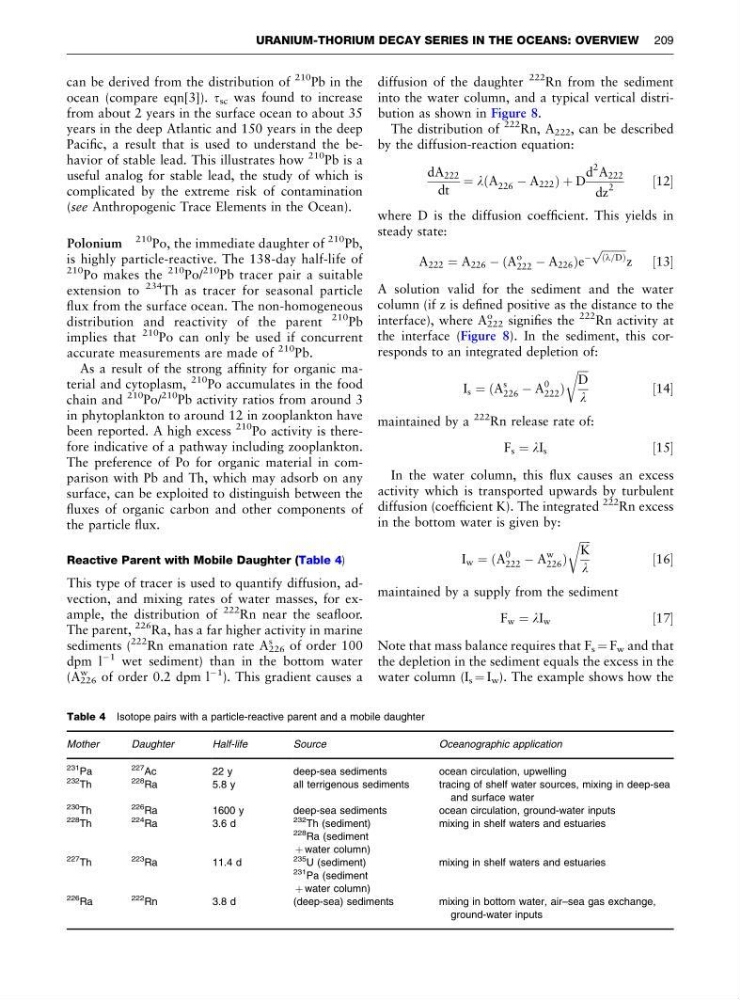
Reactive Parent with Mobile Daughter (Table 4)
This type of tracer is used to quantify diffusion, advection, and mixing rates of water masses, for example, the distribution of
222 Rn near the seafloor.
The parent,
226 Ra, has a far higher activity in marine
sediments (
222 Rn emanation rate A 226
s
of order 100
dpm l
À1 wet sediment) than in the bottom water
(A 226
w
of order 0.2 dpm l
À1
). This gradient causes a
diffusion of the daughter
222 Rn from the sediment
into the water column, and a typical vertical distribution as shown in Figure 8.
The distribution of
222 Rn, A 222 , can be described
by the diffusion-reaction equation:
dA 222
dt
¼ lðA 226 À A 222 Þ þ D
d
2 A 222
dz
2
½12
where D is the diffusion coefficient. This yields in
steady state:
A 222 ¼ A 226 À ðA
o
222 À A 226 Þe
À
ffiffiffiffiffiffiffiffiffi
ðl=DÞ
p
z
½13
A solution valid for the sediment and the water
column (if z is defined positive as the distance to the
interface), where A 222
o
signifies the
222 Rn activity at
the interface (Figure 8). In the sediment, this corresponds to an integrated depletion of:
I s ¼ ðA
s
226 À A
0
222 Þ
ffiffiffiffi
D
l
r
½14
maintained by a
222 Rn release rate of:
F s ¼ lI s
½15
In the water column, this flux causes an excess
activity which is transported upwards by turbulent
diffusion (coefficient K). The integrated
222
Rn excess
in the bottom water is given by:
I w ¼ ðA
0
222 À A
w
226 Þ
ffiffiffi ffi
K
l
r
½16
maintained by a supply from the sediment
F w ¼ lI w
½17
Note that mass balance requires that F s ¼ F w and that
the depletion in the sediment equals the excess in the
water column (I s ¼ I w ). The example shows how the
Table 4 Isotope pairs with a particle-reactive parent and a mobile daughter
Mother
Daughter
Half-life
Source
Oceanographic application
231
Pa
227 Ac
22 y
deep-sea sediments
ocean circulation, upwelling
232
Th
228 Ra
5.8 y
all terrigenous sediments
tracing of shelf water sources, mixing in deep-sea
and surface water
230
Th
226 Ra
1600 y
deep-sea sediments
ocean circulation, ground-water inputs
228
Th
224 Ra
3.6 d
232 Th (sediment)
mixing in shelf waters and estuaries
228 Ra (sediment
þ water column)
227
Th
223 Ra
11.4 d
235 U (sediment)
mixing in shelf waters and estuaries
231 Pa (sediment
þ water column)
226
Ra
222 Rn
3.8 d
(deep-sea) sediments
mixing in bottom water, air–sea gas exchange,
ground-water inputs
URANIUM-THORIUM DECAY SERIES IN THE OCEANS: OVERVIEW 209
210 Pb in the
ocean (compare eqn[3]). t sc was found to increase
from about 2 years in the surface ocean to about 35
years in the deep Atlantic and 150 years in the deep
Pacific, a result that is used to understand the behavior of stable lead. This illustrates how
210 Pb is a
useful analog for stable lead, the study of which is
complicated by the extreme risk of contamination
(see Anthropogenic Trace Elements in the Ocean).
Polonium
210 Po, the immediate daughter of
210 Pb,
is highly particle-reactive. The 138-day half-life of
210 Po makes the
210 Po/
210 Pb tracer pair a suitable
extension to
234 Th as tracer for seasonal particle
flux from the surface ocean. The non-homogeneous
distribution and reactivity of the parent
210 Pb
implies that
210 Po can only be used if concurrent
accurate measurements are made of
210 Pb.
As a result of the strong affinity for organic material and cytoplasm,
210 Po accumulates in the food
chain and
210 Po/
210 Pb activity ratios from around 3
in phytoplankton to around 12 in zooplankton have
been reported. A high excess
210 Po activity is therefore indicative of a pathway including zooplankton.
The preference of Po for organic material in comparison with Pb and Th, which may adsorb on any
surface, can be exploited to distinguish between the
fluxes of organic carbon and other components of
the particle flux.
Reactive Parent with Mobile Daughter (Table 4)
This type of tracer is used to quantify diffusion, advection, and mixing rates of water masses, for example, the distribution of
222 Rn near the seafloor.
The parent,
226 Ra, has a far higher activity in marine
sediments (
222 Rn emanation rate A 226
s
of order 100
dpm l
À1 wet sediment) than in the bottom water
(A 226
w
of order 0.2 dpm l
À1
). This gradient causes a
diffusion of the daughter
222 Rn from the sediment
into the water column, and a typical vertical distribution as shown in Figure 8.
The distribution of
222 Rn, A 222 , can be described
by the diffusion-reaction equation:
dA 222
dt
¼ lðA 226 À A 222 Þ þ D
d
2 A 222
dz
2
½12
where D is the diffusion coefficient. This yields in
steady state:
A 222 ¼ A 226 À ðA
o
222 À A 226 Þe
À
ffiffiffiffiffiffiffiffiffi
ðl=DÞ
p
z
½13
A solution valid for the sediment and the water
column (if z is defined positive as the distance to the
interface), where A 222
o
signifies the
222 Rn activity at
the interface (Figure 8). In the sediment, this corresponds to an integrated depletion of:
I s ¼ ðA
s
226 À A
0
222 Þ
ffiffiffiffi
D
l
r
½14
maintained by a
222 Rn release rate of:
F s ¼ lI s
½15
In the water column, this flux causes an excess
activity which is transported upwards by turbulent
diffusion (coefficient K). The integrated
222
Rn excess
in the bottom water is given by:
I w ¼ ðA
0
222 À A
w
226 Þ
ffiffiffi ffi
K
l
r
½16
maintained by a supply from the sediment
F w ¼ lI w
½17
Note that mass balance requires that F s ¼ F w and that
the depletion in the sediment equals the excess in the
water column (I s ¼ I w ). The example shows how the
Table 4 Isotope pairs with a particle-reactive parent and a mobile daughter
Mother
Daughter
Half-life
Source
Oceanographic application
231
Pa
227 Ac
22 y
deep-sea sediments
ocean circulation, upwelling
232
Th
228 Ra
5.8 y
all terrigenous sediments
tracing of shelf water sources, mixing in deep-sea
and surface water
230
Th
226 Ra
1600 y
deep-sea sediments
ocean circulation, ground-water inputs
228
Th
224 Ra
3.6 d
232 Th (sediment)
mixing in shelf waters and estuaries
228 Ra (sediment
þ water column)
227
Th
223 Ra
11.4 d
235 U (sediment)
mixing in shelf waters and estuaries
231 Pa (sediment
þ water column)
226
Ra
222 Rn
3.8 d
(deep-sea) sediments
mixing in bottom water, air–sea gas exchange,
ground-water inputs
URANIUM-THORIUM DECAY SERIES IN THE OCEANS: OVERVIEW 209