

where
Apart and
Adiss are the particulate and dissolved
activities, k 1 is the desorption rate constants. If the
distribution of two or more isotopes (usually
234 Th
and
230
Th or
228 Th and
234
Th) between dissolved
and particulate forms is known, k 1 and k À1 can be
calculated. Values for 1/k 1 derived for thorium are
on the order of a month in bloom situations and 41
year in clear deep water, much longer than expected
from adsorption theory. This is explained when
thorium adsorbs to colloidal-sized particules and the
rate limiting steps, which determine the distribution
of the tracers over dissolved and filterable form, are
the coagulation and disaggregation with rate constants k 2 and k À2 respectively (Figure 6). Thus, when
aggregation is clearly slower than adsorption
(ðk 2 5k 1 Þ thorium isotopes provide a way to derive
particle aggregation rates in situ.
Protactinium
231 Pa is produced from the decay of
235 U in sea water. The behavior of
231 Pa is very
similar to that of
230 Th, and these two uranium
daughters are produced throughout the water
column in a constant activity ratio, given by the
production rate of
231 Pa divided by the production
rate of
230 Th or A 235 l 231 / A234 l 230 ¼ 0:093. The
major application of
231 Pa lies in the combined use
of these two tracers, whose exact production ratio is
known. The approximately 10 times lower
reactivity of
231 Pa allows it to be transported
laterally over larger distances than
230 Th before
being scavenged. The resulting basin-wide
fractionation between
231 Pa and
230 Th is the basis
for the use of the
231 Pa/
230 Th ratio as a tracer of
productivity. In areas of high particle flux the
particles have a
231 Pa/
230 Th ratio 40.093, whereas
particles sinking in low productivity gyres have a
ratio o0.093. The
231 Pa/
230 Th ratio stored in the
sediment, after proper correction for decay since
deposition, is a powerful tool for the reconstruction
of paleoproductivity. The fractionation between Th
and Pa depends on particle composition and has
been found to be much lower when opal is
abundant. The tracer loses much of its value in a
diatom-dominated system like the Southern Ocean.
A related application of the
231 Pa/
230 Th ratio is a
correction to the
230
Th-based calibration of sediment
trap efficiency. The removal of both nuclides
from sea water can be divided into a vertically
scavenged component (V 230 ; V 231 ) and a component
Adsorption
Desorption
Dissolved
nuclide
A
diss
Particulate
nuclide
A part
k 1
k _ 1
Figure 5 Box model of the reversible exchange between the
dissolved and particulate form of a nuclide with adsorption and
desorption rate constants k 1 and k À1 .
0
7 Nov
9 Dec
0
200
400
600
Depth (m)
0.5
1.0 0
0.5
1.0
234 Th/
238 U ratio
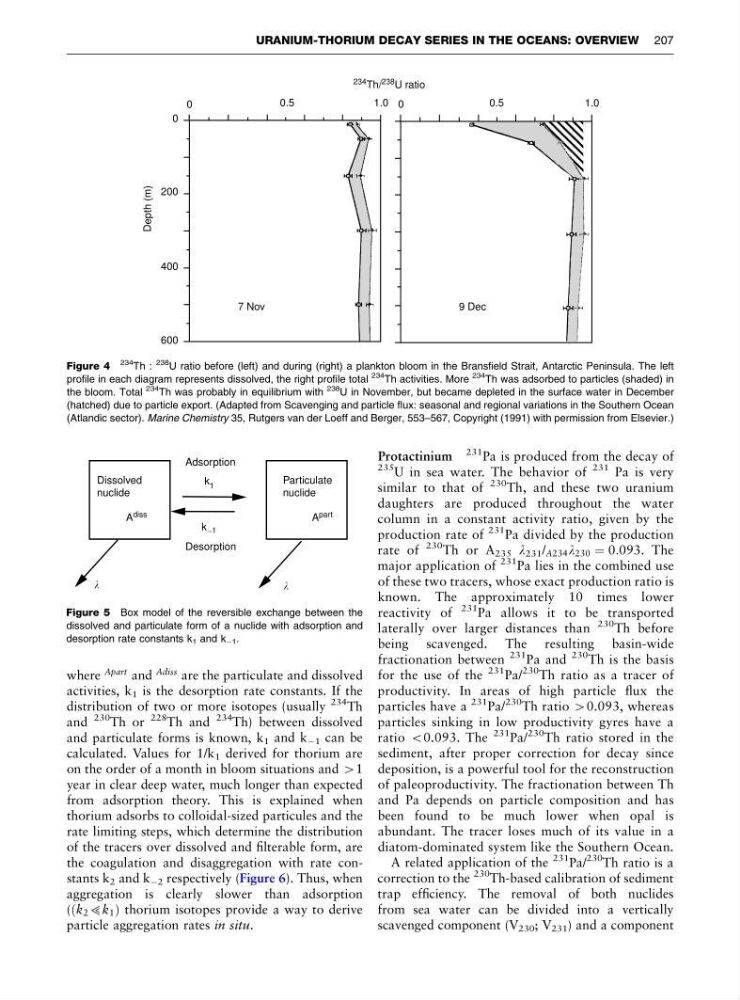
Figure 4
234
Th :
238 U ratio before (left) and during (right) a plankton bloom in the Bransfield Strait, Antarctic Peninsula. The left
profile in each diagram represents dissolved, the right profile total
234 Th activities. More
234 Th was adsorbed to particles (shaded) in
the bloom. Total
234 Th was probably in equilibrium with
238 U in November, but became depleted in the surface water in December
(hatched) due to particle export. (Adapted from Scavenging and particle flux: seasonal and regional variations in the Southern Ocean
(Atlandic sector). Marine Chemistry 35, Rutgers van der Loeff and Berger, 553–567, Copyright (1991) with permission from Elsevier.)
URANIUM-THORIUM DECAY SERIES IN THE OCEANS: OVERVIEW 207
Apart and
Adiss are the particulate and dissolved
activities, k 1 is the desorption rate constants. If the
distribution of two or more isotopes (usually
234 Th
and
230
Th or
228 Th and
234
Th) between dissolved
and particulate forms is known, k 1 and k À1 can be
calculated. Values for 1/k 1 derived for thorium are
on the order of a month in bloom situations and 41
year in clear deep water, much longer than expected
from adsorption theory. This is explained when
thorium adsorbs to colloidal-sized particules and the
rate limiting steps, which determine the distribution
of the tracers over dissolved and filterable form, are
the coagulation and disaggregation with rate constants k 2 and k À2 respectively (Figure 6). Thus, when
aggregation is clearly slower than adsorption
(ðk 2 5k 1 Þ thorium isotopes provide a way to derive
particle aggregation rates in situ.
Protactinium
231 Pa is produced from the decay of
235 U in sea water. The behavior of
231 Pa is very
similar to that of
230 Th, and these two uranium
daughters are produced throughout the water
column in a constant activity ratio, given by the
production rate of
231 Pa divided by the production
rate of
230 Th or A 235 l 231 / A234 l 230 ¼ 0:093. The
major application of
231 Pa lies in the combined use
of these two tracers, whose exact production ratio is
known. The approximately 10 times lower
reactivity of
231 Pa allows it to be transported
laterally over larger distances than
230 Th before
being scavenged. The resulting basin-wide
fractionation between
231 Pa and
230 Th is the basis
for the use of the
231 Pa/
230 Th ratio as a tracer of
productivity. In areas of high particle flux the
particles have a
231 Pa/
230 Th ratio 40.093, whereas
particles sinking in low productivity gyres have a
ratio o0.093. The
231 Pa/
230 Th ratio stored in the
sediment, after proper correction for decay since
deposition, is a powerful tool for the reconstruction
of paleoproductivity. The fractionation between Th
and Pa depends on particle composition and has
been found to be much lower when opal is
abundant. The tracer loses much of its value in a
diatom-dominated system like the Southern Ocean.
A related application of the
231 Pa/
230 Th ratio is a
correction to the
230
Th-based calibration of sediment
trap efficiency. The removal of both nuclides
from sea water can be divided into a vertically
scavenged component (V 230 ; V 231 ) and a component
Adsorption
Desorption
Dissolved
nuclide
A
diss
Particulate
nuclide
A part
k 1
k _ 1
Figure 5 Box model of the reversible exchange between the
dissolved and particulate form of a nuclide with adsorption and
desorption rate constants k 1 and k À1 .
0
7 Nov
9 Dec
0
200
400
600
Depth (m)
0.5
1.0 0
0.5
1.0
234 Th/
238 U ratio
Figure 4
234
Th :
238 U ratio before (left) and during (right) a plankton bloom in the Bransfield Strait, Antarctic Peninsula. The left
profile in each diagram represents dissolved, the right profile total
234 Th activities. More
234 Th was adsorbed to particles (shaded) in
the bloom. Total
234 Th was probably in equilibrium with
238 U in November, but became depleted in the surface water in December
(hatched) due to particle export. (Adapted from Scavenging and particle flux: seasonal and regional variations in the Southern Ocean
(Atlandic sector). Marine Chemistry 35, Rutgers van der Loeff and Berger, 553–567, Copyright (1991) with permission from Elsevier.)
URANIUM-THORIUM DECAY SERIES IN THE OCEANS: OVERVIEW 207