

234 U in the overlying water column (depth z in
meters), which amounts to:
P 230 ¼ l 230 A 234 z ¼ 9:19 Â 10
À6 ðy
À1 Þ
2820 ðdpm m
À3 ÞzðmÞ
¼ 0:0259 z ðdpm m
À2 y
À1 Þ
½ 4
This known, constant
230 Th flux, depending only on
water depth, is a powerful tool to quantify errors in
the determination of rain rates of other components
of the particle flux, either by sediment traps or
through the accumulation rate of a marine
sediment. The collection efficiency of sediment
traps, known to be highly variable and dependent
on trap design, turbulence, and flow rates, can be
derived from a comparison of the intercepted
230 Th
flux F 230 with the theoretical flux P 230 (see below
for a refinement of this procedure using
231 Pa). The
vertical rain rate R i of any component i of the
particle flux can be derived from the ratio of the
concentration C i to the
230 Th activity in the
particles A 230 , using:
R i ¼
C i
A 230
P 230
½5
In a similar way, the past flux of
230 Th xs to the sea
floor,
0 F 230 , derived from decay-corrected
230 Th
activities (
0 A 230 ) in dated sediment core sections,
can be compared to the theoretical rain rate. The
ratio C ¼
0 F 230 /P 230 , the focusing factor, is used to
determine to what extent the sediment core location
has been subject to focusing or winnowing during
certain geological periods. The preserved vertical
rain rate of sediment components corrected for such
redistribution effects follows in analogy to eqn [5]:
R i ¼
C i
0 A 230
P 230
½6
234 Th is produced from the decay of
238 U in sea
water. In the deep ocean, approximately 3% of
its activity is on particles and removal is so slow
compared with its half-life (24.1 days) that total
(dissolved þ particulate)
234 Th is in secular equilibrium with
238 U. In coastal and productive surface
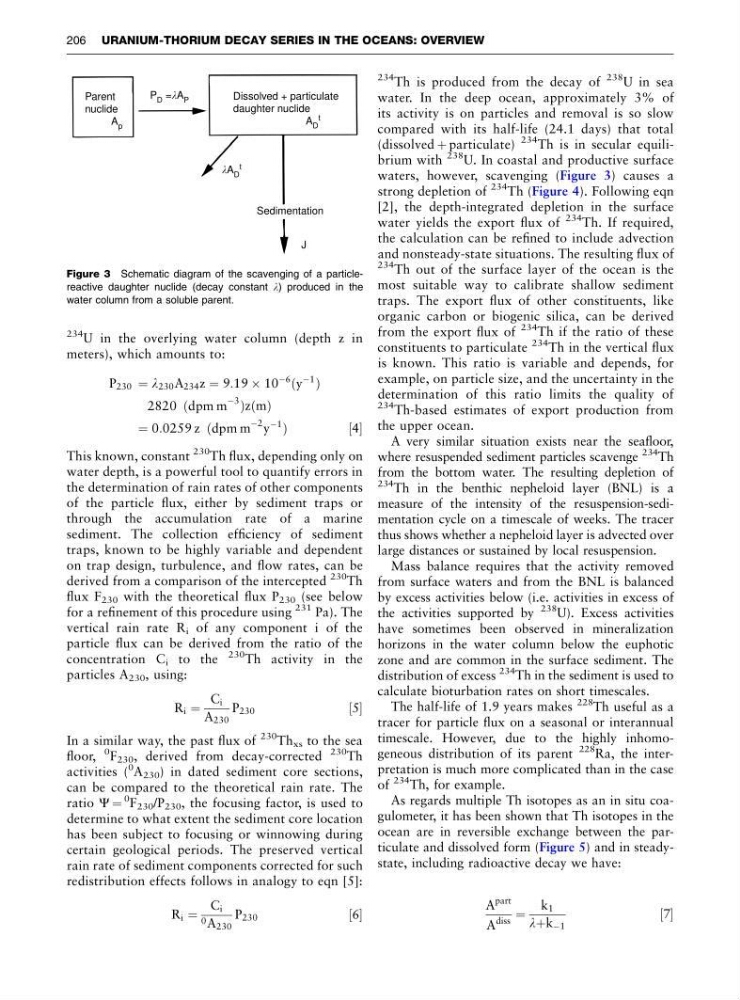
waters, however, scavenging (Figure 3) causes a
strong depletion of
234 Th (Figure 4). Following eqn
[2], the depth-integrated depletion in the surface
water yields the export flux of
234 Th. If required,
the calculation can be refined to include advection
and nonsteady-state situations. The resulting flux of
234 Th out of the surface layer of the ocean is the
most suitable way to calibrate shallow sediment
traps. The export flux of other constituents, like
organic carbon or biogenic silica, can be derived
from the export flux of
234 Th if the ratio of these
constituents to particulate
234 Th in the vertical flux
is known. This ratio is variable and depends, for
example, on particle size, and the uncertainty in the
determination of this ratio limits the quality of
234 Th-based estimates of export production from
the upper ocean.
A very similar situation exists near the seafloor,
where resuspended sediment particles scavenge
234
Th
from the bottom water. The resulting depletion of
234
Th in the benthic nepheloid layer (BNL) is a
measure of the intensity of the resuspension-sedimentation cycle on a timescale of weeks. The tracer
thus shows whether a nepheloid layer is advected over
large distances or sustained by local resuspension.
Mass balance requires that the activity removed
from surface waters and from the BNL is balanced
by excess activities below (i.e. activities in excess of
the activities supported by
238 U). Excess activities
have sometimes been observed in mineralization
horizons in the water column below the euphotic
zone and are common in the surface sediment. The
distribution of excess
234
Th in the sediment is used to
calculate bioturbation rates on short timescales.
The half-life of 1.9 years makes
228 Th useful as a
tracer for particle flux on a seasonal or interannual
timescale. However, due to the highly inhomogeneous distribution of its parent
228
Ra, the interpretation is much more complicated than in the case
of
234 Th, for example.
As regards multiple Th isotopes as an in situ coagulometer, it has been shown that Th isotopes in the
ocean are in reversible exchange between the particulate and dissolved form (Figure 5) and in steadystate, including radioactive decay we have:
A
part
A
diss
¼
k 1
lþk À1
½7
Parent
nuclide
A p
Dissolved + particulate
daughter nuclide
A D
t
Sedimentation
J
P D =A P
A D
t
Figure 3 Schematic diagram of the scavenging of a particlereactive daughter nuclide (decay constant l) produced in the
water column from a soluble parent.
206 URANIUM-THORIUM DECAY SERIES IN THE OCEANS: OVERVIEW
meters), which amounts to:
P 230 ¼ l 230 A 234 z ¼ 9:19 Â 10
À6 ðy
À1 Þ
2820 ðdpm m
À3 ÞzðmÞ
¼ 0:0259 z ðdpm m
À2 y
À1 Þ
½ 4
This known, constant
230 Th flux, depending only on
water depth, is a powerful tool to quantify errors in
the determination of rain rates of other components
of the particle flux, either by sediment traps or
through the accumulation rate of a marine
sediment. The collection efficiency of sediment
traps, known to be highly variable and dependent
on trap design, turbulence, and flow rates, can be
derived from a comparison of the intercepted
230 Th
flux F 230 with the theoretical flux P 230 (see below
for a refinement of this procedure using
231 Pa). The
vertical rain rate R i of any component i of the
particle flux can be derived from the ratio of the
concentration C i to the
230 Th activity in the
particles A 230 , using:
R i ¼
C i
A 230
P 230
½5
In a similar way, the past flux of
230 Th xs to the sea
floor,
0 F 230 , derived from decay-corrected
230 Th
activities (
0 A 230 ) in dated sediment core sections,
can be compared to the theoretical rain rate. The
ratio C ¼
0 F 230 /P 230 , the focusing factor, is used to
determine to what extent the sediment core location
has been subject to focusing or winnowing during
certain geological periods. The preserved vertical
rain rate of sediment components corrected for such
redistribution effects follows in analogy to eqn [5]:
R i ¼
C i
0 A 230
P 230
½6
234 Th is produced from the decay of
238 U in sea
water. In the deep ocean, approximately 3% of
its activity is on particles and removal is so slow
compared with its half-life (24.1 days) that total
(dissolved þ particulate)
234 Th is in secular equilibrium with
238 U. In coastal and productive surface
waters, however, scavenging (Figure 3) causes a
strong depletion of
234 Th (Figure 4). Following eqn
[2], the depth-integrated depletion in the surface
water yields the export flux of
234 Th. If required,
the calculation can be refined to include advection
and nonsteady-state situations. The resulting flux of
234 Th out of the surface layer of the ocean is the
most suitable way to calibrate shallow sediment
traps. The export flux of other constituents, like
organic carbon or biogenic silica, can be derived
from the export flux of
234 Th if the ratio of these
constituents to particulate
234 Th in the vertical flux
is known. This ratio is variable and depends, for
example, on particle size, and the uncertainty in the
determination of this ratio limits the quality of
234 Th-based estimates of export production from
the upper ocean.
A very similar situation exists near the seafloor,
where resuspended sediment particles scavenge
234
Th
from the bottom water. The resulting depletion of
234
Th in the benthic nepheloid layer (BNL) is a
measure of the intensity of the resuspension-sedimentation cycle on a timescale of weeks. The tracer
thus shows whether a nepheloid layer is advected over
large distances or sustained by local resuspension.
Mass balance requires that the activity removed
from surface waters and from the BNL is balanced
by excess activities below (i.e. activities in excess of
the activities supported by
238 U). Excess activities
have sometimes been observed in mineralization
horizons in the water column below the euphotic
zone and are common in the surface sediment. The
distribution of excess
234
Th in the sediment is used to
calculate bioturbation rates on short timescales.
The half-life of 1.9 years makes
228 Th useful as a
tracer for particle flux on a seasonal or interannual
timescale. However, due to the highly inhomogeneous distribution of its parent
228
Ra, the interpretation is much more complicated than in the case
of
234 Th, for example.
As regards multiple Th isotopes as an in situ coagulometer, it has been shown that Th isotopes in the
ocean are in reversible exchange between the particulate and dissolved form (Figure 5) and in steadystate, including radioactive decay we have:
A
part
A
diss
¼
k 1
lþk À1
½7
Parent
nuclide
A p
Dissolved + particulate
daughter nuclide
A D
t
Sedimentation
J
P D =A P
A D
t
Figure 3 Schematic diagram of the scavenging of a particlereactive daughter nuclide (decay constant l) produced in the
water column from a soluble parent.
206 URANIUM-THORIUM DECAY SERIES IN THE OCEANS: OVERVIEW