

stratification, and continues to build up throughout
summer months. Use of the seasonal accumulation of
photosynthetic oxygen in the upper ocean to estimate
primary production is complicated by the fact that it
tends to be lost to the atmosphere by gas exchange at
the surface. Furthermore, temperature changes due
to seasonal heating and cooling will change the
solubility of the gas, further driving fluxes of oxygen
across the air–sea interface. In addition, bubble
trapping by surface waves can create small supersaturations. While such processes conspire to complicate the resultant picture, it is possible to use
observations of noble gases (which do not undergo
biological and chemical processing) and upper ocean
physical models to interpret the seasonal cycle of
oxygen. These calculations have been successfully
carried out at a variety of locations, including the
subtropical North Atlantic and the North Pacific. In
the Sargasso Sea, estimates of oxygen productivity
range from 4.3 to 4.7 mol m
À2 a
À1
. Using the molar
ratio of oxygen released to carbon fixed in photosynthesis of 1.4 : 1, the carbon fixation rate is estimated to be 3.270.4 mol m
À2 a
À1
.
There is also a net seasonal decrease in SCO 2 attributable to photosynthesis at these locations. Such
decreases are simpler to use in productivity estimates, principally because air–sea interaction has a
much weaker influence on SCO 2 . On the other hand,
precise measurements are required because the
photosynthetically driven changes are much smaller
_
2 0
_
2 0
_
2
0
_
1 0
0
1 0
0
50
100
150
200
Depth (m)
0
40
80
120
160
200
240
280
320
360
Day number
2040
2 0 5 5
2 0 7 0
2
0
8
5
0
50
100
150
200
Depth (m)
0
40
80
120
160
200
240
280
320
360
Day number
2 0 5 5
Dissolved oxygen anomaly ( mol kg )
μ
_ 1
Total CO ( mol kg )
2 μ
_ 1
(A)
(B)
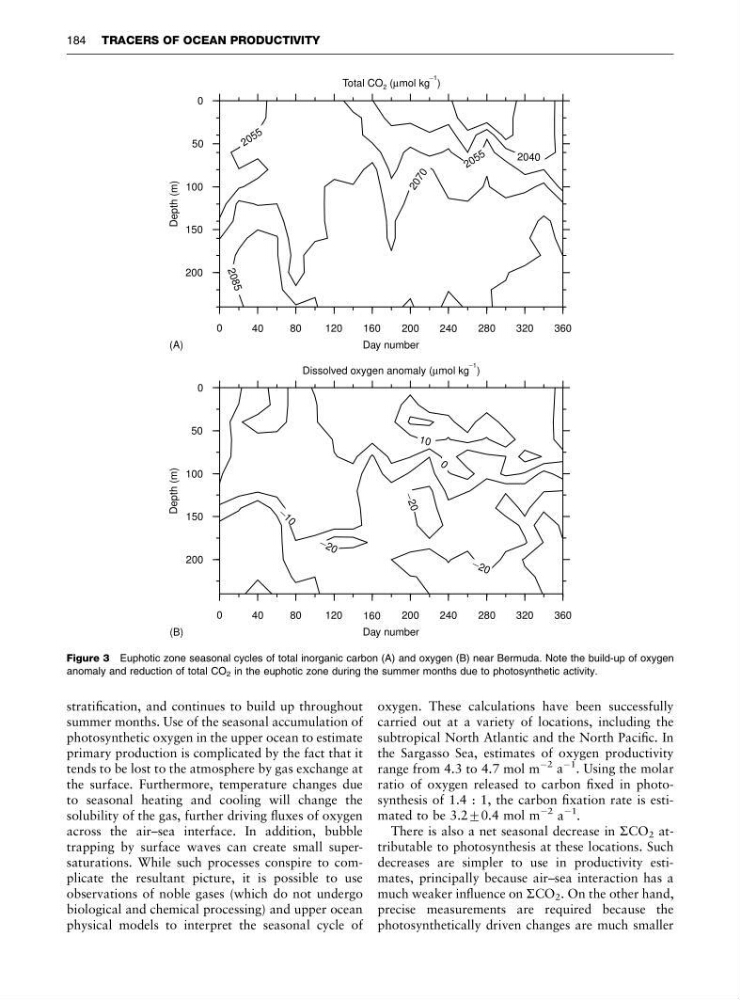
Figure 3 Euphotic zone seasonal cycles of total inorganic carbon (A) and oxygen (B) near Bermuda. Note the build-up of oxygen
anomaly and reduction of total CO 2 in the euphotic zone during the summer months due to photosynthetic activity.
184 TRACERS OF OCEAN PRODUCTIVITY
summer months. Use of the seasonal accumulation of
photosynthetic oxygen in the upper ocean to estimate
primary production is complicated by the fact that it
tends to be lost to the atmosphere by gas exchange at
the surface. Furthermore, temperature changes due
to seasonal heating and cooling will change the
solubility of the gas, further driving fluxes of oxygen
across the air–sea interface. In addition, bubble
trapping by surface waves can create small supersaturations. While such processes conspire to complicate the resultant picture, it is possible to use
observations of noble gases (which do not undergo
biological and chemical processing) and upper ocean
physical models to interpret the seasonal cycle of
oxygen. These calculations have been successfully
carried out at a variety of locations, including the
subtropical North Atlantic and the North Pacific. In
the Sargasso Sea, estimates of oxygen productivity
range from 4.3 to 4.7 mol m
À2 a
À1
. Using the molar
ratio of oxygen released to carbon fixed in photosynthesis of 1.4 : 1, the carbon fixation rate is estimated to be 3.270.4 mol m
À2 a
À1
.
There is also a net seasonal decrease in SCO 2 attributable to photosynthesis at these locations. Such
decreases are simpler to use in productivity estimates, principally because air–sea interaction has a
much weaker influence on SCO 2 . On the other hand,
precise measurements are required because the
photosynthetically driven changes are much smaller
_
2 0
_
2 0
_
2
0
_
1 0
0
1 0
0
50
100
150
200
Depth (m)
0
40
80
120
160
200
240
280
320
360
Day number
2040
2 0 5 5
2 0 7 0
2
0
8
5
0
50
100
150
200
Depth (m)
0
40
80
120
160
200
240
280
320
360
Day number
2 0 5 5
Dissolved oxygen anomaly ( mol kg )
μ
_ 1
Total CO ( mol kg )
2 μ
_ 1
(A)
(B)
Figure 3 Euphotic zone seasonal cycles of total inorganic carbon (A) and oxygen (B) near Bermuda. Note the build-up of oxygen
anomaly and reduction of total CO 2 in the euphotic zone during the summer months due to photosynthetic activity.
184 TRACERS OF OCEAN PRODUCTIVITY