

column is well mixed and of constant depth H, the
ratio r ¼ c 2 =c 1 of the concentrations of the tracers (in
excess of any concentration in equilibrium with the
atmosphere) evolves according to the equation:
1
r
dr
dt
¼ À
1
H
k 2 À k 1
ð
Þ
where k 1 and k 2 are the gas transfer velocities appropriate to each tracer. This suggested that in the
right environment, that is a shallow sea, well-mixed
and with a constant depth, measurement of the tracer ratio could be used to define the difference between the two gas transfer rates. If another relation
between the gas transfer rates could be defined, the
‘dual tracer’ technique would enable absolute values
for k 1 and k 2 to be derived.
For this second relation, dual tracer experimenters
have used a power law dependence of gas transfer
velocities on Schmidt number (the ratio of kinematic
viscosity of water to the diffusivity of the gas):
k 1
k 2
¼
Sc 1
Sc 2
n
For most conditions in which bubbles and spray are
not affecting gas exchange, n ¼ 0:5. This result is
derived from models and supported by measurements, in the laboratory and on lakes. At very low
wind speeds when the sea is glassy smooth, this relation does not hold and n ¼ 0:67 is the theoretical
result, but this condition is very rarely met at sea. In
rough seas where substantial bubble-mediated gas
transfer may occur, the theory is more complex and
different assumptions have been made to derive absolute values under these conditions. Recent theoretical work suggests that the square-root assumption
is reasonably accurate even in the presence of bubble-mediated transfer, though care is needed in scaling the results obtained using these insoluble tracers
to more soluble gases such as carbon dioxide. In one
experiment, a third tracer, bacterial spores specially
treated to be suitable for this purpose, were used as a
nonvolatile tracer, and these results also support the
use of the square-root law.
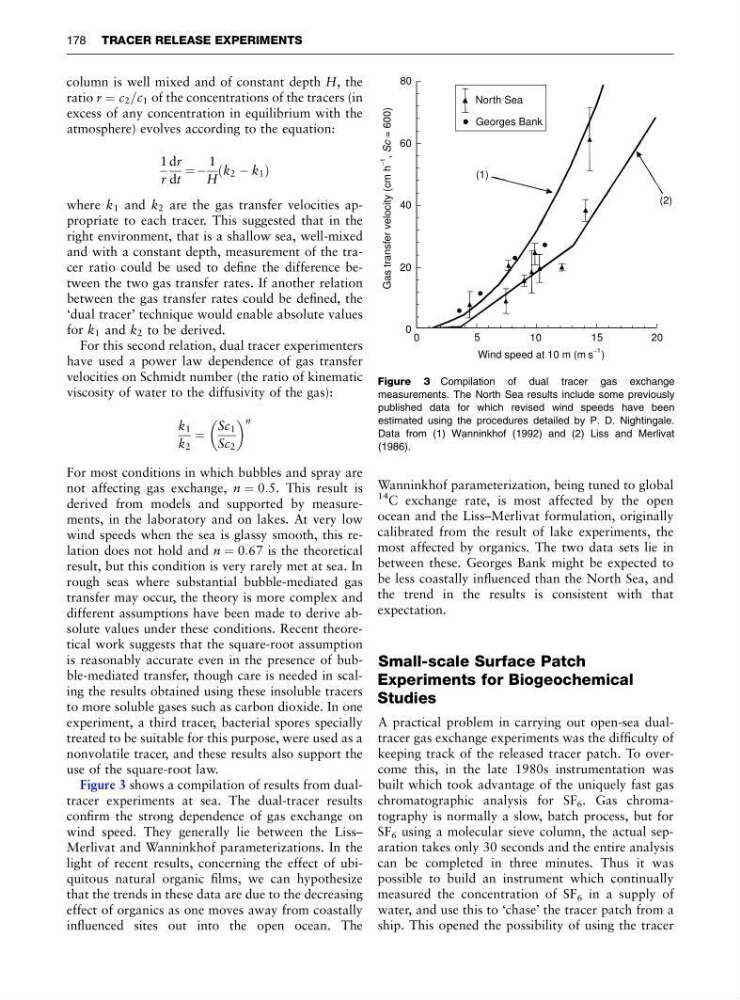
Figure 3 shows a compilation of results from dualtracer experiments at sea. The dual-tracer results
confirm the strong dependence of gas exchange on
wind speed. They generally lie between the Liss–
Merlivat and Wanninkhof parameterizations. In the
light of recent results, concerning the effect of ubiquitous natural organic films, we can hypothesize
that the trends in these data are due to the decreasing
effect of organics as one moves away from coastally
influenced sites out into the open ocean. The
Wanninkhof parameterization, being tuned to global
14 C exchange rate, is most affected by the open
ocean and the Liss–Merlivat formulation, originally
calibrated from the result of lake experiments, the
most affected by organics. The two data sets lie in
between these. Georges Bank might be expected to
be less coastally influenced than the North Sea, and
the trend in the results is consistent with that
expectation.
Small-scale Surface Patch
Experiments for Biogeochemical
Studies
A practical problem in carrying out open-sea dualtracer gas exchange experiments was the difficulty of
keeping track of the released tracer patch. To overcome this, in the late 1980s instrumentation was
built which took advantage of the uniquely fast gas
chromatographic analysis for SF 6 . Gas chromatography is normally a slow, batch process, but for
SF 6 using a molecular sieve column, the actual separation takes only 30 seconds and the entire analysis
can be completed in three minutes. Thus it was
possible to build an instrument which continually
measured the concentration of SF 6 in a supply of
water, and use this to ‘chase’ the tracer patch from a
ship. This opened the possibility of using the tracer
0
5
10
15
20
20
40
60
80
Wind speed at 10 m (m s )
_ 1
(2)
(1)
North Sea
Georges Bank
Gas transfer velocity (cm h , = 600)
_ 1
Sc
0
Figure 3 Compilation of dual tracer gas exchange
measurements. The North Sea results include some previously
published data for which revised wind speeds have been
estimated using the procedures detailed by P. D. Nightingale.
Data from (1) Wanninkhof (1992) and (2) Liss and Merlivat
(1986).
178 TRACER RELEASE EXPERIMENTS
ratio r ¼ c 2 =c 1 of the concentrations of the tracers (in
excess of any concentration in equilibrium with the
atmosphere) evolves according to the equation:
1
r
dr
dt
¼ À
1
H
k 2 À k 1
ð
Þ
where k 1 and k 2 are the gas transfer velocities appropriate to each tracer. This suggested that in the
right environment, that is a shallow sea, well-mixed
and with a constant depth, measurement of the tracer ratio could be used to define the difference between the two gas transfer rates. If another relation
between the gas transfer rates could be defined, the
‘dual tracer’ technique would enable absolute values
for k 1 and k 2 to be derived.
For this second relation, dual tracer experimenters
have used a power law dependence of gas transfer
velocities on Schmidt number (the ratio of kinematic
viscosity of water to the diffusivity of the gas):
k 1
k 2
¼
Sc 1
Sc 2
n
For most conditions in which bubbles and spray are
not affecting gas exchange, n ¼ 0:5. This result is
derived from models and supported by measurements, in the laboratory and on lakes. At very low
wind speeds when the sea is glassy smooth, this relation does not hold and n ¼ 0:67 is the theoretical
result, but this condition is very rarely met at sea. In
rough seas where substantial bubble-mediated gas
transfer may occur, the theory is more complex and
different assumptions have been made to derive absolute values under these conditions. Recent theoretical work suggests that the square-root assumption
is reasonably accurate even in the presence of bubble-mediated transfer, though care is needed in scaling the results obtained using these insoluble tracers
to more soluble gases such as carbon dioxide. In one
experiment, a third tracer, bacterial spores specially
treated to be suitable for this purpose, were used as a
nonvolatile tracer, and these results also support the
use of the square-root law.
Figure 3 shows a compilation of results from dualtracer experiments at sea. The dual-tracer results
confirm the strong dependence of gas exchange on
wind speed. They generally lie between the Liss–
Merlivat and Wanninkhof parameterizations. In the
light of recent results, concerning the effect of ubiquitous natural organic films, we can hypothesize
that the trends in these data are due to the decreasing
effect of organics as one moves away from coastally
influenced sites out into the open ocean. The
Wanninkhof parameterization, being tuned to global
14 C exchange rate, is most affected by the open
ocean and the Liss–Merlivat formulation, originally
calibrated from the result of lake experiments, the
most affected by organics. The two data sets lie in
between these. Georges Bank might be expected to
be less coastally influenced than the North Sea, and
the trend in the results is consistent with that
expectation.
Small-scale Surface Patch
Experiments for Biogeochemical
Studies
A practical problem in carrying out open-sea dualtracer gas exchange experiments was the difficulty of
keeping track of the released tracer patch. To overcome this, in the late 1980s instrumentation was
built which took advantage of the uniquely fast gas
chromatographic analysis for SF 6 . Gas chromatography is normally a slow, batch process, but for
SF 6 using a molecular sieve column, the actual separation takes only 30 seconds and the entire analysis
can be completed in three minutes. Thus it was
possible to build an instrument which continually
measured the concentration of SF 6 in a supply of
water, and use this to ‘chase’ the tracer patch from a
ship. This opened the possibility of using the tracer
0
5
10
15
20
20
40
60
80
Wind speed at 10 m (m s )
_ 1
(2)
(1)
North Sea
Georges Bank
Gas transfer velocity (cm h , = 600)
_ 1
Sc
0
Figure 3 Compilation of dual tracer gas exchange
measurements. The North Sea results include some previously
published data for which revised wind speeds have been
estimated using the procedures detailed by P. D. Nightingale.
Data from (1) Wanninkhof (1992) and (2) Liss and Merlivat
(1986).
178 TRACER RELEASE EXPERIMENTS