

areas, one example being the San Pedro Shelf,
Southern California, US coastal area (Figure 5).
The other approach that incorporates geographic
or spatial assessments with the time series measurements has been incorporated into a monitoring
strategy for assessing and monitoring concentrations
of several chemicals of environmental concern. This
involves the use of bivalves, mainly mussels and
oysters, as sentinels of biologically available contaminants such as DDT and PCBs: the ‘Mussel
Watch’ approach. Prototypes of such a program were
evaluated in the 1970s in the US, Canada, Europe,
and Australia and there are currently several operational programs such as the Mussel Watch component of the US National Oceanographic and
Atmospheric Administration (NOAA) National Status and Trends Program.
DDT and PCB concentrations from samples of
mussels and oysters obtained between 1986 and
1988 at over 150 stations located around the US
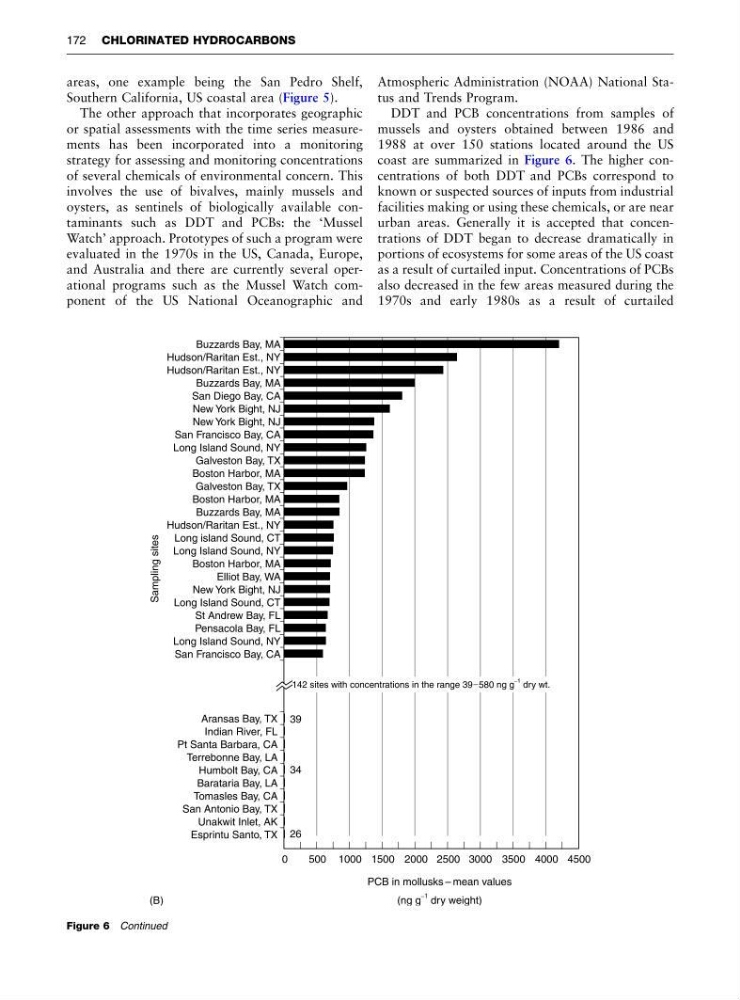
coast are summarized in Figure 6. The higher concentrations of both DDT and PCBs correspond to
known or suspected sources of inputs from industrial
facilities making or using these chemicals, or are near
urban areas. Generally it is accepted that concentrations of DDT began to decrease dramatically in
portions of ecosystems for some areas of the US coast
as a result of curtailed input. Concentrations of PCBs
also decreased in the few areas measured during the
1970s and early 1980s as a result of curtailed
Figure 6 Continued
172 CHLORINATED HYDROCARBONS
Southern California, US coastal area (Figure 5).
The other approach that incorporates geographic
or spatial assessments with the time series measurements has been incorporated into a monitoring
strategy for assessing and monitoring concentrations
of several chemicals of environmental concern. This
involves the use of bivalves, mainly mussels and
oysters, as sentinels of biologically available contaminants such as DDT and PCBs: the ‘Mussel
Watch’ approach. Prototypes of such a program were
evaluated in the 1970s in the US, Canada, Europe,
and Australia and there are currently several operational programs such as the Mussel Watch component of the US National Oceanographic and
Atmospheric Administration (NOAA) National Status and Trends Program.
DDT and PCB concentrations from samples of
mussels and oysters obtained between 1986 and
1988 at over 150 stations located around the US
coast are summarized in Figure 6. The higher concentrations of both DDT and PCBs correspond to
known or suspected sources of inputs from industrial
facilities making or using these chemicals, or are near
urban areas. Generally it is accepted that concentrations of DDT began to decrease dramatically in
portions of ecosystems for some areas of the US coast
as a result of curtailed input. Concentrations of PCBs
also decreased in the few areas measured during the
1970s and early 1980s as a result of curtailed
Figure 6 Continued
172 CHLORINATED HYDROCARBONS