

overlying water column or DDJ can be taken up
from sediments and water in the spaces or pores
between sediment particles (pore waters) by animals
living in or on the sediments (Figure 4).
Much of the present scientific effort related to DDT
and PCBs is focused towards three broad issues: (1) in
support of remediation and clean-up of areas of high
levels of concentrations as a result of past practices;
(2) preventing or limiting mistakes made in developed
countries from occurring in developing countries; and
(3) tracking the spatial and temporal trends of concentrations of these compounds in marine ecosystems,
especially coastal ecosystems.
There are two principal approaches available to
track the trend in concentrations over time. One
approach is to find areas where coastal sediments are
accumulating at a steady and sufficient rate, and are
reasonably undisturbed by activities such as mixing
of the upper layers by organisms or storm turbulence. Sediments deposited in waters with very low
or no oxygen content have limited or no mixing by
organisms and usually meet the criteria. Cores of
sediments can be carefully sliced or sectioned at fine
intervals and analyzed to provide a historical record,
layer by layer, of DDT and PCB concentrations. This
has been accomplished with success in several coastal
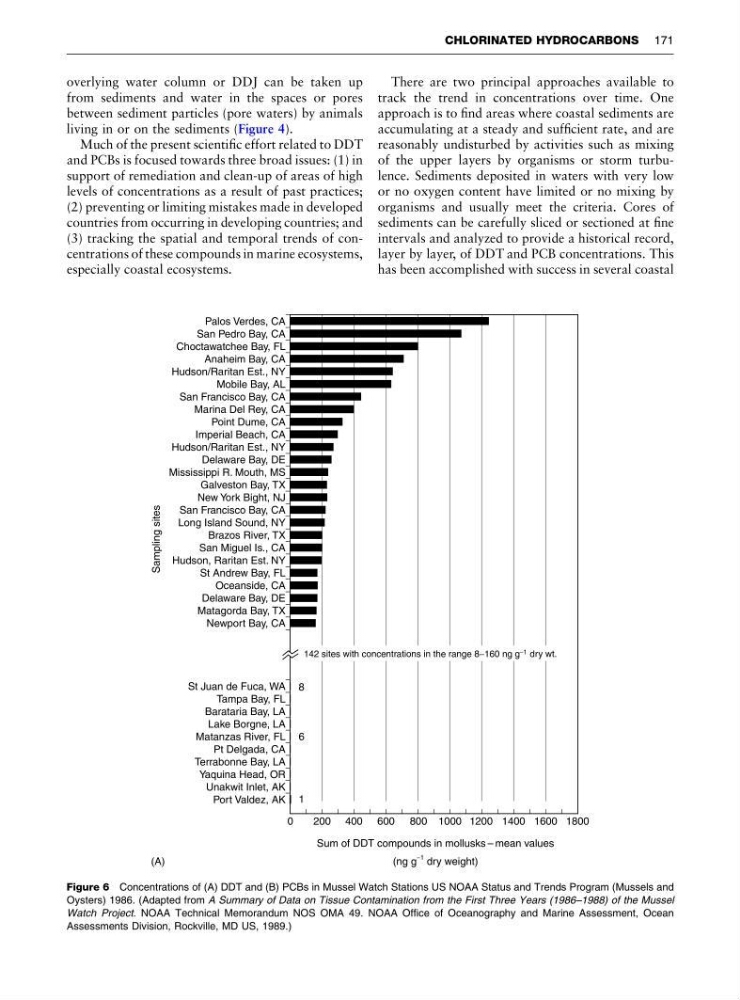
Figure 6 Concentrations of (A) DDT and (B) PCBs in Mussel Watch Stations US NOAA Status and Trends Program (Mussels and
Oysters) 1986. (Adapted from A Summary of Data on Tissue Contamination from the First Three Years (1986–1988) of the Mussel
Watch Project. NOAA Technical Memorandum NOS OMA 49. NOAA Office of Oceanography and Marine Assessment, Ocean
Assessments Division, Rockville, MD US, 1989.)
CHLORINATED HYDROCARBONS 171
from sediments and water in the spaces or pores
between sediment particles (pore waters) by animals
living in or on the sediments (Figure 4).
Much of the present scientific effort related to DDT
and PCBs is focused towards three broad issues: (1) in
support of remediation and clean-up of areas of high
levels of concentrations as a result of past practices;
(2) preventing or limiting mistakes made in developed
countries from occurring in developing countries; and
(3) tracking the spatial and temporal trends of concentrations of these compounds in marine ecosystems,
especially coastal ecosystems.
There are two principal approaches available to
track the trend in concentrations over time. One
approach is to find areas where coastal sediments are
accumulating at a steady and sufficient rate, and are
reasonably undisturbed by activities such as mixing
of the upper layers by organisms or storm turbulence. Sediments deposited in waters with very low
or no oxygen content have limited or no mixing by
organisms and usually meet the criteria. Cores of
sediments can be carefully sliced or sectioned at fine
intervals and analyzed to provide a historical record,
layer by layer, of DDT and PCB concentrations. This
has been accomplished with success in several coastal
Figure 6 Concentrations of (A) DDT and (B) PCBs in Mussel Watch Stations US NOAA Status and Trends Program (Mussels and
Oysters) 1986. (Adapted from A Summary of Data on Tissue Contamination from the First Three Years (1986–1988) of the Mussel
Watch Project. NOAA Technical Memorandum NOS OMA 49. NOAA Office of Oceanography and Marine Assessment, Ocean
Assessments Division, Rockville, MD US, 1989.)
CHLORINATED HYDROCARBONS 171