

the organism’s food and tissues eliciting a given
effect can range over many orders of magnitude
from parts per million to parts per trillion.
The near-shore and estuarine waters of the coastal
ocean contain elevated concentrations of DDT and
PCBs in comparison to the open ocean. Therefore,
attention has been focused on obtaining more data
for the coastal ocean. The data sets are more numerous and provide better geographic and temporal
coverage for coastal areas of developed countries but
much less so for most of the developing countries.
Sufficient data have been collected in several areas
and sufficient laboratory experiments have been
completed to provide a reasonable general understanding of the inputs, fates and effects of DDT and
PCBs in coastal ecosystems. Figure 4 shows a general
depiction of the cycling of PCBs in a coastal ecosystem. One key aspect of this biogeochemical cycle
is the uptake by animals of DDT and PCBs both from
food sources and from water across membrane
surfaces such as gills. Exceptions are air-breathing
organisms such as birds and marine mammals for
which the predominant source is food. Another key
aspect of the biogeochemical cycle is sorption of
DDT and PCBs onto particles and deposition to
sediments. During inadvertent or deliberate discharges or releases to the environment, a portion of
these compounds move through coastal ecosystems
with portions lost to the atmosphere and transported
elsewhere and to be deposited by dust or aerosols,
and by rain and snow.
Even though the chlorinated hydrocarbons are
among the chemicals more resistant to chemical or
biological alteration in the environment, there are
physical–chemical (e.g., sorption–desorption, transfer from water to air), microbial transformation and
degradation, and animal enzyme modifications or
transformations, that change the mixture of compounds as the chemicals move through the environment. For example, the mixture of chlorobiphenyl
congeners found in a lobster were dramatically different from the original mixture discharged in a
0
1
2
3
4
5
6
0
500
1000
1500
2000
2500
3000
3500
4000
4500
Sum of 15 chlorobiphenyl congeners (pg dm )
_ 3
Depth (m)
Suspension
Solution
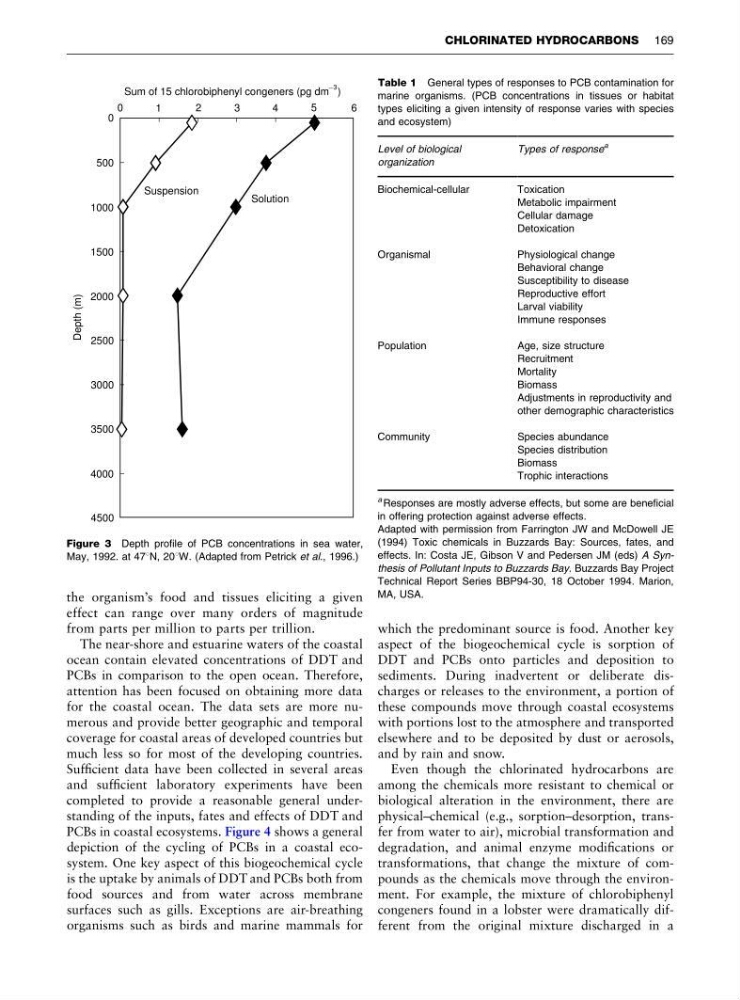
Figure 3 Depth profile of PCB concentrations in sea water,
May, 1992. at 471N, 201W. (Adapted from Petrick et al., 1996.)
Table 1 General types of responses to PCB contamination for
marine organisms. (PCB concentrations in tissues or habitat
types eliciting a given intensity of response varies with species
and ecosystem)
Level of biological
organization
Types of response
a
Biochemical-cellular
Toxication
Metabolic impairment
Cellular damage
Detoxication
Organismal
Physiological change
Behavioral change
Susceptibility to disease
Reproductive effort
Larval viability
Immune responses
Population
Age, size structure
Recruitment
Mortality
Biomass
Adjustments in reproductivity and
other demographic characteristics
Community
Species abundance
Species distribution
Biomass
Trophic interactions
a Responses are mostly adverse effects, but some are beneficial
in offering protection against adverse effects.
Adapted with permission from Farrington JW and McDowell JE
(1994) Toxic chemicals in Buzzards Bay: Sources, fates, and
effects. In: Costa JE, Gibson V and Pedersen JM (eds) A Synthesis of Pollutant Inputs to Buzzards Bay. Buzzards Bay Project
Technical Report Series BBP94-30, 18 October 1994. Marion,
MA, USA.
CHLORINATED HYDROCARBONS 169
effect can range over many orders of magnitude
from parts per million to parts per trillion.
The near-shore and estuarine waters of the coastal
ocean contain elevated concentrations of DDT and
PCBs in comparison to the open ocean. Therefore,
attention has been focused on obtaining more data
for the coastal ocean. The data sets are more numerous and provide better geographic and temporal
coverage for coastal areas of developed countries but
much less so for most of the developing countries.
Sufficient data have been collected in several areas
and sufficient laboratory experiments have been
completed to provide a reasonable general understanding of the inputs, fates and effects of DDT and
PCBs in coastal ecosystems. Figure 4 shows a general
depiction of the cycling of PCBs in a coastal ecosystem. One key aspect of this biogeochemical cycle
is the uptake by animals of DDT and PCBs both from
food sources and from water across membrane
surfaces such as gills. Exceptions are air-breathing
organisms such as birds and marine mammals for
which the predominant source is food. Another key
aspect of the biogeochemical cycle is sorption of
DDT and PCBs onto particles and deposition to
sediments. During inadvertent or deliberate discharges or releases to the environment, a portion of
these compounds move through coastal ecosystems
with portions lost to the atmosphere and transported
elsewhere and to be deposited by dust or aerosols,
and by rain and snow.
Even though the chlorinated hydrocarbons are
among the chemicals more resistant to chemical or
biological alteration in the environment, there are
physical–chemical (e.g., sorption–desorption, transfer from water to air), microbial transformation and
degradation, and animal enzyme modifications or
transformations, that change the mixture of compounds as the chemicals move through the environment. For example, the mixture of chlorobiphenyl
congeners found in a lobster were dramatically different from the original mixture discharged in a
0
1
2
3
4
5
6
0
500
1000
1500
2000
2500
3000
3500
4000
4500
Sum of 15 chlorobiphenyl congeners (pg dm )
_ 3
Depth (m)
Suspension
Solution
Figure 3 Depth profile of PCB concentrations in sea water,
May, 1992. at 471N, 201W. (Adapted from Petrick et al., 1996.)
Table 1 General types of responses to PCB contamination for
marine organisms. (PCB concentrations in tissues or habitat
types eliciting a given intensity of response varies with species
and ecosystem)
Level of biological
organization
Types of response
a
Biochemical-cellular
Toxication
Metabolic impairment
Cellular damage
Detoxication
Organismal
Physiological change
Behavioral change
Susceptibility to disease
Reproductive effort
Larval viability
Immune responses
Population
Age, size structure
Recruitment
Mortality
Biomass
Adjustments in reproductivity and
other demographic characteristics
Community
Species abundance
Species distribution
Biomass
Trophic interactions
a Responses are mostly adverse effects, but some are beneficial
in offering protection against adverse effects.
Adapted with permission from Farrington JW and McDowell JE
(1994) Toxic chemicals in Buzzards Bay: Sources, fates, and
effects. In: Costa JE, Gibson V and Pedersen JM (eds) A Synthesis of Pollutant Inputs to Buzzards Bay. Buzzards Bay Project
Technical Report Series BBP94-30, 18 October 1994. Marion,
MA, USA.
CHLORINATED HYDROCARBONS 169