

life stages of marine organisms to chlorinated
hydrocarbon pesticides and industrial chemicals
such as PCBs. These studies established lethal
tolerance limits for these chemicals in aquatic
habitats, usually in the microgram per liter range.
Such concentrations are rarely encountered today in
estuarine or coastal areas, except in the immediate
vicinity of exceptional discharges of the chemical.
Most current risk assessments for chlorinated
hydrocarbons are related to longer term, subacute
effects on human health, fish and wildlife feeding on
marine organisms. There are various sublethal
effects on various organisms that are beyond the
scope of this article. They are similar for many types
of natural and nonnatural stress on marine
organisms and ecosystems. These are summarized in
generic form in Table 1. However, the caveats
below apply, as do the cautions in Table 1.
Depending on the chemical and the species
involved, concentrations in water, sediment, or in
60˚
120˚
180˚
120˚
60˚
0˚
60˚
N
30˚
0˚
30˚
60˚
S
25 pg liter
_ 1
0
(D)
0˚
0˚
60˚
120˚
180˚
120˚
60˚
0˚
60˚
N
30˚
0˚
30˚
60˚
S
710
580
600
250 pg m
−3
0
(C)
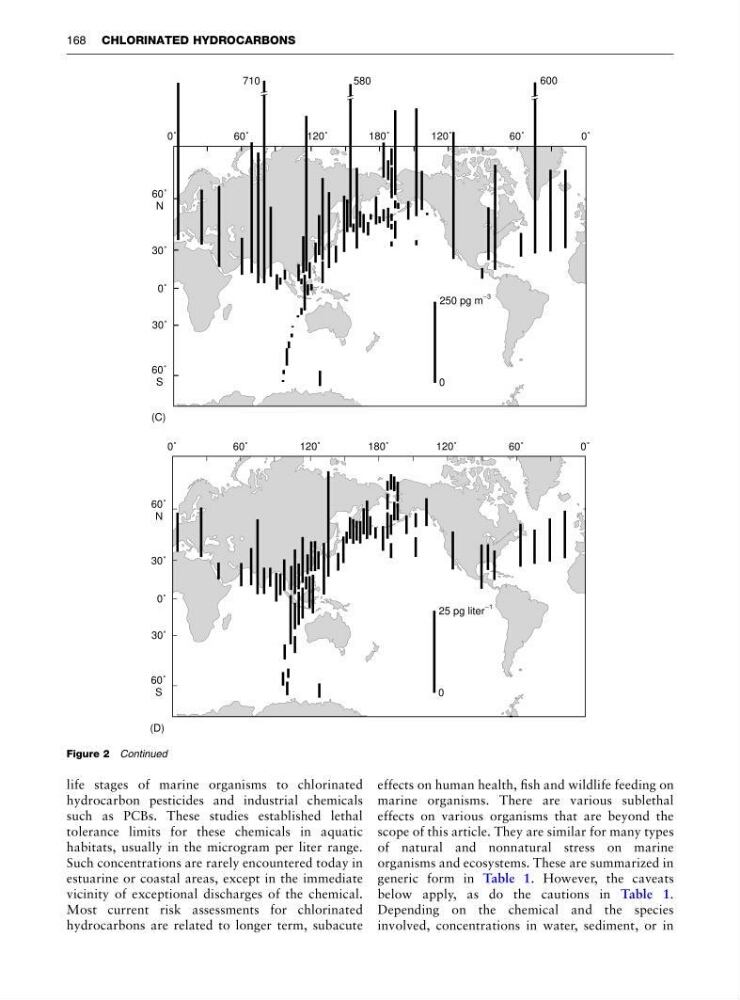
Figure 2 Continued
168 CHLORINATED HYDROCARBONS
hydrocarbon pesticides and industrial chemicals
such as PCBs. These studies established lethal
tolerance limits for these chemicals in aquatic
habitats, usually in the microgram per liter range.
Such concentrations are rarely encountered today in
estuarine or coastal areas, except in the immediate
vicinity of exceptional discharges of the chemical.
Most current risk assessments for chlorinated
hydrocarbons are related to longer term, subacute
effects on human health, fish and wildlife feeding on
marine organisms. There are various sublethal
effects on various organisms that are beyond the
scope of this article. They are similar for many types
of natural and nonnatural stress on marine
organisms and ecosystems. These are summarized in
generic form in Table 1. However, the caveats
below apply, as do the cautions in Table 1.
Depending on the chemical and the species
involved, concentrations in water, sediment, or in
60˚
120˚
180˚
120˚
60˚
0˚
60˚
N
30˚
0˚
30˚
60˚
S
25 pg liter
_ 1
0
(D)
0˚
0˚
60˚
120˚
180˚
120˚
60˚
0˚
60˚
N
30˚
0˚
30˚
60˚
S
710
580
600
250 pg m
−3
0
(C)
Figure 2 Continued
168 CHLORINATED HYDROCARBONS