

assessment of fish liver enzymes specific to metabolism of compounds such as PCBs indicate activation
of these enzymes and that the fish have responded
biologically to the presence of PCBs.
Recent data and an assessment (1993–94) of the
flux of PCBs to the North Atlantic open ocean have
estimated, as an example, that 14 000 mol year
À1 of a
tetrachlorobiphenyl congener was sequestered in the
north-western Atlantic Ocean with 75% of the flux
being in the deep-ocean pelagic sector and only 25%
in the coastal–continental shelf area. This same assessment provided good reasoning that the flux of
PCBs from the atmosphere to the North Atlantic has
decreased over the past two decades.
Coastal Ocean Aquatic toxicological studies
during the 1960s to the present have established the
range of sensitivities of several different species and
0˚
60˚
120˚
180˚
120˚
60˚
0˚
60˚
N
30˚
0˚
30˚
60˚
S
25 pg liter
_ 1
0
(B)
60˚
120˚
180˚
120˚
60˚
0˚
60˚
N
30˚
0˚
30˚
60˚
S
250 pg m
_ 3
0
1000
0˚
(A)
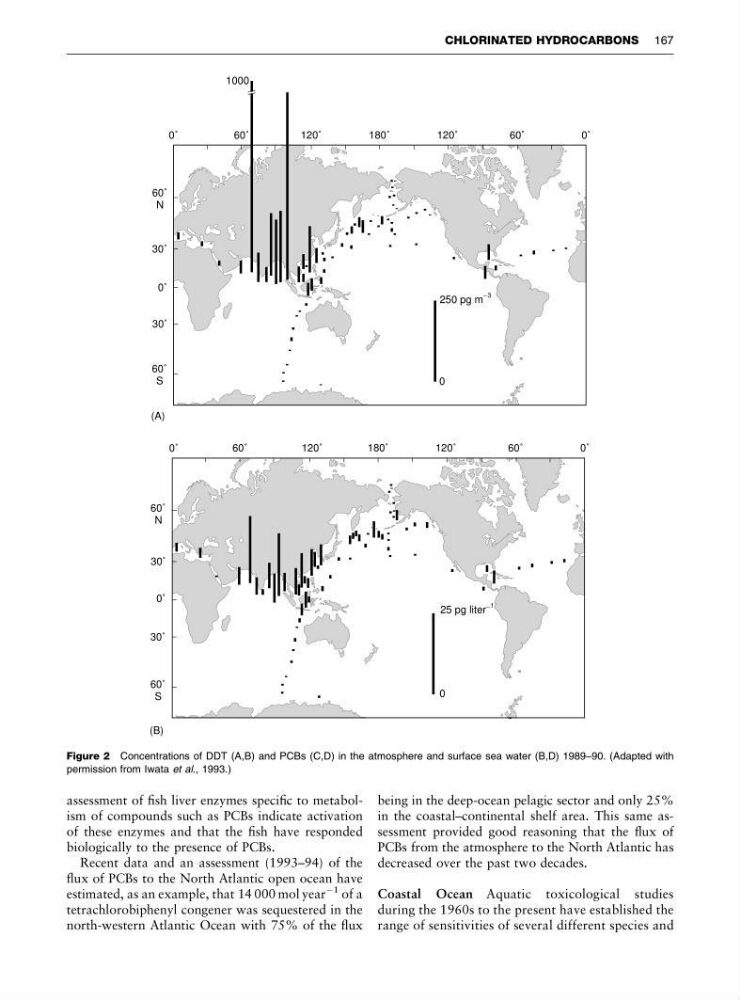
Figure 2 Concentrations of DDT (A,B) and PCBs (C,D) in the atmosphere and surface sea water (B,D) 1989–90. (Adapted with
permission from Iwata et al., 1993.)
CHLORINATED HYDROCARBONS 167
of these enzymes and that the fish have responded
biologically to the presence of PCBs.
Recent data and an assessment (1993–94) of the
flux of PCBs to the North Atlantic open ocean have
estimated, as an example, that 14 000 mol year
À1 of a
tetrachlorobiphenyl congener was sequestered in the
north-western Atlantic Ocean with 75% of the flux
being in the deep-ocean pelagic sector and only 25%
in the coastal–continental shelf area. This same assessment provided good reasoning that the flux of
PCBs from the atmosphere to the North Atlantic has
decreased over the past two decades.
Coastal Ocean Aquatic toxicological studies
during the 1960s to the present have established the
range of sensitivities of several different species and
0˚
60˚
120˚
180˚
120˚
60˚
0˚
60˚
N
30˚
0˚
30˚
60˚
S
25 pg liter
_ 1
0
(B)
60˚
120˚
180˚
120˚
60˚
0˚
60˚
N
30˚
0˚
30˚
60˚
S
250 pg m
_ 3
0
1000
0˚
(A)
Figure 2 Concentrations of DDT (A,B) and PCBs (C,D) in the atmosphere and surface sea water (B,D) 1989–90. (Adapted with
permission from Iwata et al., 1993.)
CHLORINATED HYDROCARBONS 167