

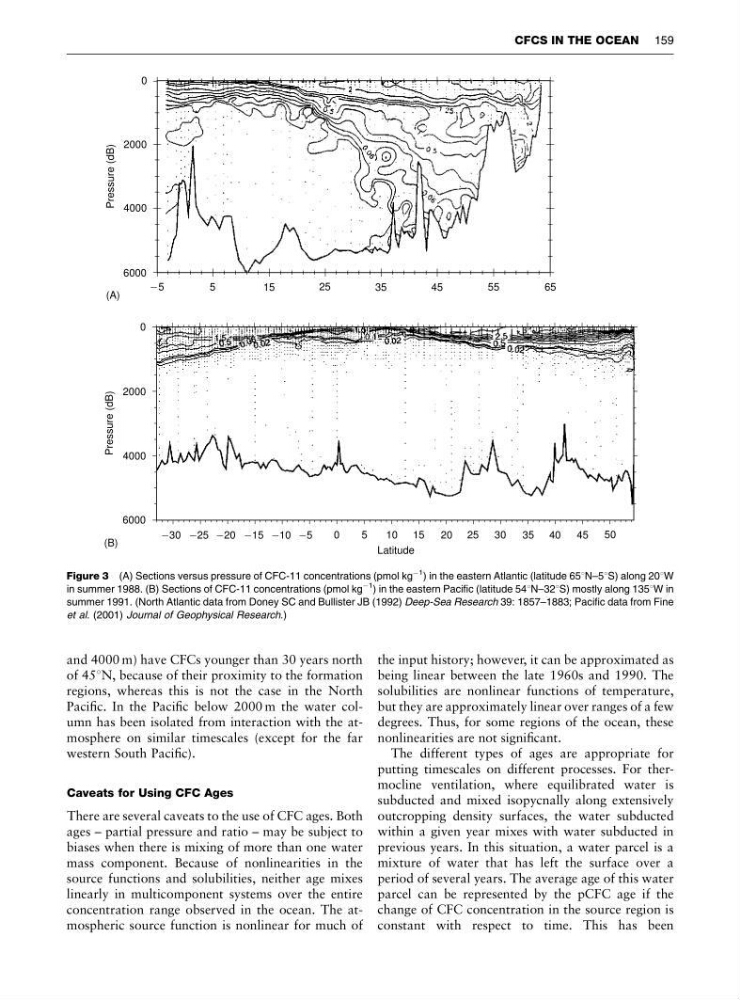
and 4000 m) have CFCs younger than 30 years north
of 451N, because of their proximity to the formation
regions, whereas this is not the case in the North
Pacific. In the Pacific below 2000 m the water column has been isolated from interaction with the atmosphere on similar timescales (except for the far
western South Pacific).
Caveats for Using CFC Ages
There are several caveats to the use of CFC ages. Both
ages – partial pressure and ratio – may be subject to
biases when there is mixing of more than one water
mass component. Because of nonlinearities in the
source functions and solubilities, neither age mixes
linearly in multicomponent systems over the entire
concentration range observed in the ocean. The atmospheric source function is nonlinear for much of
the input history; however, it can be approximated as
being linear between the late 1960s and 1990. The
solubilities are nonlinear functions of temperature,
but they are approximately linear over ranges of a few
degrees. Thus, for some regions of the ocean, these
nonlinearities are not significant.
The different types of ages are appropriate for
putting timescales on different processes. For thermocline ventilation, where equilibrated water is
subducted and mixed isopycnally along extensively
outcropping density surfaces, the water subducted
within a given year mixes with water subducted in
previous years. In this situation, a water parcel is a
mixture of water that has left the surface over a
period of several years. The average age of this water
parcel can be represented by the pCFC age if the
change of CFC concentration in the source region is
constant with respect to time. This has been
6000
4000
2000
0
5
_ 5
15
25
35
45
55
65
Pressure (dB)
(A)
_ 30 _ 25 _ 20 _ 15 _ 10 _ 5
0
5
10 15
20 25
30
35 40
45
50
6000
4000
2000
0
Latitude
Pressure (dB)
(B)
Figure 3 (A) Sections versus pressure of CFC-11 concentrations (pmol kg
À1 ) in the eastern Atlantic (latitude 651N–51S) along 201W
in summer 1988. (B) Sections of CFC-11 concentrations (pmol kg
À1
) in the eastern Pacific (latitude 541N–321S) mostly along 1351W in
summer 1991. (North Atlantic data from Doney SC and Bullister JB (1992) Deep-Sea Research 39: 1857–1883; Pacific data from Fine
et al. (2001) Journal of Geophysical Research.)
CFCS IN THE OCEAN 159
of 451N, because of their proximity to the formation
regions, whereas this is not the case in the North
Pacific. In the Pacific below 2000 m the water column has been isolated from interaction with the atmosphere on similar timescales (except for the far
western South Pacific).
Caveats for Using CFC Ages
There are several caveats to the use of CFC ages. Both
ages – partial pressure and ratio – may be subject to
biases when there is mixing of more than one water
mass component. Because of nonlinearities in the
source functions and solubilities, neither age mixes
linearly in multicomponent systems over the entire
concentration range observed in the ocean. The atmospheric source function is nonlinear for much of
the input history; however, it can be approximated as
being linear between the late 1960s and 1990. The
solubilities are nonlinear functions of temperature,
but they are approximately linear over ranges of a few
degrees. Thus, for some regions of the ocean, these
nonlinearities are not significant.
The different types of ages are appropriate for
putting timescales on different processes. For thermocline ventilation, where equilibrated water is
subducted and mixed isopycnally along extensively
outcropping density surfaces, the water subducted
within a given year mixes with water subducted in
previous years. In this situation, a water parcel is a
mixture of water that has left the surface over a
period of several years. The average age of this water
parcel can be represented by the pCFC age if the
change of CFC concentration in the source region is
constant with respect to time. This has been
6000
4000
2000
0
5
_ 5
15
25
35
45
55
65
Pressure (dB)
(A)
_ 30 _ 25 _ 20 _ 15 _ 10 _ 5
0
5
10 15
20 25
30
35 40
45
50
6000
4000
2000
0
Latitude
Pressure (dB)
(B)
Figure 3 (A) Sections versus pressure of CFC-11 concentrations (pmol kg
À1 ) in the eastern Atlantic (latitude 651N–51S) along 201W
in summer 1988. (B) Sections of CFC-11 concentrations (pmol kg
À1
) in the eastern Pacific (latitude 541N–321S) mostly along 1351W in
summer 1991. (North Atlantic data from Doney SC and Bullister JB (1992) Deep-Sea Research 39: 1857–1883; Pacific data from Fine
et al. (2001) Journal of Geophysical Research.)
CFCS IN THE OCEAN 159