

confirmed for the North Atlantic thermocline in the
eastern basin by comparing pCFC ages to tritium/
He-3 ages.
In regions where surface waters are converted to
deep and bottom waters which then spread into a
background of low-tracer water, the high CFC concentrations of the cold surface water are diluted by
entrainment and mixing. The resulting pCFC age is
much too young for the average age of the mixture
and much too old for the CFC-bearing component.
However, a tracer ratio is conserved in this situation,
and the corresponding ratio age represents that of the
youngest component of the mixture, not the average
age of the water parcel. Thus, there are different
estimates of ages that can be derived from CFC-11
and CFC-12, and the associated timescales can be
expanded in regions where CFC-113 and CCl 4 data
are available.
In most high latitude intermediate and deep-water
source regions the age clock is not reset to zero due
to lack of time to equilibrate deep mixed layers with
the atmosphere. Thus, water masses will start out
with an age of a few years (rather than zero), that is,
they are not completely renewed during formation.
This additional age is called a relic age which can be
estimated from observations of the tracers at the
water mass formation regions. The relic age can then
be subtracted from the tracer ages calculated downstream from the water mass formation regions.
Applications of CFCs to Ocean
Processes
Examples of the application of CFCs to understanding oceanographic processes are divided into
6000
4000
2000
0
5
_ 5
15
25
35
45
55
65
Pressure (dB)
(A)
> 30 years
3 0
3 0
_ 30 _ 25 _ 20 _ 15 _ 10 _ 5
0
5
10 15 20 25 30 35 40 45 50
6000
4000
2000
0
Pressure (dB)
(B)
Latitude
20
12
20
30
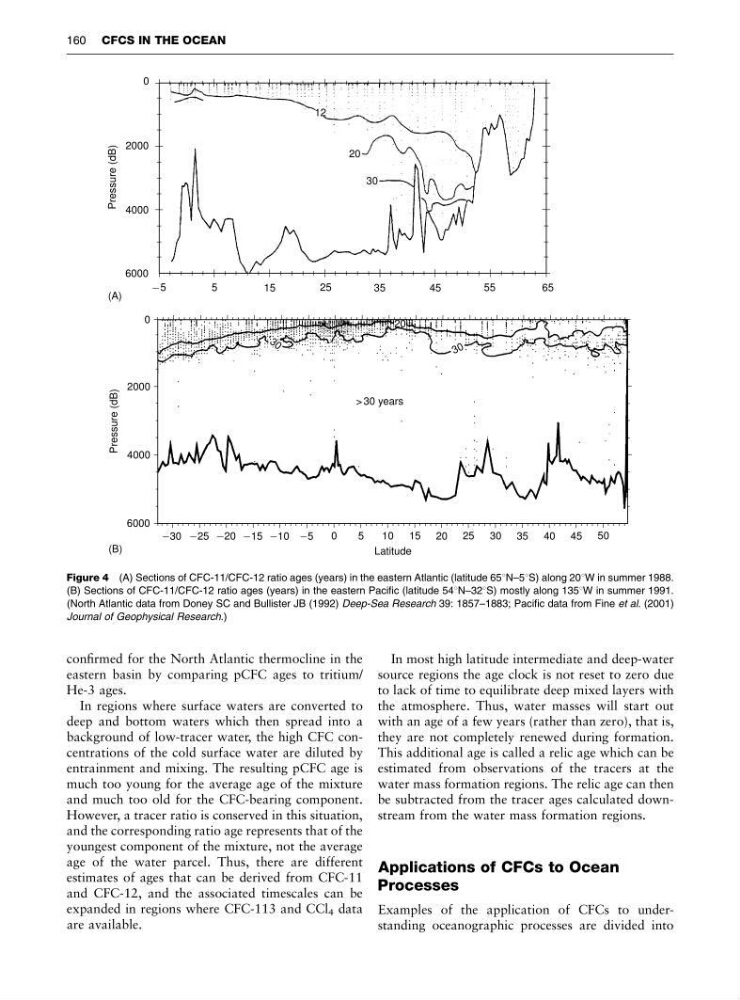
Figure 4 (A) Sections of CFC-11/CFC-12 ratio ages (years) in the eastern Atlantic (latitude 651N–51S) along 201W in summer 1988.
(B) Sections of CFC-11/CFC-12 ratio ages (years) in the eastern Pacific (latitude 541N–321S) mostly along 1351W in summer 1991.
(North Atlantic data from Doney SC and Bullister JB (1992) Deep-Sea Research 39: 1857–1883; Pacific data from Fine et al. (2001)
Journal of Geophysical Research.)
160 CFCS IN THE OCEAN
eastern basin by comparing pCFC ages to tritium/
He-3 ages.
In regions where surface waters are converted to
deep and bottom waters which then spread into a
background of low-tracer water, the high CFC concentrations of the cold surface water are diluted by
entrainment and mixing. The resulting pCFC age is
much too young for the average age of the mixture
and much too old for the CFC-bearing component.
However, a tracer ratio is conserved in this situation,
and the corresponding ratio age represents that of the
youngest component of the mixture, not the average
age of the water parcel. Thus, there are different
estimates of ages that can be derived from CFC-11
and CFC-12, and the associated timescales can be
expanded in regions where CFC-113 and CCl 4 data
are available.
In most high latitude intermediate and deep-water
source regions the age clock is not reset to zero due
to lack of time to equilibrate deep mixed layers with
the atmosphere. Thus, water masses will start out
with an age of a few years (rather than zero), that is,
they are not completely renewed during formation.
This additional age is called a relic age which can be
estimated from observations of the tracers at the
water mass formation regions. The relic age can then
be subtracted from the tracer ages calculated downstream from the water mass formation regions.
Applications of CFCs to Ocean
Processes
Examples of the application of CFCs to understanding oceanographic processes are divided into
6000
4000
2000
0
5
_ 5
15
25
35
45
55
65
Pressure (dB)
(A)
> 30 years
3 0
3 0
_ 30 _ 25 _ 20 _ 15 _ 10 _ 5
0
5
10 15 20 25 30 35 40 45 50
6000
4000
2000
0
Pressure (dB)
(B)
Latitude
20
12
20
30
Figure 4 (A) Sections of CFC-11/CFC-12 ratio ages (years) in the eastern Atlantic (latitude 651N–51S) along 201W in summer 1988.
(B) Sections of CFC-11/CFC-12 ratio ages (years) in the eastern Pacific (latitude 541N–321S) mostly along 1351W in summer 1991.
(North Atlantic data from Doney SC and Bullister JB (1992) Deep-Sea Research 39: 1857–1883; Pacific data from Fine et al. (2001)
Journal of Geophysical Research.)
160 CFCS IN THE OCEAN