

glaciated areas or a change in the provenance of the
erosional products.
Be
10
Be/
9
Be has been analyzed in Fe-Mn crusts as
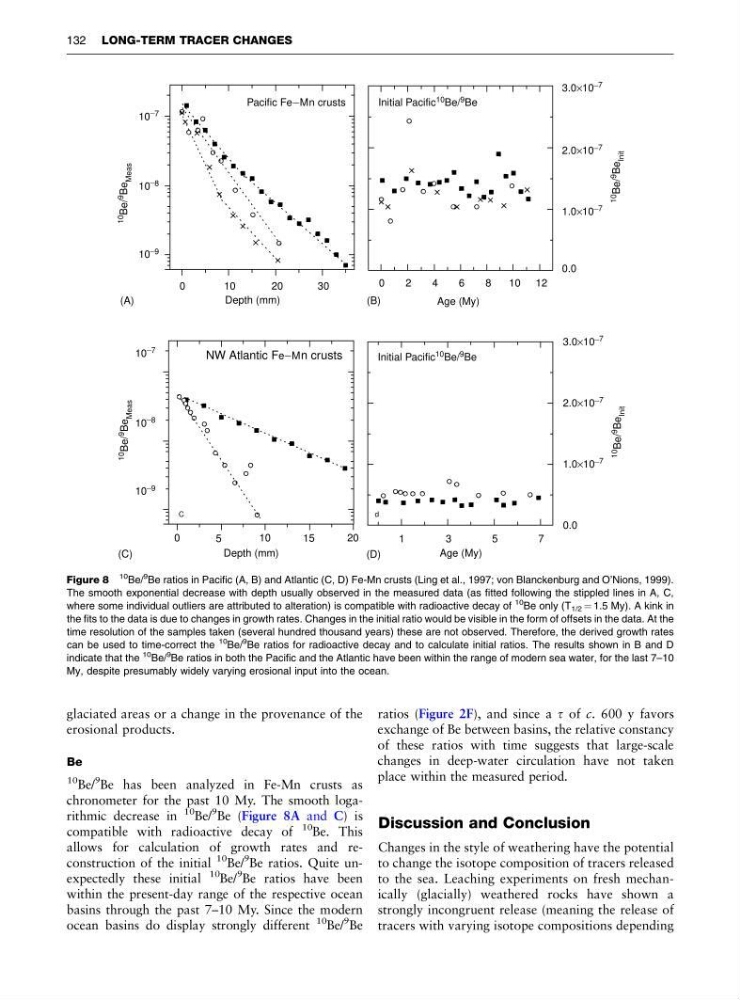
chronometer for the past 10 My. The smooth logarithmic decrease in
10
Be/
9
Be (Figure 8A and C) is
compatible with radioactive decay of
10
Be. This
allows for calculation of growth rates and reconstruction of the initial
10
Be/
9
Be ratios. Quite unexpectedly these initial
10
Be/
9
Be ratios have been
within the present-day range of the respective ocean
basins through the past 7–10 My. Since the modern
ocean basins do display strongly different
10
Be/
9
Be
ratios (Figure 2F), and since a t of c. 600 y favors
exchange of Be between basins, the relative constancy
of these ratios with time suggests that large-scale
changes in deep-water circulation have not taken
place within the measured period.
Discussion and Conclusion
Changes in the style of weathering have the potential
to change the isotope composition of tracers released
to the sea. Leaching experiments on fresh mechanically (glacially) weathered rocks have shown a
strongly incongruent release (meaning the release of
tracers with varying isotope compositions depending
0
10
Pacific Fe _ Mn crusts
Initial Pacific 10 Be/ 9 Be
10
Be/
9
Be
Meas
10
Be/ 9
Be
Init
10
_ 7
3.0×10
_ 7
1.0×10
_ 7
2.0×10
_ 7
0.0
10
_ 8
10
_ 9
20
30
0
2
4
6
8
10 12
Depth (mm)
Age (My)
NW Atlantic Fe _ Mn crusts
C
d
Initial Pacific 10 Be/ 9 Be
10
Be/
9
Be
Meas
10
_ 7
10
_ 8
10
_ 9
0
1 0
2 0
1
3
5
7
Depth (mm)
Age (My)
10
Be/ 9
Be
Init
3.0×10
_ 7
1.0×10
_ 7
2.0×10
_ 7
0.0
15
5
(C)
(D)
(A)
(B)
Figure 8
10 Be/
9 Be ratios in Pacific (A, B) and Atlantic (C, D) Fe-Mn crusts (Ling et al., 1997; von Blanckenburg and O’Nions, 1999).
The smooth exponential decrease with depth usually observed in the measured data (as fitted following the stippled lines in A, C,
where some individual outliers are attributed to alteration) is compatible with radioactive decay of
10 Be only (T 1/2 ¼ 1.5 My). A kink in
the fits to the data is due to changes in growth rates. Changes in the initial ratio would be visible in the form of offsets in the data. At the
time resolution of the samples taken (several hundred thousand years) these are not observed. Therefore, the derived growth rates
can be used to time-correct the
10
Be/
9 Be ratios for radioactive decay and to calculate initial ratios. The results shown in B and D
indicate that the
10 Be/
9
Be ratios in both the Pacific and the Atlantic have been within the range of modern sea water, for the last 7–10
My, despite presumably widely varying erosional input into the ocean.
132 LONG-TERM TRACER CHANGES
erosional products.
Be
10
Be/
9
Be has been analyzed in Fe-Mn crusts as
chronometer for the past 10 My. The smooth logarithmic decrease in
10
Be/
9
Be (Figure 8A and C) is
compatible with radioactive decay of
10
Be. This
allows for calculation of growth rates and reconstruction of the initial
10
Be/
9
Be ratios. Quite unexpectedly these initial
10
Be/
9
Be ratios have been
within the present-day range of the respective ocean
basins through the past 7–10 My. Since the modern
ocean basins do display strongly different
10
Be/
9
Be
ratios (Figure 2F), and since a t of c. 600 y favors
exchange of Be between basins, the relative constancy
of these ratios with time suggests that large-scale
changes in deep-water circulation have not taken
place within the measured period.
Discussion and Conclusion
Changes in the style of weathering have the potential
to change the isotope composition of tracers released
to the sea. Leaching experiments on fresh mechanically (glacially) weathered rocks have shown a
strongly incongruent release (meaning the release of
tracers with varying isotope compositions depending
0
10
Pacific Fe _ Mn crusts
Initial Pacific 10 Be/ 9 Be
10
Be/
9
Be
Meas
10
Be/ 9
Be
Init
10
_ 7
3.0×10
_ 7
1.0×10
_ 7
2.0×10
_ 7
0.0
10
_ 8
10
_ 9
20
30
0
2
4
6
8
10 12
Depth (mm)
Age (My)
NW Atlantic Fe _ Mn crusts
C
d
Initial Pacific 10 Be/ 9 Be
10
Be/
9
Be
Meas
10
_ 7
10
_ 8
10
_ 9
0
1 0
2 0
1
3
5
7
Depth (mm)
Age (My)
10
Be/ 9
Be
Init
3.0×10
_ 7
1.0×10
_ 7
2.0×10
_ 7
0.0
15
5
(C)
(D)
(A)
(B)
Figure 8
10 Be/
9 Be ratios in Pacific (A, B) and Atlantic (C, D) Fe-Mn crusts (Ling et al., 1997; von Blanckenburg and O’Nions, 1999).
The smooth exponential decrease with depth usually observed in the measured data (as fitted following the stippled lines in A, C,
where some individual outliers are attributed to alteration) is compatible with radioactive decay of
10 Be only (T 1/2 ¼ 1.5 My). A kink in
the fits to the data is due to changes in growth rates. Changes in the initial ratio would be visible in the form of offsets in the data. At the
time resolution of the samples taken (several hundred thousand years) these are not observed. Therefore, the derived growth rates
can be used to time-correct the
10
Be/
9 Be ratios for radioactive decay and to calculate initial ratios. The results shown in B and D
indicate that the
10 Be/
9
Be ratios in both the Pacific and the Atlantic have been within the range of modern sea water, for the last 7–10
My, despite presumably widely varying erosional input into the ocean.
132 LONG-TERM TRACER CHANGES