

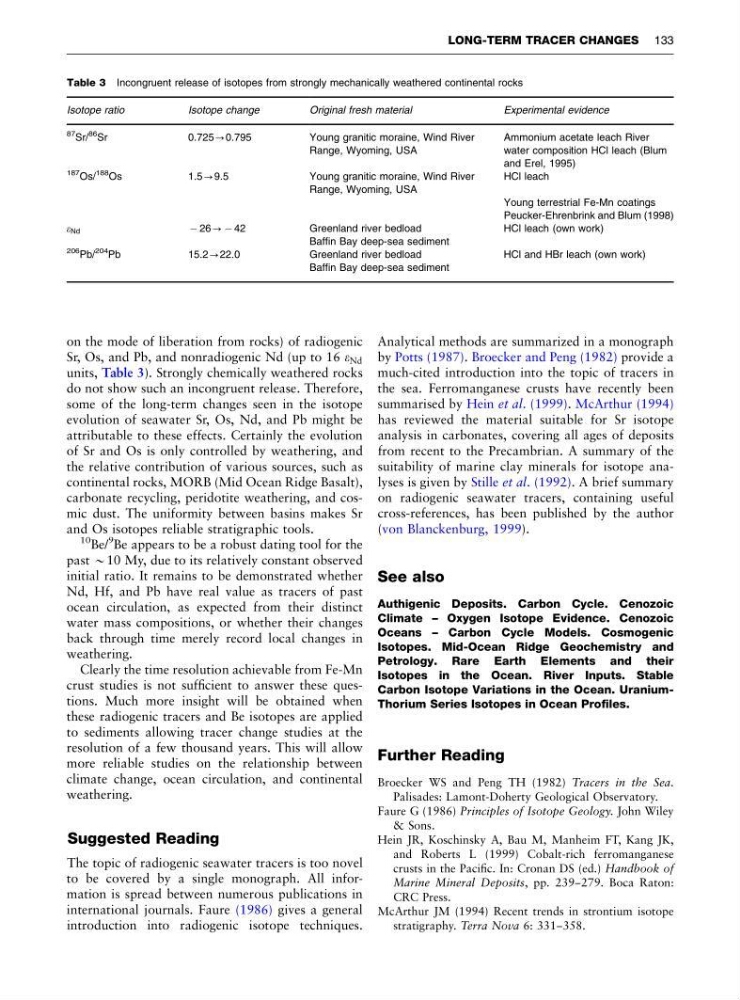
on the mode of liberation from rocks) of radiogenic
Sr, Os, and Pb, and nonradiogenic Nd (up to 16 e Nd
units, Table 3). Strongly chemically weathered rocks
do not show such an incongruent release. Therefore,
some of the long-term changes seen in the isotope
evolution of seawater Sr, Os, Nd, and Pb might be
attributable to these effects. Certainly the evolution
of Sr and Os is only controlled by weathering, and
the relative contribution of various sources, such as
continental rocks, MORB (Mid Ocean Ridge Basalt),
carbonate recycling, peridotite weathering, and cosmic dust. The uniformity between basins makes Sr
and Os isotopes reliable stratigraphic tools.
10 Be/
9 Be appears to be a robust dating tool for the
past B10 My, due to its relatively constant observed
initial ratio. It remains to be demonstrated whether
Nd, Hf, and Pb have real value as tracers of past
ocean circulation, as expected from their distinct
water mass compositions, or whether their changes
back through time merely record local changes in
weathering.
Clearly the time resolution achievable from Fe-Mn
crust studies is not sufficient to answer these questions. Much more insight will be obtained when
these radiogenic tracers and Be isotopes are applied
to sediments allowing tracer change studies at the
resolution of a few thousand years. This will allow
more reliable studies on the relationship between
climate change, ocean circulation, and continental
weathering.
Suggested Reading
The topic of radiogenic seawater tracers is too novel
to be covered by a single monograph. All information is spread between numerous publications in
international journals. Faure (1986) gives a general
introduction into radiogenic isotope techniques.
Analytical methods are summarized in a monograph
by Potts (1987). Broecker and Peng (1982) provide a
much-cited introduction into the topic of tracers in
the sea. Ferromanganese crusts have recently been
summarised by Hein et al. (1999). McArthur (1994)
has reviewed the material suitable for Sr isotope
analysis in carbonates, covering all ages of deposits
from recent to the Precambrian. A summary of the
suitability of marine clay minerals for isotope analyses is given by Stille et al. (1992). A brief summary
on radiogenic seawater tracers, containing useful
cross-references, has been published by the author
(von Blanckenburg, 1999).
See also
Authigenic Deposits. Carbon Cycle. Cenozoic
Climate – Oxygen Isotope Evidence. Cenozoic
Oceans – Carbon Cycle Models. Cosmogenic
Isotopes. Mid-Ocean Ridge Geochemistry and
Petrology. Rare Earth Elements and their
Isotopes in the Ocean. River Inputs. Stable
Carbon Isotope Variations in the Ocean. UraniumThorium Series Isotopes in Ocean Profiles.
Further Reading
Broecker WS and Peng TH (1982) Tracers in the Sea.
Palisades: Lamont-Doherty Geological Observatory.
Faure G (1986) Principles of Isotope Geology. John Wiley
& Sons.
Hein JR, Koschinsky A, Bau M, Manheim FT, Kang JK,
and Roberts L (1999) Cobalt-rich ferromanganese
crusts in the Pacific. In: Cronan DS (ed.) Handbook of
Marine Mineral Deposits, pp. 239--279. Boca Raton:
CRC Press.
McArthur JM (1994) Recent trends in strontium isotope
stratigraphy. Terra Nova 6: 331--358.
Table 3 Incongruent release of isotopes from strongly mechanically weathered continental rocks
Isotope ratio
Isotope change
Original fresh material
Experimental evidence
87
Sr/
86
Sr
0.725-0.795
Young granitic moraine, Wind River
Range, Wyoming, USA
Ammonium acetate leach River
water composition HCl leach (Blum
and Erel, 1995)
187
Os/
188 Os
1.5-9.5
Young granitic moraine, Wind River
Range, Wyoming, USA
HCl leach
Young terrestrial Fe-Mn coatings
Peucker-Ehrenbrink and Blum (1998)
e Nd
À 26- À 42
Greenland river bedload
HCl leach (own work)
Baffin Bay deep-sea sediment
206
Pb/
204
Pb
15.2-22.0
Greenland river bedload
HCl and HBr leach (own work)
Baffin Bay deep-sea sediment
LONG-TERM TRACER CHANGES 133
Sr, Os, and Pb, and nonradiogenic Nd (up to 16 e Nd
units, Table 3). Strongly chemically weathered rocks
do not show such an incongruent release. Therefore,
some of the long-term changes seen in the isotope
evolution of seawater Sr, Os, Nd, and Pb might be
attributable to these effects. Certainly the evolution
of Sr and Os is only controlled by weathering, and
the relative contribution of various sources, such as
continental rocks, MORB (Mid Ocean Ridge Basalt),
carbonate recycling, peridotite weathering, and cosmic dust. The uniformity between basins makes Sr
and Os isotopes reliable stratigraphic tools.
10 Be/
9 Be appears to be a robust dating tool for the
past B10 My, due to its relatively constant observed
initial ratio. It remains to be demonstrated whether
Nd, Hf, and Pb have real value as tracers of past
ocean circulation, as expected from their distinct
water mass compositions, or whether their changes
back through time merely record local changes in
weathering.
Clearly the time resolution achievable from Fe-Mn
crust studies is not sufficient to answer these questions. Much more insight will be obtained when
these radiogenic tracers and Be isotopes are applied
to sediments allowing tracer change studies at the
resolution of a few thousand years. This will allow
more reliable studies on the relationship between
climate change, ocean circulation, and continental
weathering.
Suggested Reading
The topic of radiogenic seawater tracers is too novel
to be covered by a single monograph. All information is spread between numerous publications in
international journals. Faure (1986) gives a general
introduction into radiogenic isotope techniques.
Analytical methods are summarized in a monograph
by Potts (1987). Broecker and Peng (1982) provide a
much-cited introduction into the topic of tracers in
the sea. Ferromanganese crusts have recently been
summarised by Hein et al. (1999). McArthur (1994)
has reviewed the material suitable for Sr isotope
analysis in carbonates, covering all ages of deposits
from recent to the Precambrian. A summary of the
suitability of marine clay minerals for isotope analyses is given by Stille et al. (1992). A brief summary
on radiogenic seawater tracers, containing useful
cross-references, has been published by the author
(von Blanckenburg, 1999).
See also
Authigenic Deposits. Carbon Cycle. Cenozoic
Climate – Oxygen Isotope Evidence. Cenozoic
Oceans – Carbon Cycle Models. Cosmogenic
Isotopes. Mid-Ocean Ridge Geochemistry and
Petrology. Rare Earth Elements and their
Isotopes in the Ocean. River Inputs. Stable
Carbon Isotope Variations in the Ocean. UraniumThorium Series Isotopes in Ocean Profiles.
Further Reading
Broecker WS and Peng TH (1982) Tracers in the Sea.
Palisades: Lamont-Doherty Geological Observatory.
Faure G (1986) Principles of Isotope Geology. John Wiley
& Sons.
Hein JR, Koschinsky A, Bau M, Manheim FT, Kang JK,
and Roberts L (1999) Cobalt-rich ferromanganese
crusts in the Pacific. In: Cronan DS (ed.) Handbook of
Marine Mineral Deposits, pp. 239--279. Boca Raton:
CRC Press.
McArthur JM (1994) Recent trends in strontium isotope
stratigraphy. Terra Nova 6: 331--358.
Table 3 Incongruent release of isotopes from strongly mechanically weathered continental rocks
Isotope ratio
Isotope change
Original fresh material
Experimental evidence
87
Sr/
86
Sr
0.725-0.795
Young granitic moraine, Wind River
Range, Wyoming, USA
Ammonium acetate leach River
water composition HCl leach (Blum
and Erel, 1995)
187
Os/
188 Os
1.5-9.5
Young granitic moraine, Wind River
Range, Wyoming, USA
HCl leach
Young terrestrial Fe-Mn coatings
Peucker-Ehrenbrink and Blum (1998)
e Nd
À 26- À 42
Greenland river bedload
HCl leach (own work)
Baffin Bay deep-sea sediment
206
Pb/
204
Pb
15.2-22.0
Greenland river bedload
HCl and HBr leach (own work)
Baffin Bay deep-sea sediment
LONG-TERM TRACER CHANGES 133