

nonradiogenic Os from peridotite weathering
(Table 2).
As is the case for
87
Sr/
86
Sr, there is a strong increase of
187 Os/
188 Os towards more radiogenic values over the past B14 My. As stated above, this has
been linked to the rise of the Himalayas, but recent
analyses of Himalayan river waters for Os isotope
compositions do not support this view. A more likely
possibility is the weathering of ancient crystalline
terranes exposed by physical erosion, or the weathering of black shales. These organic-rich sediments
have a high Re/Os ratio. Therefore old black shales
have the potential to supply Os with a very high
187 Os/
188
Os ratio to sea water.
Nd
Nd isotopes, analyzed with low-time resolution in
Fe-Mn crusts and given as e Nd units, are presented
in Figure 6. The most outstanding feature is that the
provinciality, observed in e Nd of the modern oceans
(Figure 2C), has been a feature prevailing as far
back as 55 Ma. It is thought that despite the large
isotopic variability in source materials, the t of Nd
is sufficiently long to allow for efficient intra-basin
homogenization. This produces the basins’ characteristic Nd isotope blend. Significant variations in
e Nd are mainly observed for the past 5 My. In the
Pacific a decrease in e Nd over the past 5 My might
be due to an increased flow of AABW (with low e Nd ,
Figure 2C), a rearrangement of the thermohaline
circulation following the opening of the Indonesian
throughways for exchange of thermocline waters, or
an increase in dust input. The strong decrease in
north-west Atlantic e Nd over the past 3–4 My has
been linked to a strengthening of NADW production following closure of the Panama gateway
(suppressing northward flow of AABW and AAIW
high in e Nd ). However, a pronounced decrease of e Nd
in a shallow ferromanganese crust off Florida has
ocurred as early as 8–5 Ma. This has been ascribed
to a decreasing inflow of Pacific water through the
narrowing Panama gateway. Thus, a change in the
amount and style of weathering associated with the
onset of northern hemisphere glaciation at 3 Ma is a
more likely explanation for the Pleistocene decrease
in e Nd . In particular the Labrador Sea, a major
source of NADW, is surrounded by ancient rocks
with e Nd as low as À 40 and is supplying deep water
with e Nd of À 20 to NADW (Figure 2C). An increase in weathering of this component has the
potential to drive the Nd in NADW towards lower
compositions.
Pb
No information can be obtained on natural Pb from
modern sea water, because of the strong contamination by industrial Pb. Therefore, the pre-anthropogenic Pb distribution has to be obtained from
chemical sediments.
206 Pb/
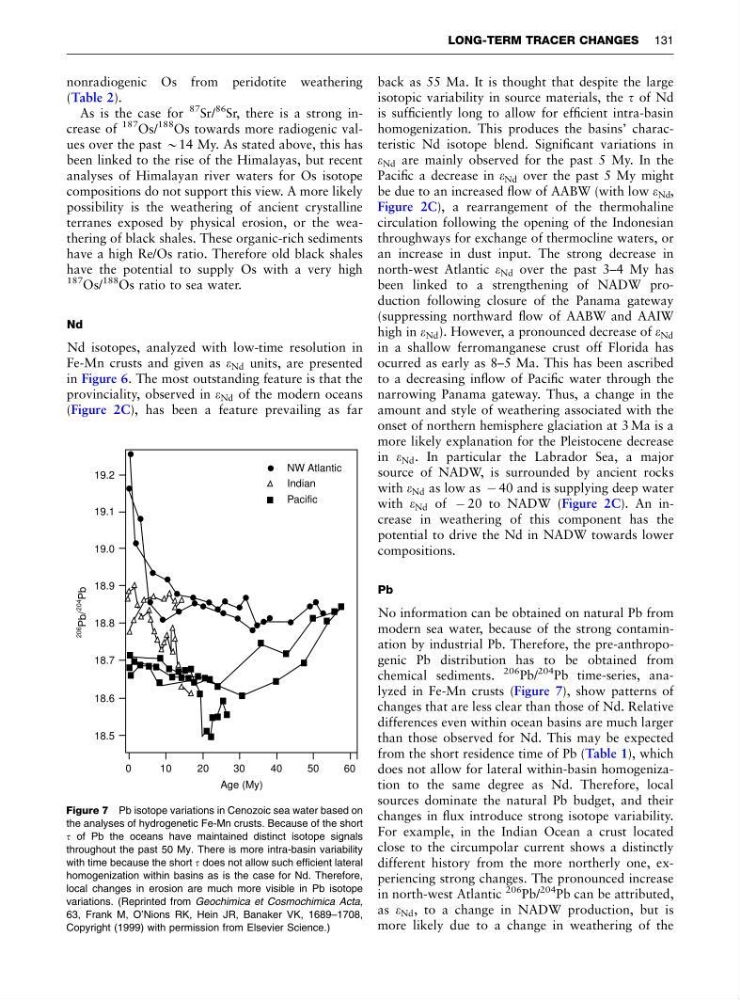
204 Pb time-series, analyzed in Fe-Mn crusts (Figure 7), show patterns of
changes that are less clear than those of Nd. Relative
differences even within ocean basins are much larger
than those observed for Nd. This may be expected
from the short residence time of Pb (Table 1), which
does not allow for lateral within-basin homogenization to the same degree as Nd. Therefore, local
sources dominate the natural Pb budget, and their
changes in flux introduce strong isotope variability.
For example, in the Indian Ocean a crust located
close to the circumpolar current shows a distinctly
different history from the more northerly one, experiencing strong changes. The pronounced increase
in north-west Atlantic
206 Pb/
204 Pb can be attributed,
as e Nd , to a change in NADW production, but is
more likely due to a change in weathering of the
NW Atlantic
Indian
Pacific
19.2
19.1
19.0
18.9
18.8
18.7
18.6
18.5
0
1 0
2 0
3 0
4 0
5 0
Age (My)
60
206
Pb/
204
Pb
Figure 7 Pb isotope variations in Cenozoic sea water based on
the analyses of hydrogenetic Fe-Mn crusts. Because of the short
t of Pb the oceans have maintained distinct isotope signals
throughout the past 50 My. There is more intra-basin variability
with time because the short t does not allow such efficient lateral
homogenization within basins as is the case for Nd. Therefore,
local changes in erosion are much more visible in Pb isotope
variations. (Reprinted from Geochimica et Cosmochimica Acta,
63, Frank M, O’Nions RK, Hein JR, Banaker VK, 1689–1708,
Copyright (1999) with permission from Elsevier Science.)
LONG-TERM TRACER CHANGES 131
(Table 2).
As is the case for
87
Sr/
86
Sr, there is a strong increase of
187 Os/
188 Os towards more radiogenic values over the past B14 My. As stated above, this has
been linked to the rise of the Himalayas, but recent
analyses of Himalayan river waters for Os isotope
compositions do not support this view. A more likely
possibility is the weathering of ancient crystalline
terranes exposed by physical erosion, or the weathering of black shales. These organic-rich sediments
have a high Re/Os ratio. Therefore old black shales
have the potential to supply Os with a very high
187 Os/
188
Os ratio to sea water.
Nd
Nd isotopes, analyzed with low-time resolution in
Fe-Mn crusts and given as e Nd units, are presented
in Figure 6. The most outstanding feature is that the
provinciality, observed in e Nd of the modern oceans
(Figure 2C), has been a feature prevailing as far
back as 55 Ma. It is thought that despite the large
isotopic variability in source materials, the t of Nd
is sufficiently long to allow for efficient intra-basin
homogenization. This produces the basins’ characteristic Nd isotope blend. Significant variations in
e Nd are mainly observed for the past 5 My. In the
Pacific a decrease in e Nd over the past 5 My might
be due to an increased flow of AABW (with low e Nd ,
Figure 2C), a rearrangement of the thermohaline
circulation following the opening of the Indonesian
throughways for exchange of thermocline waters, or
an increase in dust input. The strong decrease in
north-west Atlantic e Nd over the past 3–4 My has
been linked to a strengthening of NADW production following closure of the Panama gateway
(suppressing northward flow of AABW and AAIW
high in e Nd ). However, a pronounced decrease of e Nd
in a shallow ferromanganese crust off Florida has
ocurred as early as 8–5 Ma. This has been ascribed
to a decreasing inflow of Pacific water through the
narrowing Panama gateway. Thus, a change in the
amount and style of weathering associated with the
onset of northern hemisphere glaciation at 3 Ma is a
more likely explanation for the Pleistocene decrease
in e Nd . In particular the Labrador Sea, a major
source of NADW, is surrounded by ancient rocks
with e Nd as low as À 40 and is supplying deep water
with e Nd of À 20 to NADW (Figure 2C). An increase in weathering of this component has the
potential to drive the Nd in NADW towards lower
compositions.
Pb
No information can be obtained on natural Pb from
modern sea water, because of the strong contamination by industrial Pb. Therefore, the pre-anthropogenic Pb distribution has to be obtained from
chemical sediments.
206 Pb/
204 Pb time-series, analyzed in Fe-Mn crusts (Figure 7), show patterns of
changes that are less clear than those of Nd. Relative
differences even within ocean basins are much larger
than those observed for Nd. This may be expected
from the short residence time of Pb (Table 1), which
does not allow for lateral within-basin homogenization to the same degree as Nd. Therefore, local
sources dominate the natural Pb budget, and their
changes in flux introduce strong isotope variability.
For example, in the Indian Ocean a crust located
close to the circumpolar current shows a distinctly
different history from the more northerly one, experiencing strong changes. The pronounced increase
in north-west Atlantic
206 Pb/
204 Pb can be attributed,
as e Nd , to a change in NADW production, but is
more likely due to a change in weathering of the
NW Atlantic
Indian
Pacific
19.2
19.1
19.0
18.9
18.8
18.7
18.6
18.5
0
1 0
2 0
3 0
4 0
5 0
Age (My)
60
206
Pb/
204
Pb
Figure 7 Pb isotope variations in Cenozoic sea water based on
the analyses of hydrogenetic Fe-Mn crusts. Because of the short
t of Pb the oceans have maintained distinct isotope signals
throughout the past 50 My. There is more intra-basin variability
with time because the short t does not allow such efficient lateral
homogenization within basins as is the case for Nd. Therefore,
local changes in erosion are much more visible in Pb isotope
variations. (Reprinted from Geochimica et Cosmochimica Acta,
63, Frank M, O’Nions RK, Hein JR, Banaker VK, 1689–1708,
Copyright (1999) with permission from Elsevier Science.)
LONG-TERM TRACER CHANGES 131