

terrigenous Sr input supplied by rivers to the oceans.
Either a change in the dissolved Sr flux may have
occurred or a change in the isotopic composition of
rivers, or a combination of both. The increased
erosion and availability of weatherable mineral surfaces resulting from the build up of glaciers during
the northern hemisphere glaciation might have provided these changes.
Os
Because of the exceedingly small differences in
187 Os/
188
Os between the different ocean basins, Os
has a potential similar to Sr to serve as an isotope
stratigraphic tool. It is particularly valuable for carbonate-poor pelagic clays and metalliferous sediments, from which Os is extracted by leaching
techniques. The Os isotope curve (Figure 5) bears
many similarities to the Sr isotope curve (Figure 4),
with the exception of three excursions to low
187 Os/
188 Os ratios. The spectacular drop at the
Cretaceous/Tertiary boundary is probably of meteorite impact origin. The second, mid-Paleocene
decrease and also the slow recovery following the
impact can be explained by exposure of coastal
sediments imprinted by the meteoritic Os from the K/
T boundary. The Eocene-Oligocene excursion (B33
Ma) has been explained by an increased supply of
Age (Ma)
Nd
(+)
Pacific
_ 3
_ 5
_ 7
_ 9
_ 11
_ 13
0
1 0
2 0
3 0
4 0
5 0
6 0
Indian
NW Atlantic
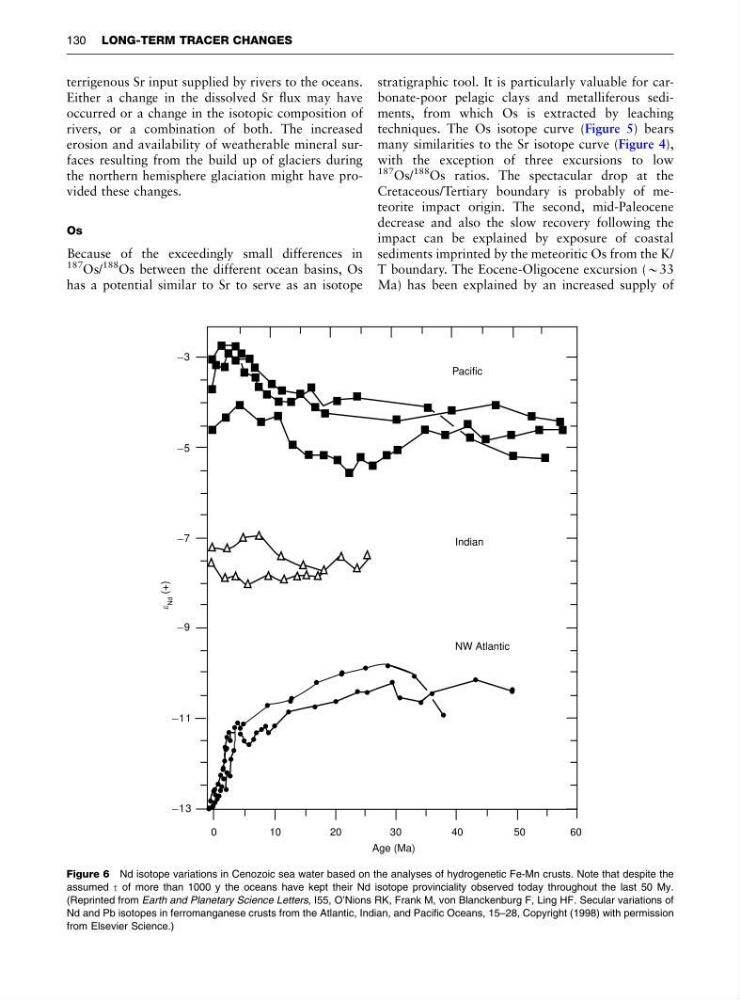
Figure 6 Nd isotope variations in Cenozoic sea water based on the analyses of hydrogenetic Fe-Mn crusts. Note that despite the
assumed t of more than 1000 y the oceans have kept their Nd isotope provinciality observed today throughout the last 50 My.
(Reprinted from Earth and Planetary Science Letters, I55, O’Nions RK, Frank M, von Blanckenburg F, Ling HF. Secular variations of
Nd and Pb isotopes in ferromanganese crusts from the Atlantic, Indian, and Pacific Oceans, 15–28, Copyright (1998) with permission
from Elsevier Science.)
130 LONG-TERM TRACER CHANGES
Either a change in the dissolved Sr flux may have
occurred or a change in the isotopic composition of
rivers, or a combination of both. The increased
erosion and availability of weatherable mineral surfaces resulting from the build up of glaciers during
the northern hemisphere glaciation might have provided these changes.
Os
Because of the exceedingly small differences in
187 Os/
188
Os between the different ocean basins, Os
has a potential similar to Sr to serve as an isotope
stratigraphic tool. It is particularly valuable for carbonate-poor pelagic clays and metalliferous sediments, from which Os is extracted by leaching
techniques. The Os isotope curve (Figure 5) bears
many similarities to the Sr isotope curve (Figure 4),
with the exception of three excursions to low
187 Os/
188 Os ratios. The spectacular drop at the
Cretaceous/Tertiary boundary is probably of meteorite impact origin. The second, mid-Paleocene
decrease and also the slow recovery following the
impact can be explained by exposure of coastal
sediments imprinted by the meteoritic Os from the K/
T boundary. The Eocene-Oligocene excursion (B33
Ma) has been explained by an increased supply of
Age (Ma)
Nd
(+)
Pacific
_ 3
_ 5
_ 7
_ 9
_ 11
_ 13
0
1 0
2 0
3 0
4 0
5 0
6 0
Indian
NW Atlantic
Figure 6 Nd isotope variations in Cenozoic sea water based on the analyses of hydrogenetic Fe-Mn crusts. Note that despite the
assumed t of more than 1000 y the oceans have kept their Nd isotope provinciality observed today throughout the last 50 My.
(Reprinted from Earth and Planetary Science Letters, I55, O’Nions RK, Frank M, von Blanckenburg F, Ling HF. Secular variations of
Nd and Pb isotopes in ferromanganese crusts from the Atlantic, Indian, and Pacific Oceans, 15–28, Copyright (1998) with permission
from Elsevier Science.)
130 LONG-TERM TRACER CHANGES