

addition of iron. Whether this is a competitive response to added iron or a function of phytoplankton
biomass and grazing is not yet well understood.
However, this is an important natural mechanism for
reducing the inorganic scavenging of iron from the
surface waters and increasing iron availability to
phytoplankton. More recent studies have considerably advanced our understanding of these ligands,
their distribution and their role in ocean ecosystems.
Carbon Flux
It is the imbalance in the community structure that
gives rise to the geochemical signal. Whereas iron
stimulation of the smaller members of the community may result in chemical signatures such as an
increased production of beta-dimethylsulfonioproprionate (DMSP), it is the stimulation of the larger
producers that decouples the large cell producers
from grazing and results in a net uptake and export
of nitrate, carbon dioxide, and silicate.
The extent to which this imbalance results in carbon flux, however, has yet to be adequately described.
The inability to quantify carbon export has primarily
been a problem of experimental scale. Even though
mesoscale experiments have, for the first time, given
us the ability to address the effect of iron on communities, the products of surface water processes and
the effects on the midwater column have been difficult
to track. For instance, in the IronEx II experiment, a
time-series of the enriched patch was diluted by 40%
per day. The dilution was primarily in a lateral
(horizontal/isopycnal) dimension. Although some
correction for lateral dilution can be made, our ability
to quantify carbon export is dependent upon the
measurement of a signal in waters below the mixed
layer or from an uneroded enriched patch. Current
data from the equatorial Pacific showed that the IronEx II experiment advected over six patch diameters
per day. This means that at no time during the
experiment were the products of increased export
reflected in the waters below the enriched area.
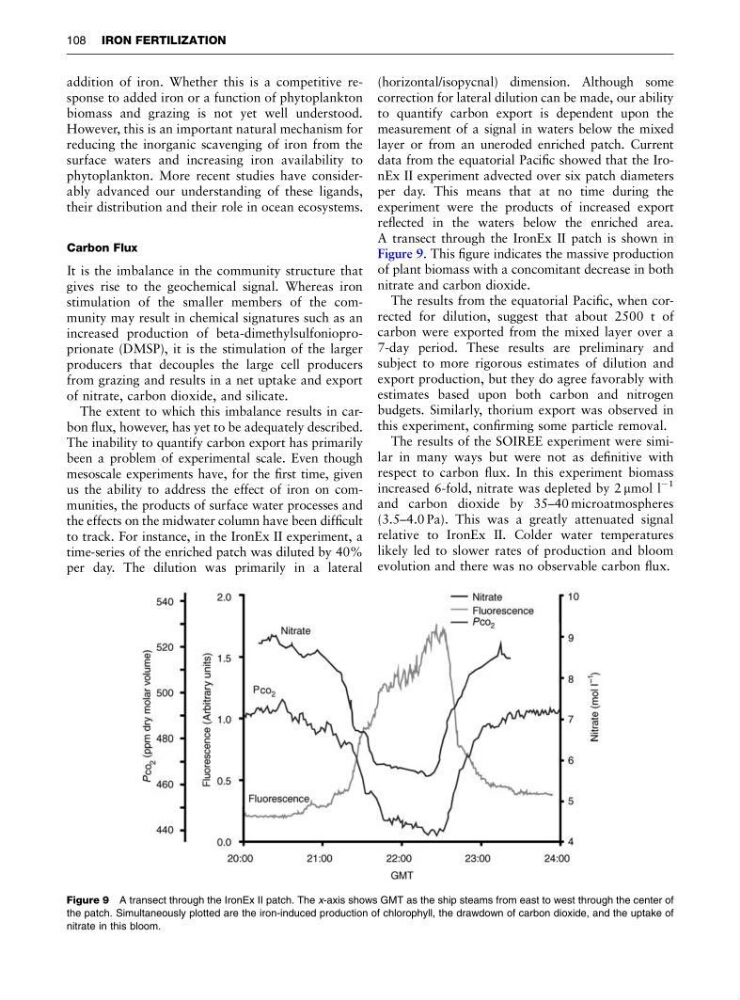
A transect through the IronEx II patch is shown in
Figure 9. This figure indicates the massive production
of plant biomass with a concomitant decrease in both
nitrate and carbon dioxide.
The results from the equatorial Pacific, when corrected for dilution, suggest that about 2500 t of
carbon were exported from the mixed layer over a
7-day period. These results are preliminary and
subject to more rigorous estimates of dilution and
export production, but they do agree favorably with
estimates based upon both carbon and nitrogen
budgets. Similarly, thorium export was observed in
this experiment, confirming some particle removal.
The results of the SOIREE experiment were similar in many ways but were not as definitive with
respect to carbon flux. In this experiment biomass
increased 6-fold, nitrate was depleted by 2 mmol l
À1
and carbon dioxide by 35–40 microatmospheres
(3.5–4.0 Pa). This was a greatly attenuated signal
relative to IronEx II. Colder water temperatures
likely led to slower rates of production and bloom
evolution and there was no observable carbon flux.
Figure 9 A transect through the IronEx II patch. The x-axis shows GMT as the ship steams from east to west through the center of
the patch. Simultaneously plotted are the iron-induced production of chlorophyll, the drawdown of carbon dioxide, and the uptake of
nitrate in this bloom.
108 IRON FERTILIZATION
biomass and grazing is not yet well understood.
However, this is an important natural mechanism for
reducing the inorganic scavenging of iron from the
surface waters and increasing iron availability to
phytoplankton. More recent studies have considerably advanced our understanding of these ligands,
their distribution and their role in ocean ecosystems.
Carbon Flux
It is the imbalance in the community structure that
gives rise to the geochemical signal. Whereas iron
stimulation of the smaller members of the community may result in chemical signatures such as an
increased production of beta-dimethylsulfonioproprionate (DMSP), it is the stimulation of the larger
producers that decouples the large cell producers
from grazing and results in a net uptake and export
of nitrate, carbon dioxide, and silicate.
The extent to which this imbalance results in carbon flux, however, has yet to be adequately described.
The inability to quantify carbon export has primarily
been a problem of experimental scale. Even though
mesoscale experiments have, for the first time, given
us the ability to address the effect of iron on communities, the products of surface water processes and
the effects on the midwater column have been difficult
to track. For instance, in the IronEx II experiment, a
time-series of the enriched patch was diluted by 40%
per day. The dilution was primarily in a lateral
(horizontal/isopycnal) dimension. Although some
correction for lateral dilution can be made, our ability
to quantify carbon export is dependent upon the
measurement of a signal in waters below the mixed
layer or from an uneroded enriched patch. Current
data from the equatorial Pacific showed that the IronEx II experiment advected over six patch diameters
per day. This means that at no time during the
experiment were the products of increased export
reflected in the waters below the enriched area.
A transect through the IronEx II patch is shown in
Figure 9. This figure indicates the massive production
of plant biomass with a concomitant decrease in both
nitrate and carbon dioxide.
The results from the equatorial Pacific, when corrected for dilution, suggest that about 2500 t of
carbon were exported from the mixed layer over a
7-day period. These results are preliminary and
subject to more rigorous estimates of dilution and
export production, but they do agree favorably with
estimates based upon both carbon and nitrogen
budgets. Similarly, thorium export was observed in
this experiment, confirming some particle removal.
The results of the SOIREE experiment were similar in many ways but were not as definitive with
respect to carbon flux. In this experiment biomass
increased 6-fold, nitrate was depleted by 2 mmol l
À1
and carbon dioxide by 35–40 microatmospheres
(3.5–4.0 Pa). This was a greatly attenuated signal
relative to IronEx II. Colder water temperatures
likely led to slower rates of production and bloom
evolution and there was no observable carbon flux.
Figure 9 A transect through the IronEx II patch. The x-axis shows GMT as the ship steams from east to west through the center of
the patch. Simultaneously plotted are the iron-induced production of chlorophyll, the drawdown of carbon dioxide, and the uptake of
nitrate in this bloom.
108 IRON FERTILIZATION