

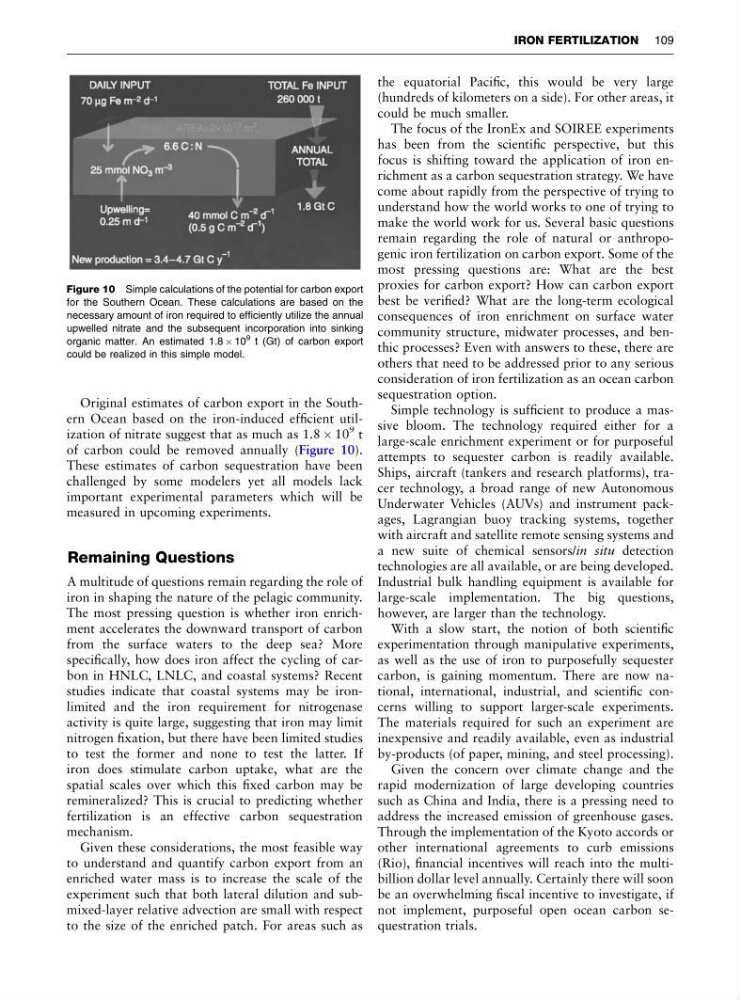
Original estimates of carbon export in the Southern Ocean based on the iron-induced efficient utilization of nitrate suggest that as much as 1.8 Â 10
9 t
of carbon could be removed annually (Figure 10).
These estimates of carbon sequestration have been
challenged by some modelers yet all models lack
important experimental parameters which will be
measured in upcoming experiments.
Remaining Questions
A multitude of questions remain regarding the role of
iron in shaping the nature of the pelagic community.
The most pressing question is whether iron enrichment accelerates the downward transport of carbon
from the surface waters to the deep sea? More
specifically, how does iron affect the cycling of carbon in HNLC, LNLC, and coastal systems? Recent
studies indicate that coastal systems may be ironlimited and the iron requirement for nitrogenase
activity is quite large, suggesting that iron may limit
nitrogen fixation, but there have been limited studies
to test the former and none to test the latter. If
iron does stimulate carbon uptake, what are the
spatial scales over which this fixed carbon may be
remineralized? This is crucial to predicting whether
fertilization is an effective carbon sequestration
mechanism.
Given these considerations, the most feasible way
to understand and quantify carbon export from an
enriched water mass is to increase the scale of the
experiment such that both lateral dilution and submixed-layer relative advection are small with respect
to the size of the enriched patch. For areas such as
the equatorial Pacific, this would be very large
(hundreds of kilometers on a side). For other areas, it
could be much smaller.
The focus of the IronEx and SOIREE experiments
has been from the scientific perspective, but this
focus is shifting toward the application of iron enrichment as a carbon sequestration strategy. We have
come about rapidly from the perspective of trying to
understand how the world works to one of trying to
make the world work for us. Several basic questions
remain regarding the role of natural or anthropogenic iron fertilization on carbon export. Some of the
most pressing questions are: What are the best
proxies for carbon export? How can carbon export
best be verified? What are the long-term ecological
consequences of iron enrichment on surface water
community structure, midwater processes, and benthic processes? Even with answers to these, there are
others that need to be addressed prior to any serious
consideration of iron fertilization as an ocean carbon
sequestration option.
Simple technology is sufficient to produce a massive bloom. The technology required either for a
large-scale enrichment experiment or for purposeful
attempts to sequester carbon is readily available.
Ships, aircraft (tankers and research platforms), tracer technology, a broad range of new Autonomous
Underwater Vehicles (AUVs) and instrument packages, Lagrangian buoy tracking systems, together
with aircraft and satellite remote sensing systems and
a new suite of chemical sensors/in situ detection
technologies are all available, or are being developed.
Industrial bulk handling equipment is available for
large-scale implementation. The big questions,
however, are larger than the technology.
With a slow start, the notion of both scientific
experimentation through manipulative experiments,
as well as the use of iron to purposefully sequester
carbon, is gaining momentum. There are now national, international, industrial, and scientific concerns willing to support larger-scale experiments.
The materials required for such an experiment are
inexpensive and readily available, even as industrial
by-products (of paper, mining, and steel processing).
Given the concern over climate change and the
rapid modernization of large developing countries
such as China and India, there is a pressing need to
address the increased emission of greenhouse gases.
Through the implementation of the Kyoto accords or
other international agreements to curb emissions
(Rio), financial incentives will reach into the multibillion dollar level annually. Certainly there will soon
be an overwhelming fiscal incentive to investigate, if
not implement, purposeful open ocean carbon sequestration trials.
Figure 10 Simple calculations of the potential for carbon export
for the Southern Ocean. These calculations are based on the
necessary amount of iron required to efficiently utilize the annual
upwelled nitrate and the subsequent incorporation into sinking
organic matter. An estimated 1.8 Â 10
9 t (Gt) of carbon export
could be realized in this simple model.
IRON FERTILIZATION 109
9 t
of carbon could be removed annually (Figure 10).
These estimates of carbon sequestration have been
challenged by some modelers yet all models lack
important experimental parameters which will be
measured in upcoming experiments.
Remaining Questions
A multitude of questions remain regarding the role of
iron in shaping the nature of the pelagic community.
The most pressing question is whether iron enrichment accelerates the downward transport of carbon
from the surface waters to the deep sea? More
specifically, how does iron affect the cycling of carbon in HNLC, LNLC, and coastal systems? Recent
studies indicate that coastal systems may be ironlimited and the iron requirement for nitrogenase
activity is quite large, suggesting that iron may limit
nitrogen fixation, but there have been limited studies
to test the former and none to test the latter. If
iron does stimulate carbon uptake, what are the
spatial scales over which this fixed carbon may be
remineralized? This is crucial to predicting whether
fertilization is an effective carbon sequestration
mechanism.
Given these considerations, the most feasible way
to understand and quantify carbon export from an
enriched water mass is to increase the scale of the
experiment such that both lateral dilution and submixed-layer relative advection are small with respect
to the size of the enriched patch. For areas such as
the equatorial Pacific, this would be very large
(hundreds of kilometers on a side). For other areas, it
could be much smaller.
The focus of the IronEx and SOIREE experiments
has been from the scientific perspective, but this
focus is shifting toward the application of iron enrichment as a carbon sequestration strategy. We have
come about rapidly from the perspective of trying to
understand how the world works to one of trying to
make the world work for us. Several basic questions
remain regarding the role of natural or anthropogenic iron fertilization on carbon export. Some of the
most pressing questions are: What are the best
proxies for carbon export? How can carbon export
best be verified? What are the long-term ecological
consequences of iron enrichment on surface water
community structure, midwater processes, and benthic processes? Even with answers to these, there are
others that need to be addressed prior to any serious
consideration of iron fertilization as an ocean carbon
sequestration option.
Simple technology is sufficient to produce a massive bloom. The technology required either for a
large-scale enrichment experiment or for purposeful
attempts to sequester carbon is readily available.
Ships, aircraft (tankers and research platforms), tracer technology, a broad range of new Autonomous
Underwater Vehicles (AUVs) and instrument packages, Lagrangian buoy tracking systems, together
with aircraft and satellite remote sensing systems and
a new suite of chemical sensors/in situ detection
technologies are all available, or are being developed.
Industrial bulk handling equipment is available for
large-scale implementation. The big questions,
however, are larger than the technology.
With a slow start, the notion of both scientific
experimentation through manipulative experiments,
as well as the use of iron to purposefully sequester
carbon, is gaining momentum. There are now national, international, industrial, and scientific concerns willing to support larger-scale experiments.
The materials required for such an experiment are
inexpensive and readily available, even as industrial
by-products (of paper, mining, and steel processing).
Given the concern over climate change and the
rapid modernization of large developing countries
such as China and India, there is a pressing need to
address the increased emission of greenhouse gases.
Through the implementation of the Kyoto accords or
other international agreements to curb emissions
(Rio), financial incentives will reach into the multibillion dollar level annually. Certainly there will soon
be an overwhelming fiscal incentive to investigate, if
not implement, purposeful open ocean carbon sequestration trials.
Figure 10 Simple calculations of the potential for carbon export
for the Southern Ocean. These calculations are based on the
necessary amount of iron required to efficiently utilize the annual
upwelled nitrate and the subsequent incorporation into sinking
organic matter. An estimated 1.8 Â 10
9 t (Gt) of carbon export
could be realized in this simple model.
IRON FERTILIZATION 109