

oceanographic experiments of our times and have
led to a profound and new understanding of ocean
systems.
Open Ocean Iron Enrichment
The question of iron limitation was brought into
sharp scientific focus with a series of public lectures,
reports by the US National Research Council,
papers, special publications, and popular articles
between 1988 and 1991. What was resolved was the
need to perform an open ocean enrichment experiment in order to definitively test the hypothesis that
iron limits phytoplankton growth and nutrient and
carbon dioxide uptake in HNLC regions. Such an
experiment posed severe logistical challenges and
had never been conducted.
Experimental Strategy
The mechanics of producing an iron-enriched experimental patch and following it over time was
developed in four release experiments in the equatorial Pacific (IronEx I and II) and more recently in
the Southern Ocean (SOIREE). At this writing, a
similar strategy is being employed in the Caruso
experiments now underway in the Atlantic sector of
the Southern Ocean. All of these strategies were developed to address certain scientific questions and
were not designed as preliminary to any geoengineering effort.
Form of Iron
All experiments to date have involved the injection
of an iron sulfate solution into the ship’s wake to
achieve rapid dilution and dispersion throughout the
mixed layer (Figure 6). The rationale for using ferrous sulfate involved the following considerations:
(1) ferrous sulfate is the most likely form of iron to
enter the oceans via atmospheric deposition; (2) it is
readily soluble (initially); (3) it is available in a
relatively pure form so as to reduce the introduction
of other potentially bioactive trace metals; and (4) its
counterion (sulfate) is ubiquitous in sea water and
not likely to produce confounding effects. Although
mixing models indicate that Fe(II) carbonate may
reach insoluble levels in the ship’s wake, rapid dilution reduces this possibility.
New forms of iron are now being considered by
those who would seek to reduce the need for subsequent infusions. Such forms could include iron
lignosite, which would increase the solubility and
residence time of iron in the surface waters. Since
this is a chelated form of iron, problems of rapid
precipitation are reduced. In addition, iron lignosulfonate is about 15% Fe by weight, making it a
space-efficient form of iron to transport. As yet untested is the extent to which such a compound would
reduce the need for re-infusion.
Although solid forms of iron have been proposed
(slow-release iron pellets; finely milled magnetite or
iron ores), the ability to trace the enriched area with
an inert tracer has required that the form of iron
added and the tracer both be in the dissolved form.
Inert Tracer
Concurrent with the injection of iron is the injection
of the inert chemical tracer sulfur hexafluoride (SF 6 ).
By presaturating a tank of sea water with SF 6 and
employing an expandable displacement bladder, a
constant molar injection ratio of Fe : SF 6 can be
achieved (Figure 6). In this way, both conservative
and nonconservative removal of iron can be quantified. Sulfur hexafluoride traces the physical properties of the enriched patch; the relatively rapid
shipboard detection of SF 6 can be used to track and
0
50
100
150 200 250 300
0
50
100 150 200 250 300
O 2
Si
Depth (km)
Si (μmol kg
–1 )
0.0
0.5
1.0
1.5
2.0
2.5
3.0
3.5
4.0
0
10
20
30 40
50
60
70
Fe NO
0.0 0.2 0.4 0.6 0.8 1.0 1.2 1.4
Fe (nmol kg
–1
)
3
O 2 (μmol kg
–1 )
NO 3
– (μmol kg
–1
)
–
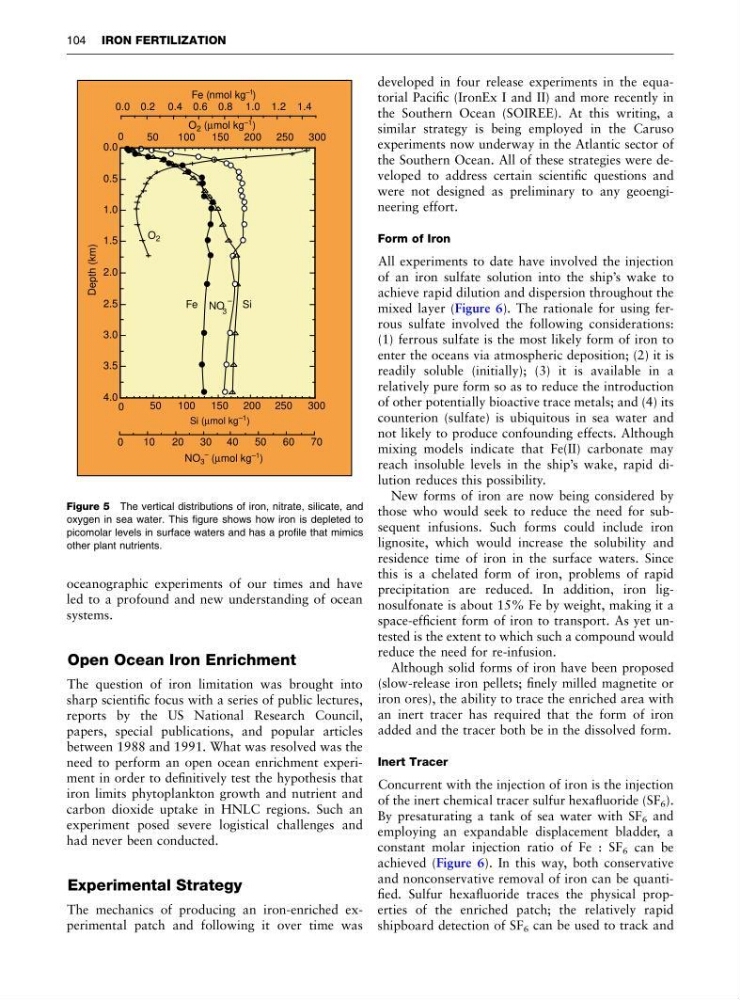
Figure 5 The vertical distributions of iron, nitrate, silicate, and
oxygen in sea water. This figure shows how iron is depleted to
picomolar levels in surface waters and has a profile that mimics
other plant nutrients.
104 IRON FERTILIZATION
led to a profound and new understanding of ocean
systems.
Open Ocean Iron Enrichment
The question of iron limitation was brought into
sharp scientific focus with a series of public lectures,
reports by the US National Research Council,
papers, special publications, and popular articles
between 1988 and 1991. What was resolved was the
need to perform an open ocean enrichment experiment in order to definitively test the hypothesis that
iron limits phytoplankton growth and nutrient and
carbon dioxide uptake in HNLC regions. Such an
experiment posed severe logistical challenges and
had never been conducted.
Experimental Strategy
The mechanics of producing an iron-enriched experimental patch and following it over time was
developed in four release experiments in the equatorial Pacific (IronEx I and II) and more recently in
the Southern Ocean (SOIREE). At this writing, a
similar strategy is being employed in the Caruso
experiments now underway in the Atlantic sector of
the Southern Ocean. All of these strategies were developed to address certain scientific questions and
were not designed as preliminary to any geoengineering effort.
Form of Iron
All experiments to date have involved the injection
of an iron sulfate solution into the ship’s wake to
achieve rapid dilution and dispersion throughout the
mixed layer (Figure 6). The rationale for using ferrous sulfate involved the following considerations:
(1) ferrous sulfate is the most likely form of iron to
enter the oceans via atmospheric deposition; (2) it is
readily soluble (initially); (3) it is available in a
relatively pure form so as to reduce the introduction
of other potentially bioactive trace metals; and (4) its
counterion (sulfate) is ubiquitous in sea water and
not likely to produce confounding effects. Although
mixing models indicate that Fe(II) carbonate may
reach insoluble levels in the ship’s wake, rapid dilution reduces this possibility.
New forms of iron are now being considered by
those who would seek to reduce the need for subsequent infusions. Such forms could include iron
lignosite, which would increase the solubility and
residence time of iron in the surface waters. Since
this is a chelated form of iron, problems of rapid
precipitation are reduced. In addition, iron lignosulfonate is about 15% Fe by weight, making it a
space-efficient form of iron to transport. As yet untested is the extent to which such a compound would
reduce the need for re-infusion.
Although solid forms of iron have been proposed
(slow-release iron pellets; finely milled magnetite or
iron ores), the ability to trace the enriched area with
an inert tracer has required that the form of iron
added and the tracer both be in the dissolved form.
Inert Tracer
Concurrent with the injection of iron is the injection
of the inert chemical tracer sulfur hexafluoride (SF 6 ).
By presaturating a tank of sea water with SF 6 and
employing an expandable displacement bladder, a
constant molar injection ratio of Fe : SF 6 can be
achieved (Figure 6). In this way, both conservative
and nonconservative removal of iron can be quantified. Sulfur hexafluoride traces the physical properties of the enriched patch; the relatively rapid
shipboard detection of SF 6 can be used to track and
0
50
100
150 200 250 300
0
50
100 150 200 250 300
O 2
Si
Depth (km)
Si (μmol kg
–1 )
0.0
0.5
1.0
1.5
2.0
2.5
3.0
3.5
4.0
0
10
20
30 40
50
60
70
Fe NO
0.0 0.2 0.4 0.6 0.8 1.0 1.2 1.4
Fe (nmol kg
–1
)
3
O 2 (μmol kg
–1 )
NO 3
– (μmol kg
–1
)
–
Figure 5 The vertical distributions of iron, nitrate, silicate, and
oxygen in sea water. This figure shows how iron is depleted to
picomolar levels in surface waters and has a profile that mimics
other plant nutrients.
104 IRON FERTILIZATION