

growth rates in the other two systems will deplete
any residual nitrate and sink out of the system. The
processes that give rise to these regimes have been the
subject of some debate over the last few years and are
of fundamental importance relative to carbon export
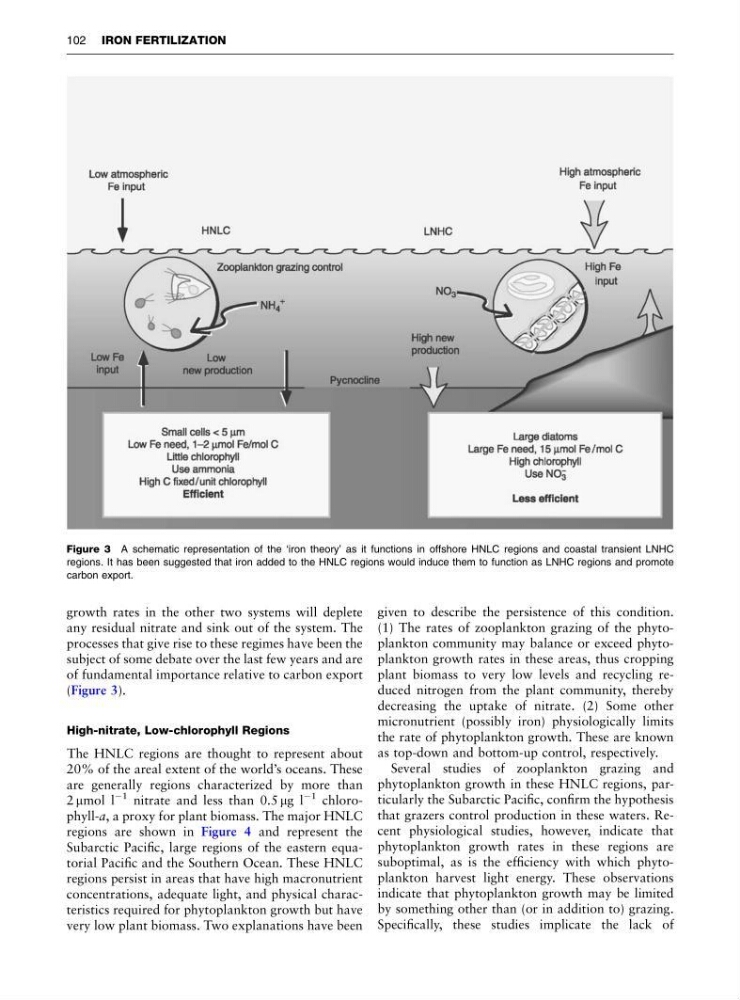
(Figure 3).
High-nitrate, Low-chlorophyll Regions
The HNLC regions are thought to represent about
20% of the areal extent of the world’s oceans. These
are generally regions characterized by more than
2 mmol l
À1 nitrate and less than 0.5 mg l
À1 chlorophyll-a, a proxy for plant biomass. The major HNLC
regions are shown in Figure 4 and represent the
Subarctic Pacific, large regions of the eastern equatorial Pacific and the Southern Ocean. These HNLC
regions persist in areas that have high macronutrient
concentrations, adequate light, and physical characteristics required for phytoplankton growth but have
very low plant biomass. Two explanations have been
given to describe the persistence of this condition.
(1) The rates of zooplankton grazing of the phytoplankton community may balance or exceed phytoplankton growth rates in these areas, thus cropping
plant biomass to very low levels and recycling reduced nitrogen from the plant community, thereby
decreasing the uptake of nitrate. (2) Some other
micronutrient (possibly iron) physiologically limits
the rate of phytoplankton growth. These are known
as top-down and bottom-up control, respectively.
Several studies of zooplankton grazing and
phytoplankton growth in these HNLC regions, particularly the Subarctic Pacific, confirm the hypothesis
that grazers control production in these waters. Recent physiological studies, however, indicate that
phytoplankton growth rates in these regions are
suboptimal, as is the efficiency with which phytoplankton harvest light energy. These observations
indicate that phytoplankton growth may be limited
by something other than (or in addition to) grazing.
Specifically, these studies implicate the lack of
Figure 3 A schematic representation of the ‘iron theory’ as it functions in offshore HNLC regions and coastal transient LNHC
regions. It has been suggested that iron added to the HNLC regions would induce them to function as LNHC regions and promote
carbon export.
102 IRON FERTILIZATION
any residual nitrate and sink out of the system. The
processes that give rise to these regimes have been the
subject of some debate over the last few years and are
of fundamental importance relative to carbon export
(Figure 3).
High-nitrate, Low-chlorophyll Regions
The HNLC regions are thought to represent about
20% of the areal extent of the world’s oceans. These
are generally regions characterized by more than
2 mmol l
À1 nitrate and less than 0.5 mg l
À1 chlorophyll-a, a proxy for plant biomass. The major HNLC
regions are shown in Figure 4 and represent the
Subarctic Pacific, large regions of the eastern equatorial Pacific and the Southern Ocean. These HNLC
regions persist in areas that have high macronutrient
concentrations, adequate light, and physical characteristics required for phytoplankton growth but have
very low plant biomass. Two explanations have been
given to describe the persistence of this condition.
(1) The rates of zooplankton grazing of the phytoplankton community may balance or exceed phytoplankton growth rates in these areas, thus cropping
plant biomass to very low levels and recycling reduced nitrogen from the plant community, thereby
decreasing the uptake of nitrate. (2) Some other
micronutrient (possibly iron) physiologically limits
the rate of phytoplankton growth. These are known
as top-down and bottom-up control, respectively.
Several studies of zooplankton grazing and
phytoplankton growth in these HNLC regions, particularly the Subarctic Pacific, confirm the hypothesis
that grazers control production in these waters. Recent physiological studies, however, indicate that
phytoplankton growth rates in these regions are
suboptimal, as is the efficiency with which phytoplankton harvest light energy. These observations
indicate that phytoplankton growth may be limited
by something other than (or in addition to) grazing.
Specifically, these studies implicate the lack of
Figure 3 A schematic representation of the ‘iron theory’ as it functions in offshore HNLC regions and coastal transient LNHC
regions. It has been suggested that iron added to the HNLC regions would induce them to function as LNHC regions and promote
carbon export.
102 IRON FERTILIZATION