

regions of divergent surface water flow, reaching
average values of 15 to 30 or greater. Thus, those
regions of high nutrient supply or persistent high
nutrient concentrations are thought to be most important in terms of carbon removal.
Nitrogen versus Phosphorus
Limitation
Although both nitrogen and phosphorus are required
at nearly constant ratios characteristic of deep water,
nitrogen has generally been thought to be the limiting nutrient in sea water rather than phosphorus.
This idea has been based on two observations:
selective enrichment experiments and surface
water distributions. When ammonia and phosphate
are added to sea water in grow-out experiments,
phytoplankton growth increases with the ammonia
addition and not with the phosphate addition, thus
indicating that reduced nitrogen and not phosphorus
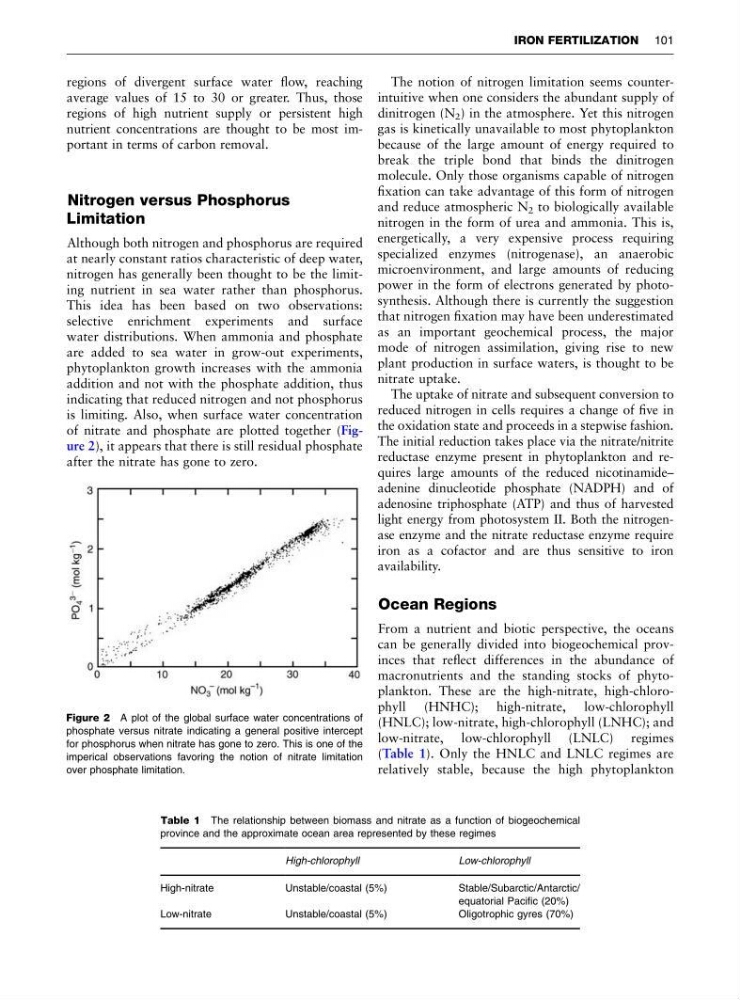
is limiting. Also, when surface water concentration
of nitrate and phosphate are plotted together (Figure 2), it appears that there is still residual phosphate
after the nitrate has gone to zero.
The notion of nitrogen limitation seems counterintuitive when one considers the abundant supply of
dinitrogen (N 2 ) in the atmosphere. Yet this nitrogen
gas is kinetically unavailable to most phytoplankton
because of the large amount of energy required to
break the triple bond that binds the dinitrogen
molecule. Only those organisms capable of nitrogen
fixation can take advantage of this form of nitrogen
and reduce atmospheric N 2 to biologically available
nitrogen in the form of urea and ammonia. This is,
energetically, a very expensive process requiring
specialized enzymes (nitrogenase), an anaerobic
microenvironment, and large amounts of reducing
power in the form of electrons generated by photosynthesis. Although there is currently the suggestion
that nitrogen fixation may have been underestimated
as an important geochemical process, the major
mode of nitrogen assimilation, giving rise to new
plant production in surface waters, is thought to be
nitrate uptake.
The uptake of nitrate and subsequent conversion to
reduced nitrogen in cells requires a change of five in
the oxidation state and proceeds in a stepwise fashion.
The initial reduction takes place via the nitrate/nitrite
reductase enzyme present in phytoplankton and requires large amounts of the reduced nicotinamide–
adenine dinucleotide phosphate (NADPH) and of
adenosine triphosphate (ATP) and thus of harvested
light energy from photosystem II. Both the nitrogenase enzyme and the nitrate reductase enzyme require
iron as a cofactor and are thus sensitive to iron
availability.
Ocean Regions
From a nutrient and biotic perspective, the oceans
can be generally divided into biogeochemical provinces that reflect differences in the abundance of
macronutrients and the standing stocks of phytoplankton. These are the high-nitrate, high-chlorophyll (HNHC); high-nitrate, low-chlorophyll
(HNLC); low-nitrate, high-chlorophyll (LNHC); and
low-nitrate, low-chlorophyll (LNLC) regimes
(Table 1). Only the HNLC and LNLC regimes are
relatively stable, because the high phytoplankton
Figure 2 A plot of the global surface water concentrations of
phosphate versus nitrate indicating a general positive intercept
for phosphorus when nitrate has gone to zero. This is one of the
imperical observations favoring the notion of nitrate limitation
over phosphate limitation.
Table 1 The relationship between biomass and nitrate as a function of biogeochemical
province and the approximate ocean area represented by these regimes
High-chlorophyll
Low-chlorophyll
High-nitrate
Unstable/coastal (5%)
Stable/Subarctic/Antarctic/
equatorial Pacific (20%)
Low-nitrate
Unstable/coastal (5%)
Oligotrophic gyres (70%)
IRON FERTILIZATION 101
average values of 15 to 30 or greater. Thus, those
regions of high nutrient supply or persistent high
nutrient concentrations are thought to be most important in terms of carbon removal.
Nitrogen versus Phosphorus
Limitation
Although both nitrogen and phosphorus are required
at nearly constant ratios characteristic of deep water,
nitrogen has generally been thought to be the limiting nutrient in sea water rather than phosphorus.
This idea has been based on two observations:
selective enrichment experiments and surface
water distributions. When ammonia and phosphate
are added to sea water in grow-out experiments,
phytoplankton growth increases with the ammonia
addition and not with the phosphate addition, thus
indicating that reduced nitrogen and not phosphorus
is limiting. Also, when surface water concentration
of nitrate and phosphate are plotted together (Figure 2), it appears that there is still residual phosphate
after the nitrate has gone to zero.
The notion of nitrogen limitation seems counterintuitive when one considers the abundant supply of
dinitrogen (N 2 ) in the atmosphere. Yet this nitrogen
gas is kinetically unavailable to most phytoplankton
because of the large amount of energy required to
break the triple bond that binds the dinitrogen
molecule. Only those organisms capable of nitrogen
fixation can take advantage of this form of nitrogen
and reduce atmospheric N 2 to biologically available
nitrogen in the form of urea and ammonia. This is,
energetically, a very expensive process requiring
specialized enzymes (nitrogenase), an anaerobic
microenvironment, and large amounts of reducing
power in the form of electrons generated by photosynthesis. Although there is currently the suggestion
that nitrogen fixation may have been underestimated
as an important geochemical process, the major
mode of nitrogen assimilation, giving rise to new
plant production in surface waters, is thought to be
nitrate uptake.
The uptake of nitrate and subsequent conversion to
reduced nitrogen in cells requires a change of five in
the oxidation state and proceeds in a stepwise fashion.
The initial reduction takes place via the nitrate/nitrite
reductase enzyme present in phytoplankton and requires large amounts of the reduced nicotinamide–
adenine dinucleotide phosphate (NADPH) and of
adenosine triphosphate (ATP) and thus of harvested
light energy from photosystem II. Both the nitrogenase enzyme and the nitrate reductase enzyme require
iron as a cofactor and are thus sensitive to iron
availability.
Ocean Regions
From a nutrient and biotic perspective, the oceans
can be generally divided into biogeochemical provinces that reflect differences in the abundance of
macronutrients and the standing stocks of phytoplankton. These are the high-nitrate, high-chlorophyll (HNHC); high-nitrate, low-chlorophyll
(HNLC); low-nitrate, high-chlorophyll (LNHC); and
low-nitrate, low-chlorophyll (LNLC) regimes
(Table 1). Only the HNLC and LNLC regimes are
relatively stable, because the high phytoplankton
Figure 2 A plot of the global surface water concentrations of
phosphate versus nitrate indicating a general positive intercept
for phosphorus when nitrate has gone to zero. This is one of the
imperical observations favoring the notion of nitrate limitation
over phosphate limitation.
Table 1 The relationship between biomass and nitrate as a function of biogeochemical
province and the approximate ocean area represented by these regimes
High-chlorophyll
Low-chlorophyll
High-nitrate
Unstable/coastal (5%)
Stable/Subarctic/Antarctic/
equatorial Pacific (20%)
Low-nitrate
Unstable/coastal (5%)
Oligotrophic gyres (70%)
IRON FERTILIZATION 101