

IRON FERTILIZATION
K. H. Coale, Moss Landing Marine Laboratories,
CA, USA
Copyright & 2001 Elsevier Ltd.
Introduction
The trace element iron has been shown to play a
critical role in nutrient utilization and phytoplankton
growth and therefore in the uptake of carbon dioxide
from the surface waters of the global ocean. Carbon
fixation in the surface waters, via phytoplankton
growth, shifts the ocean–atmosphere exchange
equilibrium for carbon dioxide. As a result, levels of
atmospheric carbon dioxide (a greenhouse gas) and
iron flux to the oceans have been linked to climate
change (glacial to interglacial transitions). These recent findings have led some to suggest that largescale iron fertilization of the world’s oceans might
therefore be a feasible strategy for controlling climate. Others speculate that such a strategy could
deleteriously alter the ocean ecosystem, and still
others have calculated that such a strategy would be
ineffective in removing sufficient carbon dioxide to
produce a sizable and rapid result. This article focuses on carbon and the major plant nutrients, nitrate, phosphate, and silicate, and describes how our
recent discovery of the role of iron in the oceans has
increased our understanding of phytoplankton
growth, nutrient cycling, and the flux of carbon from
the atmosphere to the deep sea.
Major Nutrients
Phytoplankton growth in the oceans requires many
physical, chemical, and biological factors that are
distributed inhomogenously in space and time. Because carbon, primarily in the form of the bicarbonate ion, and sulfur, as sulfate, are abundant
throughout the water column, the major plant nutrients in the ocean commonly thought to be critical
for phytoplankton growth are those that exist at the
micromolar level such as nitrate, phosphate, and
silicate. These, together with carbon and sulfur, form
the major building blocks for biomass in the sea. As
fundamental cellular constituents, they are generally
thought to be taken up and remineralized in constant
ratio to one another. This is known as the Redfield
ratio (Redfield, 1934, 1958) and can be expressed on
a molar basis relative to carbon as 106C : 16N : 1P.
Significant local variations in this uptake/regeneration relationship can be found and are a function of
the phytoplankton community and growth conditions, yet this ratio can serve as a conceptual model
for nutrient uptake and export.
The vertical distribution of the major nutrients
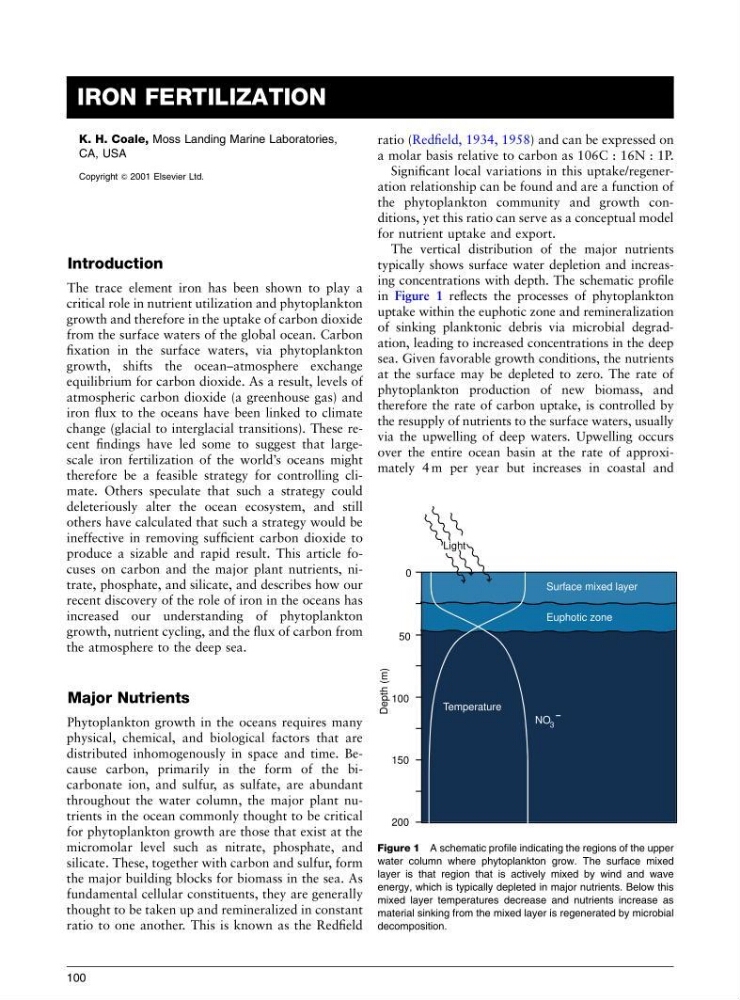
typically shows surface water depletion and increasing concentrations with depth. The schematic profile
in Figure 1 reflects the processes of phytoplankton
uptake within the euphotic zone and remineralization
of sinking planktonic debris via microbial degradation, leading to increased concentrations in the deep
sea. Given favorable growth conditions, the nutrients
at the surface may be depleted to zero. The rate of
phytoplankton production of new biomass, and
therefore the rate of carbon uptake, is controlled by
the resupply of nutrients to the surface waters, usually
via the upwelling of deep waters. Upwelling occurs
over the entire ocean basin at the rate of approximately 4 m per year but increases in coastal and
0
50
100
150
200
Depth (m)
Surface mixed layer
Euphotic zone
NO 3
Temperature
Light
–
Figure 1 A schematic profile indicating the regions of the upper
water column where phytoplankton grow. The surface mixed
layer is that region that is actively mixed by wind and wave
energy, which is typically depleted in major nutrients. Below this
mixed layer temperatures decrease and nutrients increase as
material sinking from the mixed layer is regenerated by microbial
decomposition.
100
K. H. Coale, Moss Landing Marine Laboratories,
CA, USA
Copyright & 2001 Elsevier Ltd.
Introduction
The trace element iron has been shown to play a
critical role in nutrient utilization and phytoplankton
growth and therefore in the uptake of carbon dioxide
from the surface waters of the global ocean. Carbon
fixation in the surface waters, via phytoplankton
growth, shifts the ocean–atmosphere exchange
equilibrium for carbon dioxide. As a result, levels of
atmospheric carbon dioxide (a greenhouse gas) and
iron flux to the oceans have been linked to climate
change (glacial to interglacial transitions). These recent findings have led some to suggest that largescale iron fertilization of the world’s oceans might
therefore be a feasible strategy for controlling climate. Others speculate that such a strategy could
deleteriously alter the ocean ecosystem, and still
others have calculated that such a strategy would be
ineffective in removing sufficient carbon dioxide to
produce a sizable and rapid result. This article focuses on carbon and the major plant nutrients, nitrate, phosphate, and silicate, and describes how our
recent discovery of the role of iron in the oceans has
increased our understanding of phytoplankton
growth, nutrient cycling, and the flux of carbon from
the atmosphere to the deep sea.
Major Nutrients
Phytoplankton growth in the oceans requires many
physical, chemical, and biological factors that are
distributed inhomogenously in space and time. Because carbon, primarily in the form of the bicarbonate ion, and sulfur, as sulfate, are abundant
throughout the water column, the major plant nutrients in the ocean commonly thought to be critical
for phytoplankton growth are those that exist at the
micromolar level such as nitrate, phosphate, and
silicate. These, together with carbon and sulfur, form
the major building blocks for biomass in the sea. As
fundamental cellular constituents, they are generally
thought to be taken up and remineralized in constant
ratio to one another. This is known as the Redfield
ratio (Redfield, 1934, 1958) and can be expressed on
a molar basis relative to carbon as 106C : 16N : 1P.
Significant local variations in this uptake/regeneration relationship can be found and are a function of
the phytoplankton community and growth conditions, yet this ratio can serve as a conceptual model
for nutrient uptake and export.
The vertical distribution of the major nutrients
typically shows surface water depletion and increasing concentrations with depth. The schematic profile
in Figure 1 reflects the processes of phytoplankton
uptake within the euphotic zone and remineralization
of sinking planktonic debris via microbial degradation, leading to increased concentrations in the deep
sea. Given favorable growth conditions, the nutrients
at the surface may be depleted to zero. The rate of
phytoplankton production of new biomass, and
therefore the rate of carbon uptake, is controlled by
the resupply of nutrients to the surface waters, usually
via the upwelling of deep waters. Upwelling occurs
over the entire ocean basin at the rate of approximately 4 m per year but increases in coastal and
0
50
100
150
200
Depth (m)
Surface mixed layer
Euphotic zone
NO 3
Temperature
Light
–
Figure 1 A schematic profile indicating the regions of the upper
water column where phytoplankton grow. The surface mixed
layer is that region that is actively mixed by wind and wave
energy, which is typically depleted in major nutrients. Below this
mixed layer temperatures decrease and nutrients increase as
material sinking from the mixed layer is regenerated by microbial
decomposition.
100