

tion of functional dissimilatory NO3 and NO2 reductases in Cl. butyricum SS6 (Keith,
MacFarlane and Herbert, 1982). Concurrent with the increase in cell population density
on NO 3
-
there was a marked shift in fermentation end-products (Table 1). Ammonia
grown cultures produced butyrate as the principal fermentation end-product whereas on
NO 3
-
acetate predominated. In addition to lower fatty acids substantial quantities of
ethanol were also produced as an end-product of glucose fermentation by Cl. butyricum
SS6 and this was the preferred carbon and energy source used by D. desulfuricans DT101
when grown in mixed culture.
Carbon source
N-source
15mM SO 4
2Cell density
(ml culture)" 1
Dry Weight
(mg. 1) -1
20mM lactate 7mM NH 4
+
+
3.9 x 10 8
300
20mM lactate 7mM NO 3 -
+
8.0 x 10 8
300
20mM lactate 7mM NH 4
+
-
1.0 x 10 8
113
20mM lactate 7mM NO 3 -
-
4.1 x 10 8
344
Table 2. Influence of inorganic nitrogen source on cell density of Desulfovribrio desulfuricans DT 101 grown under C-limitation in continuous culture at a dilution rate of 0.050 h -1,
25°C.
In an analagous manner data in Table 2 show that D. desulfuricans DT101 will also utilise
NO 3
-
as an alternative terminal e - acceptor to SO
4
2- and spent media analyses have shown
that NH
4
+ was the principal end-product of NO
3
-
respiration. Nitrite never accumulated
in more than trace quantities irrespective of NO
3
-
availability. Cell yields on NO
3
- were
the same as those on SO
4
2- + NH
4
+ but when NO3 and SO
4
2- were simultaneously
present cell numbers and cell yield doubled. The probable explanation for the nitrate
enhancement’ effect is that SO
4
2- grown cultures expend ATP in the formation of
adenylphosphosulphate (APS) whereas NO3' grown cultures require no energy expenditure in activating the e - acceptor.
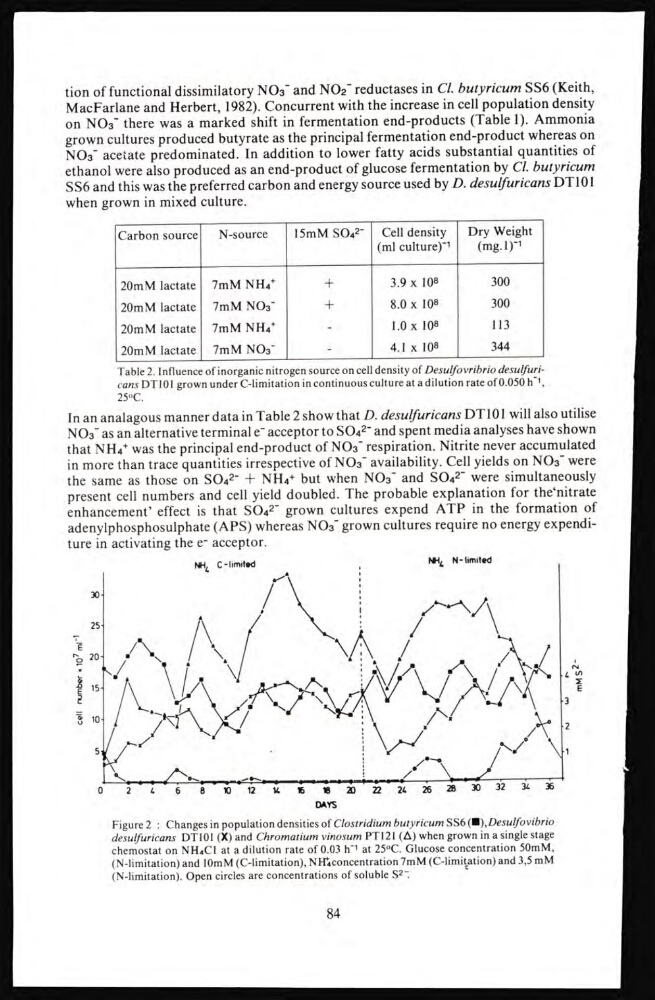
(N-limitation) and 10mM (C-limitation), NH 4
+ concentration 7mM (C-limitation) and 3,5 mM
(N-limitation). Open circles are concentrations of soluble S 2- .
84
MacFarlane and Herbert, 1982). Concurrent with the increase in cell population density
on NO 3
-
there was a marked shift in fermentation end-products (Table 1). Ammonia
grown cultures produced butyrate as the principal fermentation end-product whereas on
NO 3
-
acetate predominated. In addition to lower fatty acids substantial quantities of
ethanol were also produced as an end-product of glucose fermentation by Cl. butyricum
SS6 and this was the preferred carbon and energy source used by D. desulfuricans DT101
when grown in mixed culture.
Carbon source
N-source
15mM SO 4
2Cell density
(ml culture)" 1
Dry Weight
(mg. 1) -1
20mM lactate 7mM NH 4
+
+
3.9 x 10 8
300
20mM lactate 7mM NO 3 -
+
8.0 x 10 8
300
20mM lactate 7mM NH 4
+
-
1.0 x 10 8
113
20mM lactate 7mM NO 3 -
-
4.1 x 10 8
344
Table 2. Influence of inorganic nitrogen source on cell density of Desulfovribrio desulfuricans DT 101 grown under C-limitation in continuous culture at a dilution rate of 0.050 h -1,
25°C.
In an analagous manner data in Table 2 show that D. desulfuricans DT101 will also utilise
NO 3
-
as an alternative terminal e - acceptor to SO
4
2- and spent media analyses have shown
that NH
4
+ was the principal end-product of NO
3
-
respiration. Nitrite never accumulated
in more than trace quantities irrespective of NO
3
-
availability. Cell yields on NO
3
- were
the same as those on SO
4
2- + NH
4
+ but when NO3 and SO
4
2- were simultaneously
present cell numbers and cell yield doubled. The probable explanation for the nitrate
enhancement’ effect is that SO
4
2- grown cultures expend ATP in the formation of
adenylphosphosulphate (APS) whereas NO3' grown cultures require no energy expenditure in activating the e - acceptor.
(N-limitation) and 10mM (C-limitation), NH 4
+ concentration 7mM (C-limitation) and 3,5 mM
(N-limitation). Open circles are concentrations of soluble S 2- .
84