

Mixed culture experiments
Having determined the physiological characteristics of the individual bacteria, Keith et al.
1982 ; Keith and Herbert, 1982, experiments were performed with defined mixed cultures
of Cl. butyricum SS6/ Dv. desulfuricans DTK)l/ Chr. vinosum PT121 and Cl. butyricum
SS6/ Dv. desulfuricans DT101/ Chr. vinosum PT121 in a single stage chemostat at a
dilution rate of 0.03 h _1 and temperature of 25°C. Data presented in figure 2 show that
when NH 4
+ was the N-source Chr. vinosum PT101 predominated irrespective of limitation. Under glucose limiting conditions the free S 2- concentration remained low and was
almost undetectable whereas under NH 4
+ limitation the population of the sulphate
reducing bacterium progressively increased leading to increased levels of free S 2 and
ultimately a sharp reduction in the Chromatium population. In contrast NO3 grown
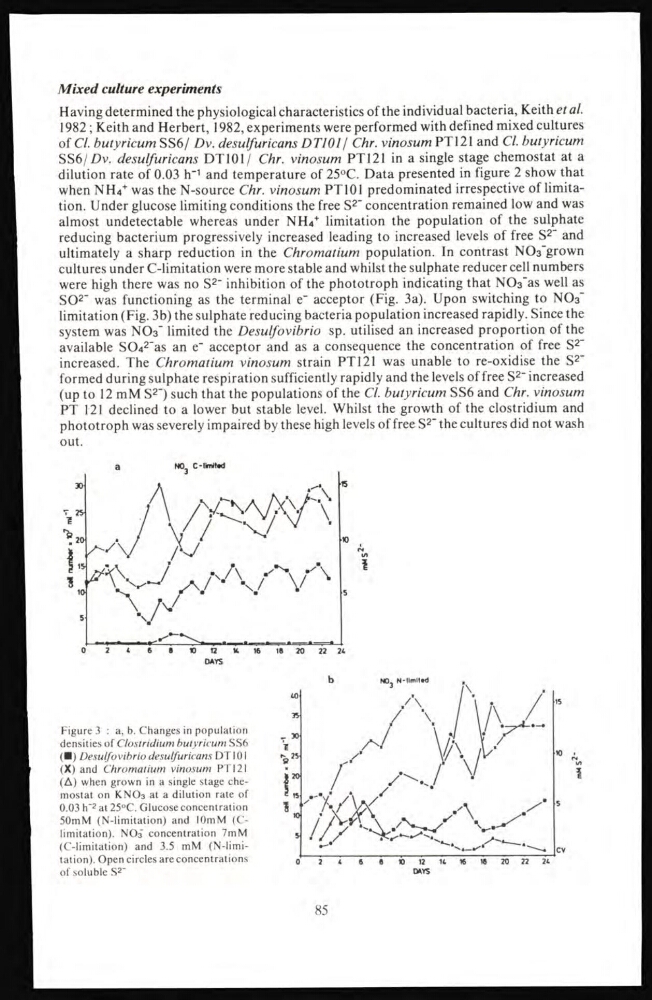
cultures under C-limitation were more stable and whilst the sulphate reducer cell numbers
were high there was no S 2 ' inhibition of the phototroph indicating that NO
3
- as well as
SO
2 " was functioning as the terminal e' acceptor (Fig. 3a). Upon switching to NO3
limitation (Fig. 3b) the sulphate reducing bacteria population increased rapidly. Since the
system was NO 3
-
limited the Desulfovibrio sp. utilised an increased proportion of the
available S0 4
2- as an e - acceptor and as a consequence the concentration of free S 2
increased. The Chromatium vinosum strain PT121 was unable to re-oxidise the S 2
formed during sulphate respiration sufficiently rapidly and the levels of free S 2 " increased
(up to 12 mM S
2 ") such that the populations of the Cl. butyricum SS6 and Chr. vinosum
PT 121 declined to a lower but stable level. Whilst the growth of the clostridium and
phototroph was severely impaired by these high levels of free S 2- the cultures did not wash
out.
Figure 3 : a, b. Changes in population
densities of Clostridium butyricum SS6
(■) Desulfovibrio desulfuricans DT 101
(X) and Chromatium vinosum PT121
(A) when grown in a single stage chemostat on KNO 3 at a dilution rate of
0.03 h" 2 at 25°C. Glucose concentration
50mM (N-limitation) and 10mM (Climitation). NO 3
- concentration 7mM
(C-limitation) and 3.5 mM (N-limitation). Open circles are concentrations
of soluble S 2 '
cv
85
Having determined the physiological characteristics of the individual bacteria, Keith et al.
1982 ; Keith and Herbert, 1982, experiments were performed with defined mixed cultures
of Cl. butyricum SS6/ Dv. desulfuricans DTK)l/ Chr. vinosum PT121 and Cl. butyricum
SS6/ Dv. desulfuricans DT101/ Chr. vinosum PT121 in a single stage chemostat at a
dilution rate of 0.03 h _1 and temperature of 25°C. Data presented in figure 2 show that
when NH 4
+ was the N-source Chr. vinosum PT101 predominated irrespective of limitation. Under glucose limiting conditions the free S 2- concentration remained low and was
almost undetectable whereas under NH 4
+ limitation the population of the sulphate
reducing bacterium progressively increased leading to increased levels of free S 2 and
ultimately a sharp reduction in the Chromatium population. In contrast NO3 grown
cultures under C-limitation were more stable and whilst the sulphate reducer cell numbers
were high there was no S 2 ' inhibition of the phototroph indicating that NO
3
- as well as
SO
2 " was functioning as the terminal e' acceptor (Fig. 3a). Upon switching to NO3
limitation (Fig. 3b) the sulphate reducing bacteria population increased rapidly. Since the
system was NO 3
-
limited the Desulfovibrio sp. utilised an increased proportion of the
available S0 4
2- as an e - acceptor and as a consequence the concentration of free S 2
increased. The Chromatium vinosum strain PT121 was unable to re-oxidise the S 2
formed during sulphate respiration sufficiently rapidly and the levels of free S 2 " increased
(up to 12 mM S
2 ") such that the populations of the Cl. butyricum SS6 and Chr. vinosum
PT 121 declined to a lower but stable level. Whilst the growth of the clostridium and
phototroph was severely impaired by these high levels of free S 2- the cultures did not wash
out.
Figure 3 : a, b. Changes in population
densities of Clostridium butyricum SS6
(■) Desulfovibrio desulfuricans DT 101
(X) and Chromatium vinosum PT121
(A) when grown in a single stage chemostat on KNO 3 at a dilution rate of
0.03 h" 2 at 25°C. Glucose concentration
50mM (N-limitation) and 10mM (Climitation). NO 3
- concentration 7mM
(C-limitation) and 3.5 mM (N-limitation). Open circles are concentrations
of soluble S 2 '
cv
85