

Enumeration of saccharolytic clostridium, sulphate reducing and phototrophic bacteria
populations
Population densities of Clostridium butyricum SS6, Desulfovibrio desulfuricans DT101
and Chromatium vinosum PT121 were determined by direct counting methods using a
Neubauer counting chamber (Cruickshank, 1965).
Growth in continuous culture
(a) Single pure cultures : -Clostridium butyricum SS6 and Desulfovibrio desulfuricans
DT101 were grown in continuous culture as described by Keith, Macfarlane and Herbert
(1982) and Keith and Herbert (1982).
(b) Mixed population studies : -Mixed population studies were carried out in a single
stage 1 litre chemostat as described by Baker (1968). Growth medium pH was maintained
at pH 7.5 using an E.I.L pH controller (E.I.L. Chertsey, Surrey) and a temperature of
25°C maintained using a thermo-circulator (Churchill Instruments, Perivale, London).
Anaerobic conditions in the culture vessel and medium reservoir were maintained by
sparging with high purity nitrogen (1.5 litre min' 1 ). The growth medium had the following
composition (g.l -1 ) : MgSO
4
. 7H2O, 0.5 ; CaCl
2
.2H
2
O, 0.08 ; K2HPO4, 0.125 ; KH2PO,
0.5 ; KCl, 0.33 ; Na 2 SO 4 , 1.0 ; FeSO
4
, 0.004 ; Na-citrate, 0.1 ; 1% w/v Fe citrate, 0.6 ml ;
vitamin B12 0.001% w/v,2 ml ; Yeast extract, 0.1 g. The concentration of the carbon
source (glucose) and nitrogen sources (KNO
3
and NH
4
Cl) were varied as required (Fig.
2 and 3).
Analysis of spent media
Spent media were analysed for NO 2
- and NH
4
+ according to the methods described by
Brown et al. (1972). Free sulphide concentrations were determined using an ion-specific
electrode (Orion Inc. Blackstone Street, Cambridge, MA 02139, U.S.A.).
RESULTS -
Growth on different nitrogen source
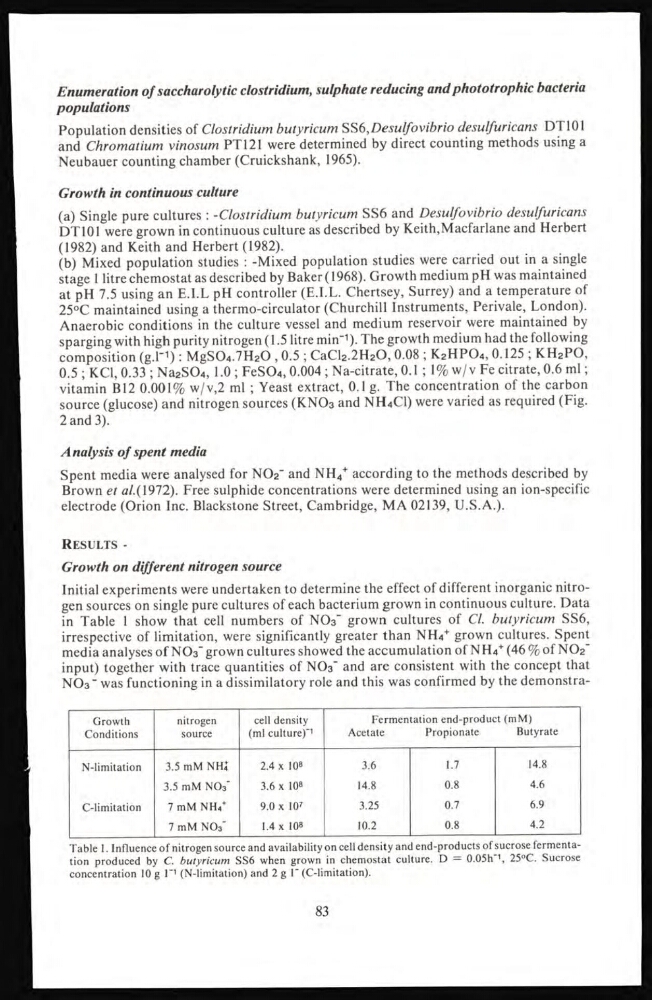
Initial experiments were undertaken to determine the effect of different inorganic nitrogen sources on single pure cultures of each bacterium grown in continuous culture. Data
in Table 1 show that cell numbers of NO 3
-
grown cultures of Cl. butyricum SS6,
irrespective of limitation, were significantly greater than NH
4
+ grown cultures. Spent
media analyses of NO3" grown cultures showed the accumulation of NH
4
+ (46 % of NO2
input) together with trace quantities of NO3' and are consistent with the concept that
NO3 ' was functioning in a dissimilatory role and this was confirmed by the demonstraGrowth
Conditions
nitrogen
source
cell density
(ml culture)" 1
Fermentation end-product (mM)
Acetate
Propionate
Butyrate
N-limitation
3.5 mM NH 4
+
2.4 x 10 8
3.6
1.7
14.8
3.5 mM NO 3
-
3.6 x 10 8
14.8
0.8
4.6
C-limitation
7 mM NH 4
+
9.0 x 10 7
3.25
0.7
6.9
7 mM NO 3 -
1.4 x 10 8
10.2
0.8
4.2
Table 1. Influence of nitrogen source and availability on cell density and end-products of sucrose fermentation produced by C. butyricum SS6 when grown in chemostat culture. D = 0.05h -1, 25°C. Sucrose
concentration 10 g 1 -1 (N-limitation) and 2 g 1 - (C-limitation).
83
populations
Population densities of Clostridium butyricum SS6, Desulfovibrio desulfuricans DT101
and Chromatium vinosum PT121 were determined by direct counting methods using a
Neubauer counting chamber (Cruickshank, 1965).
Growth in continuous culture
(a) Single pure cultures : -Clostridium butyricum SS6 and Desulfovibrio desulfuricans
DT101 were grown in continuous culture as described by Keith, Macfarlane and Herbert
(1982) and Keith and Herbert (1982).
(b) Mixed population studies : -Mixed population studies were carried out in a single
stage 1 litre chemostat as described by Baker (1968). Growth medium pH was maintained
at pH 7.5 using an E.I.L pH controller (E.I.L. Chertsey, Surrey) and a temperature of
25°C maintained using a thermo-circulator (Churchill Instruments, Perivale, London).
Anaerobic conditions in the culture vessel and medium reservoir were maintained by
sparging with high purity nitrogen (1.5 litre min' 1 ). The growth medium had the following
composition (g.l -1 ) : MgSO
4
. 7H2O, 0.5 ; CaCl
2
.2H
2
O, 0.08 ; K2HPO4, 0.125 ; KH2PO,
0.5 ; KCl, 0.33 ; Na 2 SO 4 , 1.0 ; FeSO
4
, 0.004 ; Na-citrate, 0.1 ; 1% w/v Fe citrate, 0.6 ml ;
vitamin B12 0.001% w/v,2 ml ; Yeast extract, 0.1 g. The concentration of the carbon
source (glucose) and nitrogen sources (KNO
3
and NH
4
Cl) were varied as required (Fig.
2 and 3).
Analysis of spent media
Spent media were analysed for NO 2
- and NH
4
+ according to the methods described by
Brown et al. (1972). Free sulphide concentrations were determined using an ion-specific
electrode (Orion Inc. Blackstone Street, Cambridge, MA 02139, U.S.A.).
RESULTS -
Growth on different nitrogen source
Initial experiments were undertaken to determine the effect of different inorganic nitrogen sources on single pure cultures of each bacterium grown in continuous culture. Data
in Table 1 show that cell numbers of NO 3
-
grown cultures of Cl. butyricum SS6,
irrespective of limitation, were significantly greater than NH
4
+ grown cultures. Spent
media analyses of NO3" grown cultures showed the accumulation of NH
4
+ (46 % of NO2
input) together with trace quantities of NO3' and are consistent with the concept that
NO3 ' was functioning in a dissimilatory role and this was confirmed by the demonstraGrowth
Conditions
nitrogen
source
cell density
(ml culture)" 1
Fermentation end-product (mM)
Acetate
Propionate
Butyrate
N-limitation
3.5 mM NH 4
+
2.4 x 10 8
3.6
1.7
14.8
3.5 mM NO 3
-
3.6 x 10 8
14.8
0.8
4.6
C-limitation
7 mM NH 4
+
9.0 x 10 7
3.25
0.7
6.9
7 mM NO 3 -
1.4 x 10 8
10.2
0.8
4.2
Table 1. Influence of nitrogen source and availability on cell density and end-products of sucrose fermentation produced by C. butyricum SS6 when grown in chemostat culture. D = 0.05h -1, 25°C. Sucrose
concentration 10 g 1 -1 (N-limitation) and 2 g 1 - (C-limitation).
83