

this study we have used a saccharolytic clostridium identified as a strain of Clostridium
butyricum, a sulphate reducing bacterium identified as a strain of Desulfovibrio desulfuricans and a purple sulphur bacterium identified as a strain of Chromatium vinosum.
Whilst these three bacteria form only a simple experimental system they nonetheless
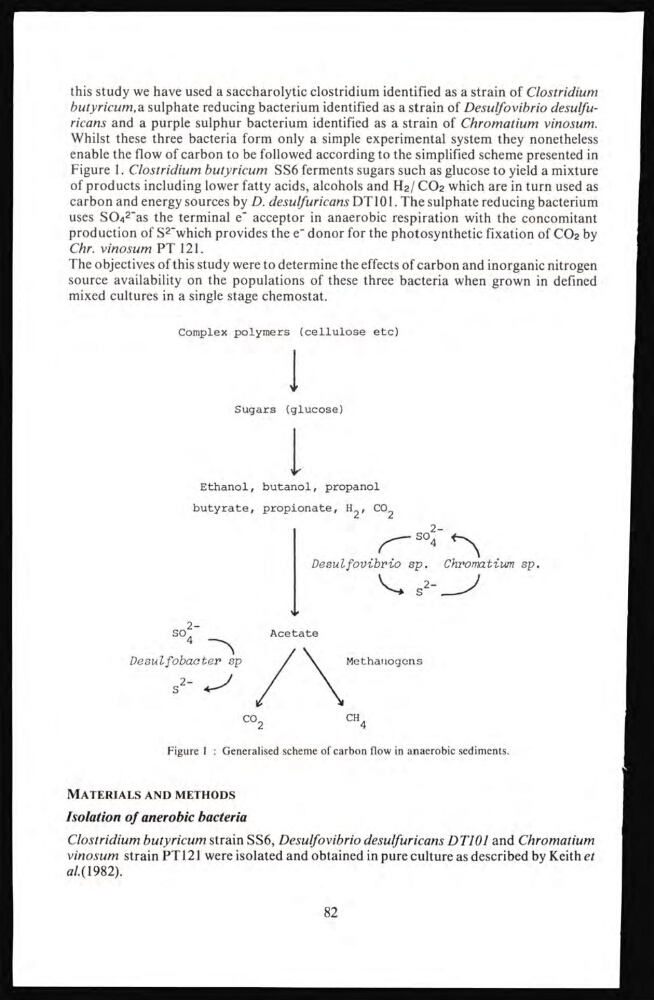
enable the flow of carbon to be followed according to the simplified scheme presented in
Figure 1. Clostridium butyricum SS6 ferments sugars such as glucose to yield a mixture
of products including lower fatty acids, alcohols and H 2 / CO2 which are in turn used as
carbon and energy sources by D. desulfuricans DT 101. The sulphate reducing bacterium
uses SO 4
2- as the terminal e' acceptor in anaerobic respiration with the concomitant
production of S
2- which provides the e' donor for the photosynthetic fixation of CO 2 by
Chr. vinosum PT 121.
The objectives of this study were to determine the effects of carbon and inorganic nitrogen
source availability on the populations of these three bacteria when grown in defined
mixed cultures in a single stage chemostat.
Complex polymers (cellulose etc)
Sugars (glucose)
Ethanol, butanol, propanol
butyrate, propionate,
CO 2
2
Desulfovibrio sp. Chromatium sp.
Desulfobaoter sp
CH
co.
4
2
Figure 1 : Generalised scheme of carbon flow in anaerobic sediments.
MATERIALS AND METHODS
Isolation of anerobic bacteria
Clostridium butyricum strain SS6, Desulfovibrio desulfuricans DT101 and Chromatium
vinosum strain PT 121 were isolated and obtained in pure culture as described by Keith et
al. ( 1982).
82
butyricum, a sulphate reducing bacterium identified as a strain of Desulfovibrio desulfuricans and a purple sulphur bacterium identified as a strain of Chromatium vinosum.
Whilst these three bacteria form only a simple experimental system they nonetheless
enable the flow of carbon to be followed according to the simplified scheme presented in
Figure 1. Clostridium butyricum SS6 ferments sugars such as glucose to yield a mixture
of products including lower fatty acids, alcohols and H 2 / CO2 which are in turn used as
carbon and energy sources by D. desulfuricans DT 101. The sulphate reducing bacterium
uses SO 4
2- as the terminal e' acceptor in anaerobic respiration with the concomitant
production of S
2- which provides the e' donor for the photosynthetic fixation of CO 2 by
Chr. vinosum PT 121.
The objectives of this study were to determine the effects of carbon and inorganic nitrogen
source availability on the populations of these three bacteria when grown in defined
mixed cultures in a single stage chemostat.
Complex polymers (cellulose etc)
Sugars (glucose)
Ethanol, butanol, propanol
butyrate, propionate,
CO 2
2
Desulfovibrio sp. Chromatium sp.
Desulfobaoter sp
CH
co.
4
2
Figure 1 : Generalised scheme of carbon flow in anaerobic sediments.
MATERIALS AND METHODS
Isolation of anerobic bacteria
Clostridium butyricum strain SS6, Desulfovibrio desulfuricans DT101 and Chromatium
vinosum strain PT 121 were isolated and obtained in pure culture as described by Keith et
al. ( 1982).
82