

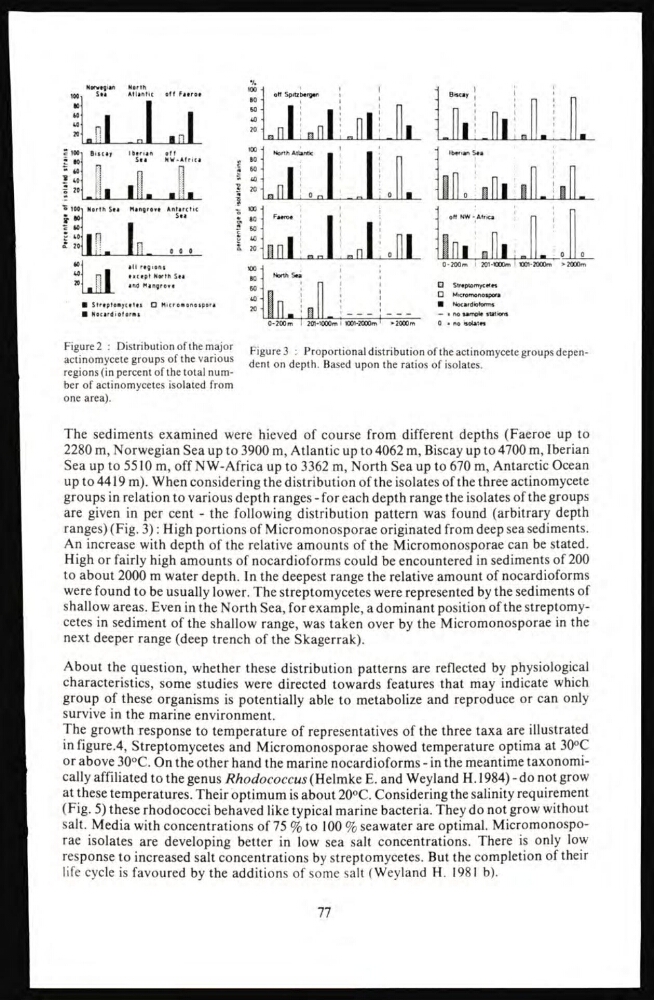
Figure 2 . Distribution of the major Figure 3 : Proportional distribution of the actinomycete groups depenactinomycete groups of the various dent on depth. Based upon the ratios of isolates
regions (in percent of the total number of actinomycetes isolated from
one area).
The sediments examined were hieved of course from different depths (Faeroe up to
2280 m, Norwegian Sea up to 3900 m, Atlantic up to 4062 m, Biscay up to 4700 m, Iberian
Sea up to 5510 m, off NW-Africa up to 3362 m, North Sea up to 670 m, Antarctic Ocean
up to 4419 m). When considering the distribution of the isolates of the three actinomycete
groups in relation to various depth ranges - for each depth range the isolates of the groups
are given in per cent - the following distribution pattern was found (arbitrary depth
ranges) (Fig. 3) : High portions of Micromonosporae originated from deep sea sediments.
An increase with depth of the relative amounts of the Micromonosporae can be stated.
High or fairly high amounts of nocardioforms could be encountered in sediments of 200
to about 2000 m water depth. In the deepest range the relative amount of nocardioforms
were found to be usually lower. The streptomycetes were represented by the sediments of
shallow areas. Even in the North Sea, for example, a dominant position of the streptomycetes in sediment of the shallow range, was taken over by the Micromonosporae in the
next deeper range (deep trench of the Skagerrak).
About the question, whether these distribution patterns are reflected by physiological
characteristics, some studies were directed towards features that may indicate which
group of these organisms is potentially able to metabolize and reproduce or can only
survive in the marine environment.
The growth response to temperature of representatives of the three taxa are illustrated
in figure.4, Streptomycetes and Micromonosporae showed temperature optima at 30°C
or above 30°C. On the other hand the marine nocardioforms - in the meantime taxonomically affiliated to the genus Rhodococcus (Helmke E. and Weyland H. 1984) - do not grow
at these temperatures. Their optimum is about 20°C. Considering the salinity requirement
(Fig. 5) these rhodococci behaved like typical marine bacteria. They do not grow without
salt. Media with concentrations of 75 % to 100 % seawater are optimal. Micromonosporae isolates are developing better in low sea salt concentrations. There is only low
response to increased salt concentrations by streptomycetes. But the completion of their
life cycle is favoured by the additions of some salt (Weyland H. 1981 b).
77
regions (in percent of the total number of actinomycetes isolated from
one area).
The sediments examined were hieved of course from different depths (Faeroe up to
2280 m, Norwegian Sea up to 3900 m, Atlantic up to 4062 m, Biscay up to 4700 m, Iberian
Sea up to 5510 m, off NW-Africa up to 3362 m, North Sea up to 670 m, Antarctic Ocean
up to 4419 m). When considering the distribution of the isolates of the three actinomycete
groups in relation to various depth ranges - for each depth range the isolates of the groups
are given in per cent - the following distribution pattern was found (arbitrary depth
ranges) (Fig. 3) : High portions of Micromonosporae originated from deep sea sediments.
An increase with depth of the relative amounts of the Micromonosporae can be stated.
High or fairly high amounts of nocardioforms could be encountered in sediments of 200
to about 2000 m water depth. In the deepest range the relative amount of nocardioforms
were found to be usually lower. The streptomycetes were represented by the sediments of
shallow areas. Even in the North Sea, for example, a dominant position of the streptomycetes in sediment of the shallow range, was taken over by the Micromonosporae in the
next deeper range (deep trench of the Skagerrak).
About the question, whether these distribution patterns are reflected by physiological
characteristics, some studies were directed towards features that may indicate which
group of these organisms is potentially able to metabolize and reproduce or can only
survive in the marine environment.
The growth response to temperature of representatives of the three taxa are illustrated
in figure.4, Streptomycetes and Micromonosporae showed temperature optima at 30°C
or above 30°C. On the other hand the marine nocardioforms - in the meantime taxonomically affiliated to the genus Rhodococcus (Helmke E. and Weyland H. 1984) - do not grow
at these temperatures. Their optimum is about 20°C. Considering the salinity requirement
(Fig. 5) these rhodococci behaved like typical marine bacteria. They do not grow without
salt. Media with concentrations of 75 % to 100 % seawater are optimal. Micromonosporae isolates are developing better in low sea salt concentrations. There is only low
response to increased salt concentrations by streptomycetes. But the completion of their
life cycle is favoured by the additions of some salt (Weyland H. 1981 b).
77