

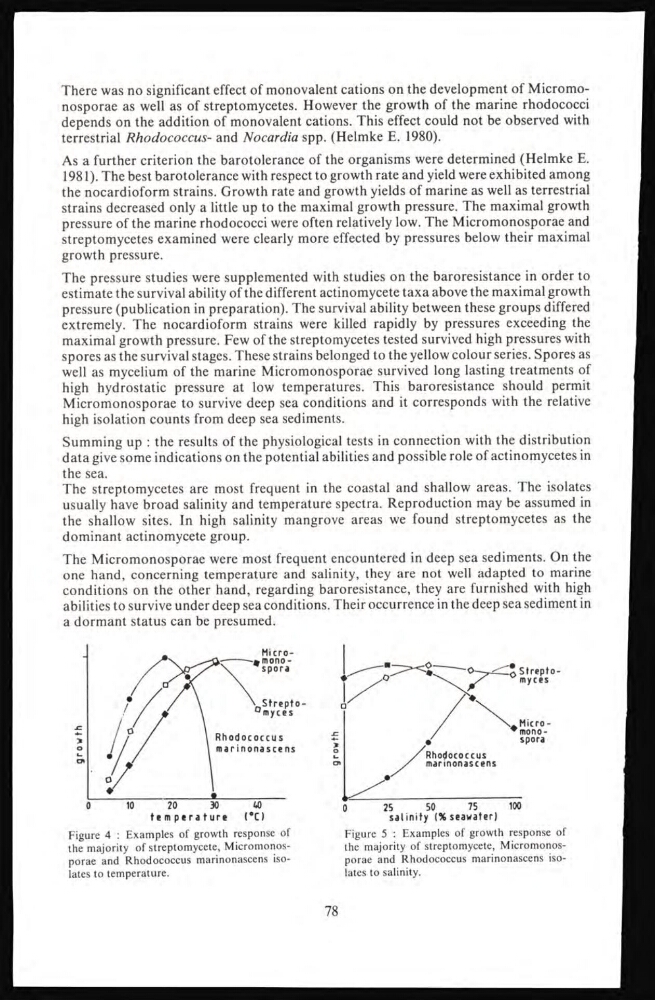
There was no significant effect of monovalent cations on the development of Micromonosporae as well as of streptomycetes. However the growth of the marine rhodococci
depends on the addition of monovalent cations. This effect could not be observed with
terrestrial Rhodococcus- and Nocardia spp. (Helmke E. 1980).
As a further criterion the barotolerance of the organisms were determined (Helmke E.
1981). The best barotolerance with respect to growth rate and yield were exhibited among
the nocardioform strains. Growth rate and growth yields of marine as well as terrestrial
strains decreased only a little up to the maximal growth pressure. The maximal growth
pressure of the marine rhodococci were often relatively low. The Micromonosporae and
streptomycetes examined were clearly more effected by pressures below their maximal
growth pressure.
The pressure studies were supplemented with studies on the baroresistance in order to
estimate the survival ability of the different actinomycete taxa above the maximal growth
pressure (publication in preparation). The survival ability between these groups differed
extremely. The nocardioform strains were killed rapidly by pressures exceeding the
maximal growth pressure. Few of the streptomycetes tested survived high pressures with
spores as the survival stages. These strains belonged to the yellow colour series. Spores as
well as mycelium of the marine Micromonosporae survived long lasting treatments of
high hydrostatic pressure at low temperatures. This baroresistance should permit
Micromonosporae to survive deep sea conditions and it corresponds with the relative
high isolation counts from deep sea sediments.
Summing up : the results of the physiological tests in connection with the distribution
data give some indications on the potential abilities and possible role of actinomycetes in
the sea.
The streptomycetes are most frequent in the coastal and shallow areas. The isolates
usually have broad salinity and temperature spectra. Reproduction may be assumed in
the shallow sites. In high salinity mangrove areas we found streptomycetes as the
dominant actinomycete group.
The Micromonosporae were most frequent encountered in deep sea sediments. On the
one hand, concerning temperature and salinity, they are not well adapted to marine
conditions on the other hand, regarding baroresistance, they are furnished with high
abilities to survive under deep sea conditions. Their occurrence in the deep sea sediment in
a dormant status can be presumed.
Figure 4 : Examples of growth response of
the majority of streptomycete, Micromonosporae and Rhodococcus marinonascens isolates to temperature.
Figure 5 : Examples of growth response of
the majority of streptomycete, Micromonosporae and Rhodococcus marinonascens isolates to salinity.
78
depends on the addition of monovalent cations. This effect could not be observed with
terrestrial Rhodococcus- and Nocardia spp. (Helmke E. 1980).
As a further criterion the barotolerance of the organisms were determined (Helmke E.
1981). The best barotolerance with respect to growth rate and yield were exhibited among
the nocardioform strains. Growth rate and growth yields of marine as well as terrestrial
strains decreased only a little up to the maximal growth pressure. The maximal growth
pressure of the marine rhodococci were often relatively low. The Micromonosporae and
streptomycetes examined were clearly more effected by pressures below their maximal
growth pressure.
The pressure studies were supplemented with studies on the baroresistance in order to
estimate the survival ability of the different actinomycete taxa above the maximal growth
pressure (publication in preparation). The survival ability between these groups differed
extremely. The nocardioform strains were killed rapidly by pressures exceeding the
maximal growth pressure. Few of the streptomycetes tested survived high pressures with
spores as the survival stages. These strains belonged to the yellow colour series. Spores as
well as mycelium of the marine Micromonosporae survived long lasting treatments of
high hydrostatic pressure at low temperatures. This baroresistance should permit
Micromonosporae to survive deep sea conditions and it corresponds with the relative
high isolation counts from deep sea sediments.
Summing up : the results of the physiological tests in connection with the distribution
data give some indications on the potential abilities and possible role of actinomycetes in
the sea.
The streptomycetes are most frequent in the coastal and shallow areas. The isolates
usually have broad salinity and temperature spectra. Reproduction may be assumed in
the shallow sites. In high salinity mangrove areas we found streptomycetes as the
dominant actinomycete group.
The Micromonosporae were most frequent encountered in deep sea sediments. On the
one hand, concerning temperature and salinity, they are not well adapted to marine
conditions on the other hand, regarding baroresistance, they are furnished with high
abilities to survive under deep sea conditions. Their occurrence in the deep sea sediment in
a dormant status can be presumed.
Figure 4 : Examples of growth response of
the majority of streptomycete, Micromonosporae and Rhodococcus marinonascens isolates to temperature.
Figure 5 : Examples of growth response of
the majority of streptomycete, Micromonosporae and Rhodococcus marinonascens isolates to salinity.
78