

Ammonia-stimulation of dark fixation in the oxidized top layer did not necessarily
indicate a peak of bacterial nitrification ; for NH4+ ions are also known to increase dark
CO2 fixation by marine diatoms (Goldman and Dennett, 1983).
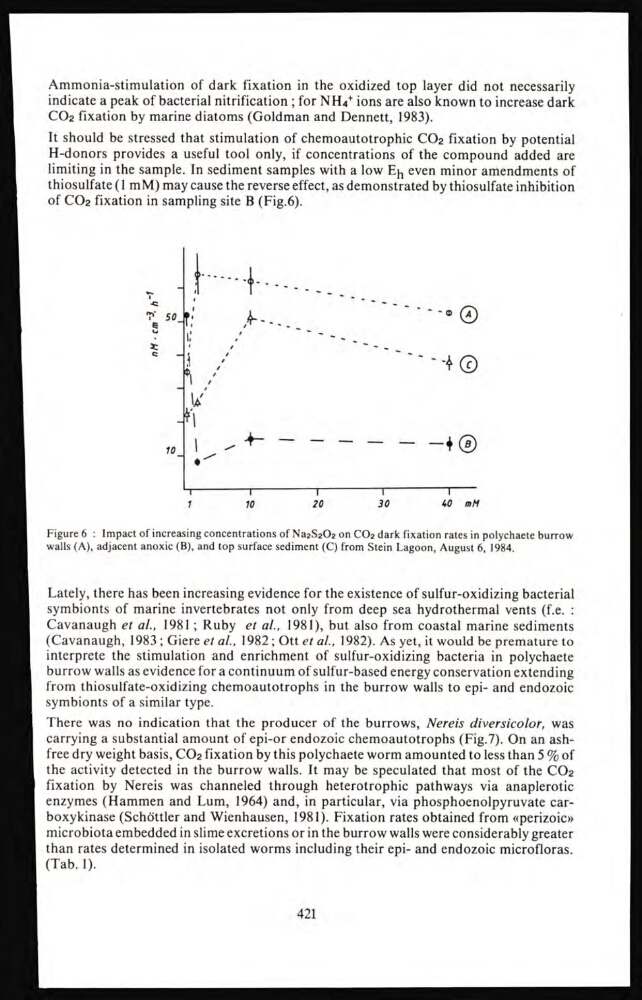
It should be stressed that stimulation of chemoautotrophic CO2 fixation by potential
H-donors provides a useful tool only, if concentrations of the compound added are
limiting in the sample. In sediment samples with a low
even minor amendments of
thiosulfate (1 mM) may cause the reverse effect, as demonstrated by thiosulfate inhibition
of CO2 fixation in sampling site B (Fig.6).
Figure 6 : Impact of increasing concentrations of Na 2 S 2 O 2 on CO 2 dark fixation rates in polychaete burrow
walls (A), adjacent anoxic (B), and top surface sediment (C) from Stein Lagoon, August 6, 1984.
Lately, there has been increasing evidence for the existence of sulfur-oxidizing bacterial
symbionts of marine invertebrates not only from deep sea hydrothermal vents (f.e. :
Cavanaugh et al., 1981 ; Ruby et al., 1981), but also from coastal marine sediments
(Cavanaugh, 1983 ; Giere et al., 1982 ; Ott et al., 1982). As yet, it would be premature to
interprete the stimulation and enrichment of sulfur-oxidizing bacteria in polychaete
burrow walls as evidence for a continuum of sulfur-based energy conservation extending
from thiosulfate-oxidizing chemoautotrophs in the burrow walls to epi- and endozoic
symbionts of a similar type.
There was no indication that the producer of the burrows, Nereis diversicolor, was
carrying a substantial amount of epi-or endozoic chemoautotrophs (Fig.7). On an ashfree dry weight basis, CO2 fixation by this polychaete worm amounted to less than 5 % of
the activity detected in the burrow walls. It may be speculated that most of the CO2
fixation by Nereis was channeled through heterotrophic pathways via anaplerotic
enzymes (Hammen and Lum, 1964) and, in particular, via phosphoenolpyruvate carboxykinase (Schöttler and Wienhausen, 1981). Fixation rates obtained from «perizoic»
microbiota embedded in slime excretions or in the burrow walls were considerably greater
than rates determined in isolated worms including their epi- and endozoic microfloras.
(Tab. 1).
421
indicate a peak of bacterial nitrification ; for NH4+ ions are also known to increase dark
CO2 fixation by marine diatoms (Goldman and Dennett, 1983).
It should be stressed that stimulation of chemoautotrophic CO2 fixation by potential
H-donors provides a useful tool only, if concentrations of the compound added are
limiting in the sample. In sediment samples with a low
even minor amendments of
thiosulfate (1 mM) may cause the reverse effect, as demonstrated by thiosulfate inhibition
of CO2 fixation in sampling site B (Fig.6).
Figure 6 : Impact of increasing concentrations of Na 2 S 2 O 2 on CO 2 dark fixation rates in polychaete burrow
walls (A), adjacent anoxic (B), and top surface sediment (C) from Stein Lagoon, August 6, 1984.
Lately, there has been increasing evidence for the existence of sulfur-oxidizing bacterial
symbionts of marine invertebrates not only from deep sea hydrothermal vents (f.e. :
Cavanaugh et al., 1981 ; Ruby et al., 1981), but also from coastal marine sediments
(Cavanaugh, 1983 ; Giere et al., 1982 ; Ott et al., 1982). As yet, it would be premature to
interprete the stimulation and enrichment of sulfur-oxidizing bacteria in polychaete
burrow walls as evidence for a continuum of sulfur-based energy conservation extending
from thiosulfate-oxidizing chemoautotrophs in the burrow walls to epi- and endozoic
symbionts of a similar type.
There was no indication that the producer of the burrows, Nereis diversicolor, was
carrying a substantial amount of epi-or endozoic chemoautotrophs (Fig.7). On an ashfree dry weight basis, CO2 fixation by this polychaete worm amounted to less than 5 % of
the activity detected in the burrow walls. It may be speculated that most of the CO2
fixation by Nereis was channeled through heterotrophic pathways via anaplerotic
enzymes (Hammen and Lum, 1964) and, in particular, via phosphoenolpyruvate carboxykinase (Schöttler and Wienhausen, 1981). Fixation rates obtained from «perizoic»
microbiota embedded in slime excretions or in the burrow walls were considerably greater
than rates determined in isolated worms including their epi- and endozoic microfloras.
(Tab. 1).
421