

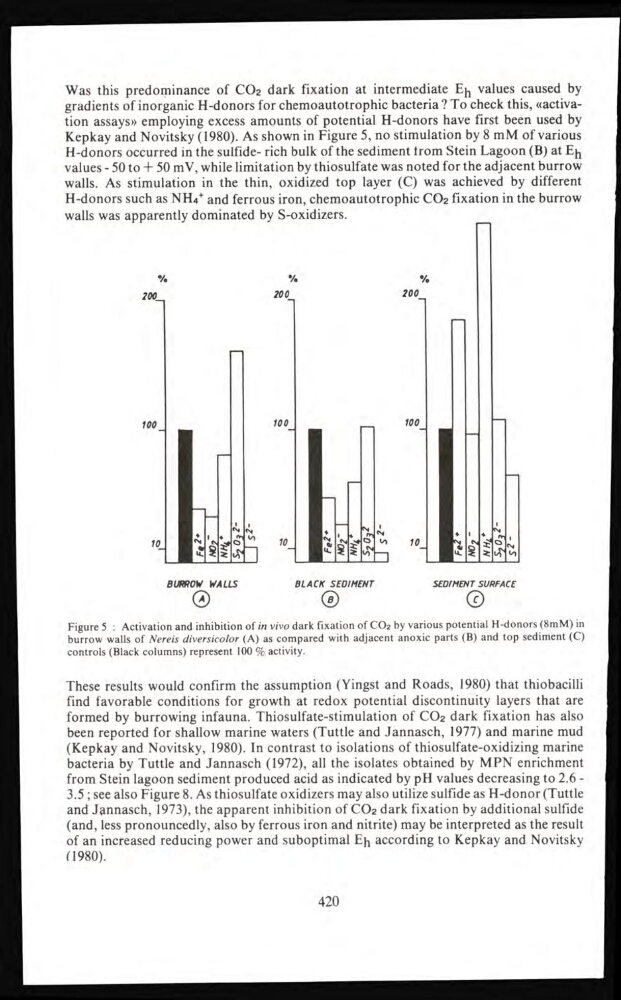
Was this predominance of CO2 dark fixation at intermediate
values caused by
gradients of inorganic H-donors for chemoautotrophic bacteria ? To check this, «activation assays» employing excess amounts of potential H-donors have first been used by
Kepkay and Novitsky (1980). As shown in Figure 5, no stimulation by 8 mM of various
H-donors occurred in the sulfide- rich bulk of the sediment from Stein Lagoon (B) at Eh
values - 50 to + 50 mV, while limitation by thiosulfate was noted for the adjacent burrow
walls. As stimulation in the thin, oxidized top layer (C) was achieved by different
H-donors such as NH4+ and ferrous iron, chemoautotrophic CO2 fixation in the burrow
®
©
©
Figure 5 : Activation and inhibition of in vivo dark fixation of CO2 by various potential H-donors (8mM) in
burrow walls of Nereis diversicolor (A) as compared with adjacent anoxic parts (B) and top sediment (C)
controls (Black columns) represent 100 % activity.
These results would confirm the assumption (Yingst and Roads, 1980) that thiobacilli
find favorable conditions for growth at redox potential discontinuity layers that are
formed by burrowing infauna. Thiosulfate-stimulation of CO2 dark fixation has also
been reported for shallow marine waters (Tuttle and Jannasch, 1977) and marine mud
(Kepkay and Novitsky, 1980). In contrast to isolations of thiosulfate-oxidizing marine
bacteria by Tuttle and Jannasch (1972), all the isolates obtained by MPN enrichment
from Stein lagoon sediment produced acid as indicated by pH values decreasing to 2.6 -
3.5 ; see also Figure 8. As thiosulfate oxidizers may also utilize sulfide as H-donor (Tuttle
and Jannasch, 1973), the apparent inhibition of CO2 dark fixation by additional sulfide
(and, less pronouncedly, also by ferrous iron and nitrite) may be interpreted as the result
of an increased reducing power and suboptimal Eh according to Kepkay and Novitsky
(1980).
420
values caused by
gradients of inorganic H-donors for chemoautotrophic bacteria ? To check this, «activation assays» employing excess amounts of potential H-donors have first been used by
Kepkay and Novitsky (1980). As shown in Figure 5, no stimulation by 8 mM of various
H-donors occurred in the sulfide- rich bulk of the sediment from Stein Lagoon (B) at Eh
values - 50 to + 50 mV, while limitation by thiosulfate was noted for the adjacent burrow
walls. As stimulation in the thin, oxidized top layer (C) was achieved by different
H-donors such as NH4+ and ferrous iron, chemoautotrophic CO2 fixation in the burrow
®
©
©
Figure 5 : Activation and inhibition of in vivo dark fixation of CO2 by various potential H-donors (8mM) in
burrow walls of Nereis diversicolor (A) as compared with adjacent anoxic parts (B) and top sediment (C)
controls (Black columns) represent 100 % activity.
These results would confirm the assumption (Yingst and Roads, 1980) that thiobacilli
find favorable conditions for growth at redox potential discontinuity layers that are
formed by burrowing infauna. Thiosulfate-stimulation of CO2 dark fixation has also
been reported for shallow marine waters (Tuttle and Jannasch, 1977) and marine mud
(Kepkay and Novitsky, 1980). In contrast to isolations of thiosulfate-oxidizing marine
bacteria by Tuttle and Jannasch (1972), all the isolates obtained by MPN enrichment
from Stein lagoon sediment produced acid as indicated by pH values decreasing to 2.6 -
3.5 ; see also Figure 8. As thiosulfate oxidizers may also utilize sulfide as H-donor (Tuttle
and Jannasch, 1973), the apparent inhibition of CO2 dark fixation by additional sulfide
(and, less pronouncedly, also by ferrous iron and nitrite) may be interpreted as the result
of an increased reducing power and suboptimal Eh according to Kepkay and Novitsky
(1980).
420