

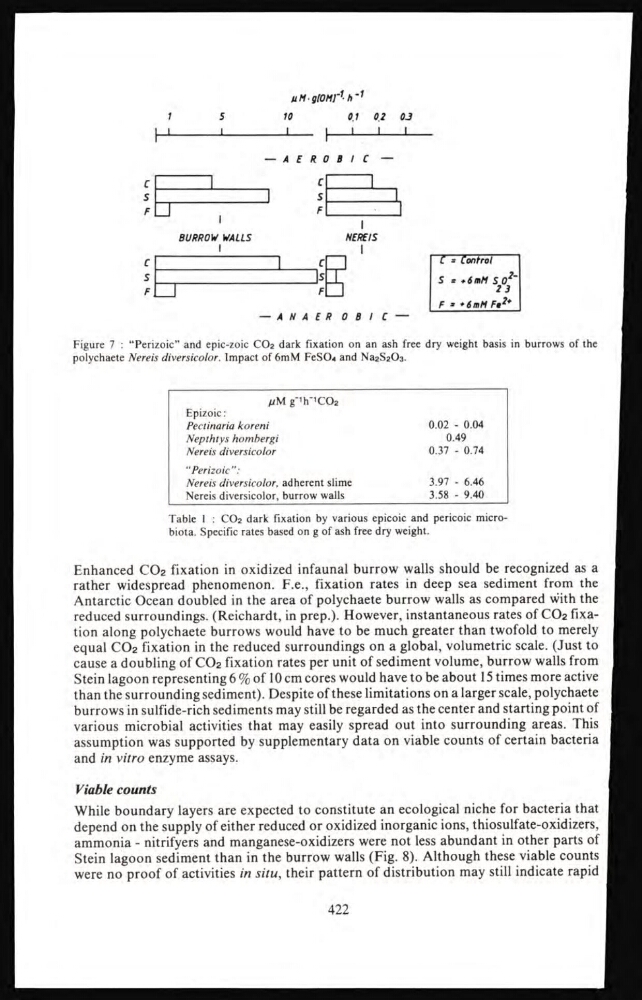
Figure 7 : “Perizoic” and epic-zoic CO2 dark fixation on an ash free dry weight basis in burrows of the
polychaete Nereis diversicolor. Impact of 6mM FeSO4 and Na2S2O3.
µM g -1 h -1 CO2
Epizoic :
Pectinaria koreni
0.02 - 0.04
Nepthtys hombergi
0.49
Nereis diversicolor
0.37 - 0.74
"Perizoic
Nereis diversicolor, adherent slime
3.97 - 6.46
Nereis diversicolor, burrow walls
3.58 - 9.40
Table 1 : CO2 dark fixation by various epicoic and pericoic microbiota. Specific rates based on g of ash free dry weight.
Enhanced CO 2 fixation in oxidized infaunal burrow walls should be recognized as a
rather widespread phenomenon. F.e., fixation rates in deep sea sediment from the
Antarctic Ocean doubled in the area of polychaete burrow walls as compared with the
reduced surroundings. (Reichardt, in prep.). However, instantaneous rates of CO2 fixation along polychaete burrows would have to be much greater than twofold to merely
equal CO2 fixation in the reduced surroundings on a global, volumetric scale. (Just to
cause a doubling of CO2 fixation rates per unit of sediment volume, burrow walls from
Stein lagoon representing 6 % of 10 cm cores would have to be about 15 times more active
than the surrounding sediment). Despite of these limitations on a larger scale, polychaete
burrows in sulfide-rich sediments may still be regarded as the center and starting point of
various microbial activities that may easily spread out into surrounding areas. This
assumption was supported by supplementary data on viable counts of certain bacteria
and in vitro enzyme assays.
Viable counts
While boundary layers are expected to constitute an ecological niche for bacteria that
depend on the supply of either reduced or oxidized inorganic ions, thiosulfate-oxidizers,
ammonia - nitrifyers and manganese-oxidizers were not less abundant in other parts of
Stein lagoon sediment than in the burrow walls (Fig. 8). Although these viable counts
were no proof of activities in situ, their pattern of distribution may still indicate rapid
422
polychaete Nereis diversicolor. Impact of 6mM FeSO4 and Na2S2O3.
µM g -1 h -1 CO2
Epizoic :
Pectinaria koreni
0.02 - 0.04
Nepthtys hombergi
0.49
Nereis diversicolor
0.37 - 0.74
"Perizoic
Nereis diversicolor, adherent slime
3.97 - 6.46
Nereis diversicolor, burrow walls
3.58 - 9.40
Table 1 : CO2 dark fixation by various epicoic and pericoic microbiota. Specific rates based on g of ash free dry weight.
Enhanced CO 2 fixation in oxidized infaunal burrow walls should be recognized as a
rather widespread phenomenon. F.e., fixation rates in deep sea sediment from the
Antarctic Ocean doubled in the area of polychaete burrow walls as compared with the
reduced surroundings. (Reichardt, in prep.). However, instantaneous rates of CO2 fixation along polychaete burrows would have to be much greater than twofold to merely
equal CO2 fixation in the reduced surroundings on a global, volumetric scale. (Just to
cause a doubling of CO2 fixation rates per unit of sediment volume, burrow walls from
Stein lagoon representing 6 % of 10 cm cores would have to be about 15 times more active
than the surrounding sediment). Despite of these limitations on a larger scale, polychaete
burrows in sulfide-rich sediments may still be regarded as the center and starting point of
various microbial activities that may easily spread out into surrounding areas. This
assumption was supported by supplementary data on viable counts of certain bacteria
and in vitro enzyme assays.
Viable counts
While boundary layers are expected to constitute an ecological niche for bacteria that
depend on the supply of either reduced or oxidized inorganic ions, thiosulfate-oxidizers,
ammonia - nitrifyers and manganese-oxidizers were not less abundant in other parts of
Stein lagoon sediment than in the burrow walls (Fig. 8). Although these viable counts
were no proof of activities in situ, their pattern of distribution may still indicate rapid
422