

Hydrogen-producing isolates.
Thirty-eight isolates were obtained from the vials which produced hydrogen, 17 of which
were capable of producing hydrogen after isolation. All were short, gram-negative rods.
Fifteen of the isolates appeared identical and keyed out to be members of the Enterobacteriaceae. The remaining two isolates appeared to belong to the genus Photobacterium.
Fluorescent antibody enumeration.
Hydrogen-producing bacteria present in water samples from the R/V Gyre cruise were
enumerated using the immunofluorescence techniques previously described. Antisera,
prepared against pure cultures isolated from the U.S.N.S. Lynch two years prior, were
reacted with freshly preserved water samples taken from various depths during the R. V
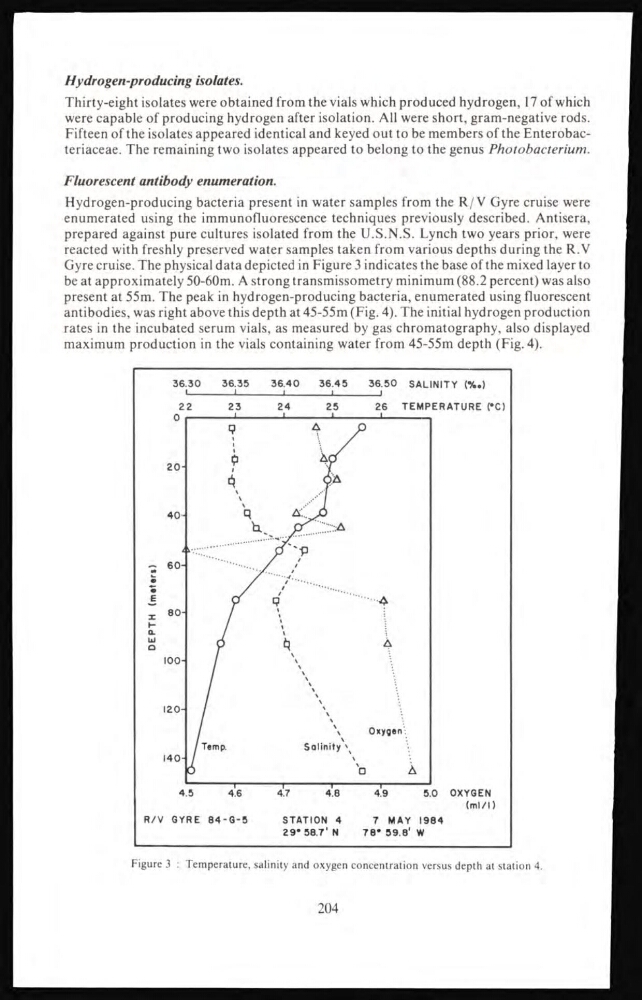
Gyre cruise. The physical data depicted in Figure 3 indicates the base of the mixed layer to
be at approximately 50-60m. A strong transmissometry minimum (88.2 percent) was also
present at 55m. The peak in hydrogen-producing bacteria, enumerated using fluorescent
antibodies, was right above this depth at 45-55m (Fig. 4). The initial hydrogen production
rates in the incubated serum vials, as measured by gas chromatography, also displayed
maximum production in the vials containing water from 45-55m depth (Fig. 4).
Figure 3 : Temperature, salinity and oxygen concentration versus depth at station 4.
204
Thirty-eight isolates were obtained from the vials which produced hydrogen, 17 of which
were capable of producing hydrogen after isolation. All were short, gram-negative rods.
Fifteen of the isolates appeared identical and keyed out to be members of the Enterobacteriaceae. The remaining two isolates appeared to belong to the genus Photobacterium.
Fluorescent antibody enumeration.
Hydrogen-producing bacteria present in water samples from the R/V Gyre cruise were
enumerated using the immunofluorescence techniques previously described. Antisera,
prepared against pure cultures isolated from the U.S.N.S. Lynch two years prior, were
reacted with freshly preserved water samples taken from various depths during the R. V
Gyre cruise. The physical data depicted in Figure 3 indicates the base of the mixed layer to
be at approximately 50-60m. A strong transmissometry minimum (88.2 percent) was also
present at 55m. The peak in hydrogen-producing bacteria, enumerated using fluorescent
antibodies, was right above this depth at 45-55m (Fig. 4). The initial hydrogen production
rates in the incubated serum vials, as measured by gas chromatography, also displayed
maximum production in the vials containing water from 45-55m depth (Fig. 4).
Figure 3 : Temperature, salinity and oxygen concentration versus depth at station 4.
204