

Biomarkers
Table 2 - Reported 5α-stanol content (%) in Suberitidae sponges.
Aaptos sp.
New Zealand
90.0
Bergquist et al., 1980
Aaptos aaptos
Mediterranean
99.5
Dini et al., 1984
S. carnosus
Mediterranean
86.0
De Simone et al., 1980
S. domuncula
Mediterranean
98.0
Bergquist et al., 1980
S. domuncula
Mediterranean
05.1
Dini et al., 1984
Terpios zeteki
Hawaii
90.8
Delseth et al., 1979
S.: Suberites
Major stanol content was formerly found in Aaptos sp., Suberites compacta,
S. domuncula, suberea, Terpios fugax and T. zeteki (Bergmann et al.,
1950). The genus Aaptos, formerly classified wirhin the Thetyiidae
family, now belongs to the Suberitidae family on rhe basis of 18S RNA
sequences.
As an exception within the subclass Tetractinomorpha, Axinella damicornis was reported to contain 99% of stanols (Dini et al., 1984). Like
the Suberitidae sponges, two other sponges from the Hadromerida order
(thus close to them), Polymastia fusea and Chondrilla nucula, contained
respectively 96% and 80% of stanols (Delseth et al., 1979).
Halichondriidae sponge sterols
Table 3 shows that the three species of Collocalypta possessed similar
srerol composition. The 24-isopropyl and 24-isopropenyl A5-sterols
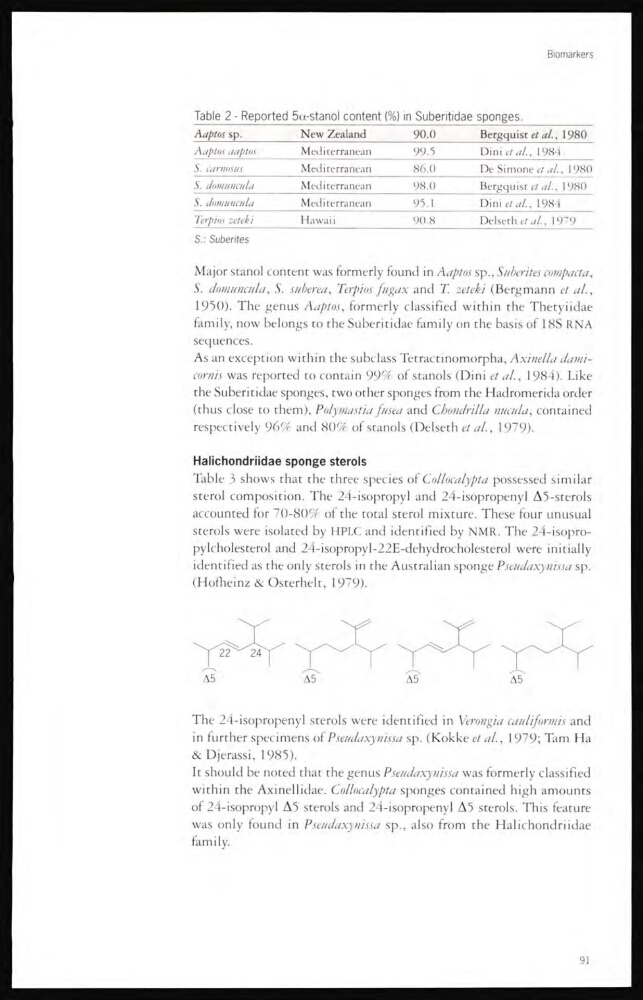
accounted for 70-80% of the total sterol mixture. These four unusual
sterols were isolated by HPLC and identified by NMR. The 24-isopropylcholesterol and 24-isopropyl-22E-dehydrocholesterol were initially
identified as the only sterols in the Australian sponge Pseudaxynissa sp.
(Hofheinz & Osterhelt, 1979).
The 24-isopropenyl sterols were identified in Verongia cauliformis and
in further specimens of Pseudaxynissa sp. (Kokke et al., 1979; Tam Ha
& Djerassi, 1985).
It should be noted that the genus Pseudaxynissa was formerly classified
within the Axinellidae. Collocatypta sponges contained high amounts
of 24-isopropyl Δ5 sterols and 24-isopropenyl Δ5 srerols. This feature
was only found in Pseudaxynissa sp., also from the Halichondriidae
family.
91
Table 2 - Reported 5α-stanol content (%) in Suberitidae sponges.
Aaptos sp.
New Zealand
90.0
Bergquist et al., 1980
Aaptos aaptos
Mediterranean
99.5
Dini et al., 1984
S. carnosus
Mediterranean
86.0
De Simone et al., 1980
S. domuncula
Mediterranean
98.0
Bergquist et al., 1980
S. domuncula
Mediterranean
05.1
Dini et al., 1984
Terpios zeteki
Hawaii
90.8
Delseth et al., 1979
S.: Suberites
Major stanol content was formerly found in Aaptos sp., Suberites compacta,
S. domuncula, suberea, Terpios fugax and T. zeteki (Bergmann et al.,
1950). The genus Aaptos, formerly classified wirhin the Thetyiidae
family, now belongs to the Suberitidae family on rhe basis of 18S RNA
sequences.
As an exception within the subclass Tetractinomorpha, Axinella damicornis was reported to contain 99% of stanols (Dini et al., 1984). Like
the Suberitidae sponges, two other sponges from the Hadromerida order
(thus close to them), Polymastia fusea and Chondrilla nucula, contained
respectively 96% and 80% of stanols (Delseth et al., 1979).
Halichondriidae sponge sterols
Table 3 shows that the three species of Collocalypta possessed similar
srerol composition. The 24-isopropyl and 24-isopropenyl A5-sterols
accounted for 70-80% of the total sterol mixture. These four unusual
sterols were isolated by HPLC and identified by NMR. The 24-isopropylcholesterol and 24-isopropyl-22E-dehydrocholesterol were initially
identified as the only sterols in the Australian sponge Pseudaxynissa sp.
(Hofheinz & Osterhelt, 1979).
The 24-isopropenyl sterols were identified in Verongia cauliformis and
in further specimens of Pseudaxynissa sp. (Kokke et al., 1979; Tam Ha
& Djerassi, 1985).
It should be noted that the genus Pseudaxynissa was formerly classified
within the Axinellidae. Collocatypta sponges contained high amounts
of 24-isopropyl Δ5 sterols and 24-isopropenyl Δ5 srerols. This feature
was only found in Pseudaxynissa sp., also from the Halichondriidae
family.
91