

Marine lipids
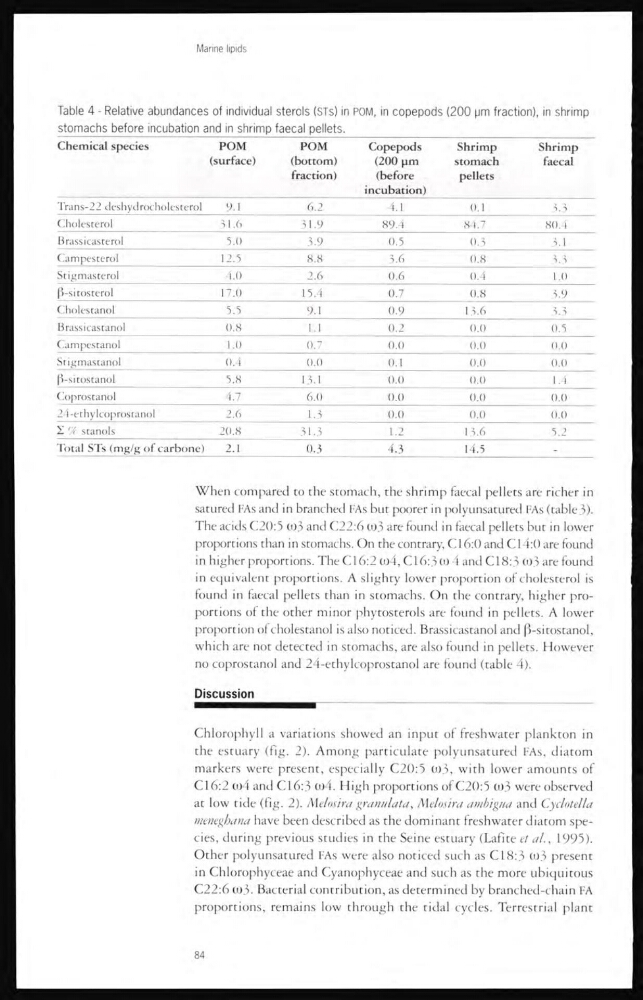
Table 4 - Relative abundances of individual sterols (STs) in POM, in copepods (200 µm fraction), in shrimp
stomachs before incubation and in shrimp faecal pellets.
Chemical species
POM
(surface)
POM
(bottom)
fraction)
Copepods
(200 µm
(before
incubation)
Shrimp
stomach
pellets
Shrimp
faecal
Trans-22 deshydrocholesterol
9.1
6.2
4.1
0.1
3.3
Cholesterol
31.6
31.9
89.4
84.7
80.4
Brassicasterol
5.0
3.9
0.5
0.3
5.1
Campesterol
12.5
8.8
3.6
0.8
3.3
Stigmasterol
4.0
2.6
0.6
0.4
1.0
P-sitosterol
17.0
15.4
0.7
0.8
3.9
Cholestanol
5.5
9.1
0.9
1 3.6
3.3
Brassicastanol
0.8
1.1
0.2
0.0
0.5
Campestanol
1.0
0.7
0.0
0.0
0.0
Stigmastanol
0.4
0.0
0.1
0.0
0.0
P-sitostanol
5.8
13.1
0.0
0.0
1.4
Coprostanol
4.7
6.0
0.0
0.0
0.0
24-ethylcoprostanol
2.6
1.3
0.0
0.0
0.0
Σ % stanols
20.8
31.3
1.2
13.6
5.2
Total STs (mg/g of carbone)
2.1
0.3
4.3
14.5
-
When compared to the stomach, the shrimp faecal pellets are richer in
satnred FAs and in branched FAs but poorer in polyunsatured FAs (table 3).
The acids C20:5 ω3 and C22:6 ω3 are found in faecal pellets but in lower
proportions than in stomachs. On the contrary, C16:0 and 04:0 are found
in higher proportions. The C16:2 ω4, C16:3 ω4 and C18:3 ω3 are found
in equivalent proportions. A slighty lower proportion of cholesterol is
found in taecal pellets than in stomachs. On the contrary, higher proportions of the other minor phytosterols are found in pellets. A lower
proportion of cholestanol is also noticed. Brassicastanol and β-sitostanol,
which are not detected in stomachs, are also found in pellets. However
no coprostanol and 24-ethylcoprostanol are found (table 4).
Discussion
Chlorophyll a variations showed an input of freshwater plankton in
the estuary (fig. 2). Among particulate polyunsatured FAs, diatom
markers were present, especially C20:5 ω3, with lower amounts of
C16:2 ω4 and C16:3 ω4. High proportions of C20:5 ω3 were observed
at low tide (fig. 2). Melosira granulata, Melosira ambigua and Cyclotella
meneghana have been described as the dominant freshwater diatom species, during previous studies in the Seine estuary (Lafite et al., 1995).
Other polyunsatured FAs were also noticed such as C18:3 ω3 present
in Chlorophyceae and Cyanophyceae and such as the more ubiquitous
C22:6 ω3. Bacterial contribution, as determined by branched-chain FA
proportions, remains low through the tidal cycles. Terrestrial plant
84
Table 4 - Relative abundances of individual sterols (STs) in POM, in copepods (200 µm fraction), in shrimp
stomachs before incubation and in shrimp faecal pellets.
Chemical species
POM
(surface)
POM
(bottom)
fraction)
Copepods
(200 µm
(before
incubation)
Shrimp
stomach
pellets
Shrimp
faecal
Trans-22 deshydrocholesterol
9.1
6.2
4.1
0.1
3.3
Cholesterol
31.6
31.9
89.4
84.7
80.4
Brassicasterol
5.0
3.9
0.5
0.3
5.1
Campesterol
12.5
8.8
3.6
0.8
3.3
Stigmasterol
4.0
2.6
0.6
0.4
1.0
P-sitosterol
17.0
15.4
0.7
0.8
3.9
Cholestanol
5.5
9.1
0.9
1 3.6
3.3
Brassicastanol
0.8
1.1
0.2
0.0
0.5
Campestanol
1.0
0.7
0.0
0.0
0.0
Stigmastanol
0.4
0.0
0.1
0.0
0.0
P-sitostanol
5.8
13.1
0.0
0.0
1.4
Coprostanol
4.7
6.0
0.0
0.0
0.0
24-ethylcoprostanol
2.6
1.3
0.0
0.0
0.0
Σ % stanols
20.8
31.3
1.2
13.6
5.2
Total STs (mg/g of carbone)
2.1
0.3
4.3
14.5
-
When compared to the stomach, the shrimp faecal pellets are richer in
satnred FAs and in branched FAs but poorer in polyunsatured FAs (table 3).
The acids C20:5 ω3 and C22:6 ω3 are found in faecal pellets but in lower
proportions than in stomachs. On the contrary, C16:0 and 04:0 are found
in higher proportions. The C16:2 ω4, C16:3 ω4 and C18:3 ω3 are found
in equivalent proportions. A slighty lower proportion of cholesterol is
found in taecal pellets than in stomachs. On the contrary, higher proportions of the other minor phytosterols are found in pellets. A lower
proportion of cholestanol is also noticed. Brassicastanol and β-sitostanol,
which are not detected in stomachs, are also found in pellets. However
no coprostanol and 24-ethylcoprostanol are found (table 4).
Discussion
Chlorophyll a variations showed an input of freshwater plankton in
the estuary (fig. 2). Among particulate polyunsatured FAs, diatom
markers were present, especially C20:5 ω3, with lower amounts of
C16:2 ω4 and C16:3 ω4. High proportions of C20:5 ω3 were observed
at low tide (fig. 2). Melosira granulata, Melosira ambigua and Cyclotella
meneghana have been described as the dominant freshwater diatom species, during previous studies in the Seine estuary (Lafite et al., 1995).
Other polyunsatured FAs were also noticed such as C18:3 ω3 present
in Chlorophyceae and Cyanophyceae and such as the more ubiquitous
C22:6 ω3. Bacterial contribution, as determined by branched-chain FA
proportions, remains low through the tidal cycles. Terrestrial plant
84