

Biomarkers
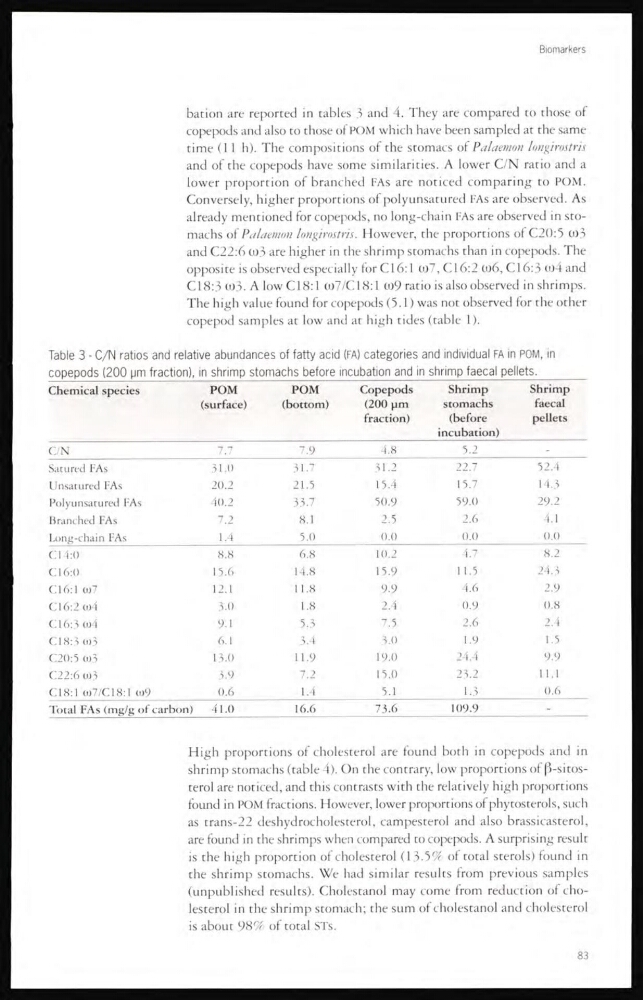
bation are reported in tables 3 and 4. They are compared to those of
copepods and also to those of POM which have been sampled at the same
time (11 h). The compositions of the stomacs of Palaemon longirostris
and of the copepods have some similarities. A lower C/N ratio and a
lower proportion of branched FAs are noticed comparing to POM.
Conversely, higher proportions of polyunsatured FAs are observed. As
already mentioned for copepods, no long-chain FAs are observed in stomachs of Palaemon longirostris. However, the proportions of C20:5 ω3
and C22:6 ω3 are higher in the shrimp stomachs than in copepods. The
opposite is observed especially for C16:1 ω7, C16:2 ω6, C16:3 ω4 and
C18:3 ω3. A low C18:1 ω7/C18:1 ω9 ratio is also observed in shrimps.
The high value found for copepods (5.1) was not observed for the other
copepod samples at low and at high tides (table 1 ).
Table 3 - C/N ratios and relative abundances of fatty acid (FA) categories and individual FA in POM, in
copepods (200 pm fraction), in shrimp stomachs before incubation and in shrimp faecal pellets.
Chemical species
POM
(surface)
POM
(bottom)
Copepods
(200 µm
fraction)
Shrimp
stomachs
(before
incubation)
Shrimp
faecal
pellets
C/N
7.7
7.9
4.8
5.2
-
Satured FAs
31.0
31.7
31.2
22.7
52.4
Unsatured FAs
20.2
21.5
15.4
15.7
14.3
Polyunsatured FAs
40.2
33.7
50.9
59.0
29.2
Branched FAs
7.2
8.1
2.5
2.6
i.l
Long-chain FAs
1.4
5.0
0.0
0.0
0.0
C14:0
8.8
6.8
10.2
4.7
8.2
C16:0
15.6
14.8
15.9
11.5
24.3
C16:1 ω7
12.1
11.8
9.9
4.6
2.9
C16:2 ω4
3.0
1.8
2.4
0.9
0.8
C16:3 ω4
9.1
5.3
7.5
2.6
2.4
C18:3 ω3
6.1
3.4
3.0
1.9
1.5
C20:5 ω3
13.0
11.9
19.0
24.4
9.9
C22:6 0)3
3.9
7.2
15.0
23.2
11.1
C18:1 ω7/C18:1 ω9
0.6
1.4
5.1
1.3
0.6
Total FAs (mg/g of carbon)
41.0
16.6
73.6
109.9
-
High proportions of cholesterol are found both in copepods and in
shrimp stomachs (table 4). On the contrary, low proportions of |3-sitosterol are noticed, and this contrasts with the relatively high proportions
found in POM fractions. However, lower proportions of phytosterols, such
as trans-22 deshydrocholesterol, campesterol and also brassicasterol,
are found in the shrimps when compared to copepods. A surprising result
is the high proportion of cholesterol (1 3.5% of total sterols) found in
the shrimp stomachs. We had similar results from previous samples
(unpublished results). Cholestanol may come from reduction of cholesterol in the shrimp stomach; the sum of cholestanol and cholesterol
is about 98% of total STs.
83
bation are reported in tables 3 and 4. They are compared to those of
copepods and also to those of POM which have been sampled at the same
time (11 h). The compositions of the stomacs of Palaemon longirostris
and of the copepods have some similarities. A lower C/N ratio and a
lower proportion of branched FAs are noticed comparing to POM.
Conversely, higher proportions of polyunsatured FAs are observed. As
already mentioned for copepods, no long-chain FAs are observed in stomachs of Palaemon longirostris. However, the proportions of C20:5 ω3
and C22:6 ω3 are higher in the shrimp stomachs than in copepods. The
opposite is observed especially for C16:1 ω7, C16:2 ω6, C16:3 ω4 and
C18:3 ω3. A low C18:1 ω7/C18:1 ω9 ratio is also observed in shrimps.
The high value found for copepods (5.1) was not observed for the other
copepod samples at low and at high tides (table 1 ).
Table 3 - C/N ratios and relative abundances of fatty acid (FA) categories and individual FA in POM, in
copepods (200 pm fraction), in shrimp stomachs before incubation and in shrimp faecal pellets.
Chemical species
POM
(surface)
POM
(bottom)
Copepods
(200 µm
fraction)
Shrimp
stomachs
(before
incubation)
Shrimp
faecal
pellets
C/N
7.7
7.9
4.8
5.2
-
Satured FAs
31.0
31.7
31.2
22.7
52.4
Unsatured FAs
20.2
21.5
15.4
15.7
14.3
Polyunsatured FAs
40.2
33.7
50.9
59.0
29.2
Branched FAs
7.2
8.1
2.5
2.6
i.l
Long-chain FAs
1.4
5.0
0.0
0.0
0.0
C14:0
8.8
6.8
10.2
4.7
8.2
C16:0
15.6
14.8
15.9
11.5
24.3
C16:1 ω7
12.1
11.8
9.9
4.6
2.9
C16:2 ω4
3.0
1.8
2.4
0.9
0.8
C16:3 ω4
9.1
5.3
7.5
2.6
2.4
C18:3 ω3
6.1
3.4
3.0
1.9
1.5
C20:5 ω3
13.0
11.9
19.0
24.4
9.9
C22:6 0)3
3.9
7.2
15.0
23.2
11.1
C18:1 ω7/C18:1 ω9
0.6
1.4
5.1
1.3
0.6
Total FAs (mg/g of carbon)
41.0
16.6
73.6
109.9
-
High proportions of cholesterol are found both in copepods and in
shrimp stomachs (table 4). On the contrary, low proportions of |3-sitosterol are noticed, and this contrasts with the relatively high proportions
found in POM fractions. However, lower proportions of phytosterols, such
as trans-22 deshydrocholesterol, campesterol and also brassicasterol,
are found in the shrimps when compared to copepods. A surprising result
is the high proportion of cholesterol (1 3.5% of total sterols) found in
the shrimp stomachs. We had similar results from previous samples
(unpublished results). Cholestanol may come from reduction of cholesterol in the shrimp stomach; the sum of cholestanol and cholesterol
is about 98% of total STs.
83