

Marine lipids
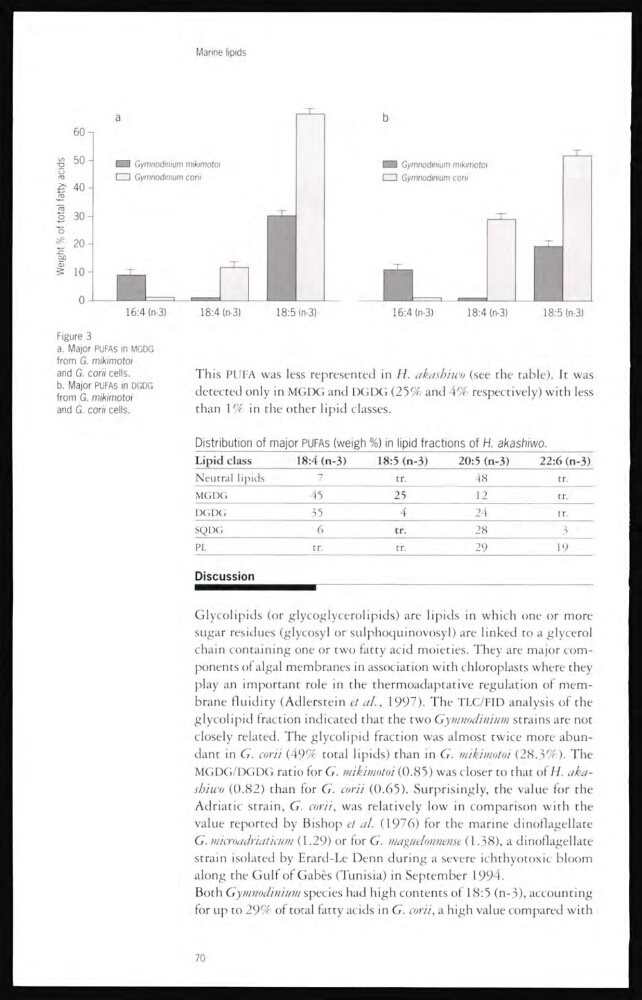
Figure 3
a. Major PUFAS in MGDG
from G. mikimotoi
and G. corii cells.
b. Major PUFAs in DGDG
from G. mikimotoi
and G. corii cells.
This PUFA was less represented in H. akashiwo (see the table). It was
detected only in MGDG and DGDG (25% and 4°/o respectively) with less
than 1% in the other lipid classes.
Distribution of major PUFAs (weigh %) in lipid fractions of H. akashiwo.
Lipid class
18:4 (n-3)
18:5 (n-3)
20:5 (n-3)
22:6 (n-3)
Neutral lipids
7
tr.
48
tr.
MGDG
45
25
12
tr.
DGDG
35
4
2 l
tr.
SQDG
6
tr.
28
3
PL
tr.
tr.
29
19
Discussion
Glycolipids (or glycoglycerolipids) are lipids in which one or more
sugar residues (glycosyl or sulphoquinovosyl) are linked to a glycerol
chain containing one or two fatty acid moieties. They are major components of algal membranes in association with chloroplasts where they
play an important role in the thermoadaptative regulation of membrane fluidity (Adlerstein et, 1997). The TLC/FID analysis of the
glycolipid fraction indicated that the two Gymnodinium strains are not
closely related. The glycolipid fraction was almost twice more abundant in G. corii (49% total lipids) than in G. mikimotoi (28.3%). The
MGDG/DGDG ratio for G. mikimotoi (0.85) was closer to that of H. akashiwn (0.82) than for G. corii (0.65). Surprisingly, the value for the
Adriatic strain, G. corii, was relatively low in comparison with the
value reported by Bishop et al. (1976) for the marine dinoflagellate
G. microadriaticum (1.29) or for G. maguelonnense (1.38), a dinoflagellate
strain isolated by Erard-Le Denn during a severe ichthyotoxic bloom
along the Gulf of Gabès (Tunisia) in September 1994.
Both Gyrnnodinium species had high contents of 18:5 (n-3), accounting
for up to 29% of total fatty acids in G. corii, a high value compared with
70
Figure 3
a. Major PUFAS in MGDG
from G. mikimotoi
and G. corii cells.
b. Major PUFAs in DGDG
from G. mikimotoi
and G. corii cells.
This PUFA was less represented in H. akashiwo (see the table). It was
detected only in MGDG and DGDG (25% and 4°/o respectively) with less
than 1% in the other lipid classes.
Distribution of major PUFAs (weigh %) in lipid fractions of H. akashiwo.
Lipid class
18:4 (n-3)
18:5 (n-3)
20:5 (n-3)
22:6 (n-3)
Neutral lipids
7
tr.
48
tr.
MGDG
45
25
12
tr.
DGDG
35
4
2 l
tr.
SQDG
6
tr.
28
3
PL
tr.
tr.
29
19
Discussion
Glycolipids (or glycoglycerolipids) are lipids in which one or more
sugar residues (glycosyl or sulphoquinovosyl) are linked to a glycerol
chain containing one or two fatty acid moieties. They are major components of algal membranes in association with chloroplasts where they
play an important role in the thermoadaptative regulation of membrane fluidity (Adlerstein et, 1997). The TLC/FID analysis of the
glycolipid fraction indicated that the two Gymnodinium strains are not
closely related. The glycolipid fraction was almost twice more abundant in G. corii (49% total lipids) than in G. mikimotoi (28.3%). The
MGDG/DGDG ratio for G. mikimotoi (0.85) was closer to that of H. akashiwn (0.82) than for G. corii (0.65). Surprisingly, the value for the
Adriatic strain, G. corii, was relatively low in comparison with the
value reported by Bishop et al. (1976) for the marine dinoflagellate
G. microadriaticum (1.29) or for G. maguelonnense (1.38), a dinoflagellate
strain isolated by Erard-Le Denn during a severe ichthyotoxic bloom
along the Gulf of Gabès (Tunisia) in September 1994.
Both Gyrnnodinium species had high contents of 18:5 (n-3), accounting
for up to 29% of total fatty acids in G. corii, a high value compared with
70