

Marine lipids
marine organisms including massive losses of caged salmonids, and
with abnormalities in the growth of Pecten maximus scallops introduced
into this area (Erard-Le Denn et al., 1990; Gentien, 1998). Given the
similar noxious effects these species have on fish and shellfish, this study
was conducted in order to seek similarities in the chemical composition
which may be related to toxicity and to identify marker compounds
useful in screening contaminated water or seafood samples.
Material and methods
G. mikimotoi (strain Gatin87; alias G. cf. nagasakiense) and H. akashiwo
(Hacam94) were isolated by Itrard-Le Denn and Partensky from samples
collected in the Bay of Brest during ichthyotoxic blooms. G. corii isolated from waters off Emilia-Romagna coast (NW Adriatic Sea) is a small
green-tide gymnodinoid species, with strong morphological similarities with G. cf. nagasakiense (Fara et al., 1994). These microalgae were
batch cultured under the conditions described previously (Gentien &
Arzul, 1990). Lipid classes were analysed using the Chromarod TLC-FID
Iatroscan system (Parrish et al., 1996) in conjunction with a silica gel
cartridge procedure focused on the separation of the glycolipid fraction
into its components: monogalactosyl diacylglycerol (MGDG), digalactosyl diacylglycerol (DGDG), and sulphoquinovosyl diacylglycerol (SQDG).
The fatty acid composition of lipid extracts and silica gel separation
fractions was determined by gas chromatography on polar (Supelcowax-10) and non-polar (SE-54) capillary columns after methylation
(Bodennec et al., 1995).
Results
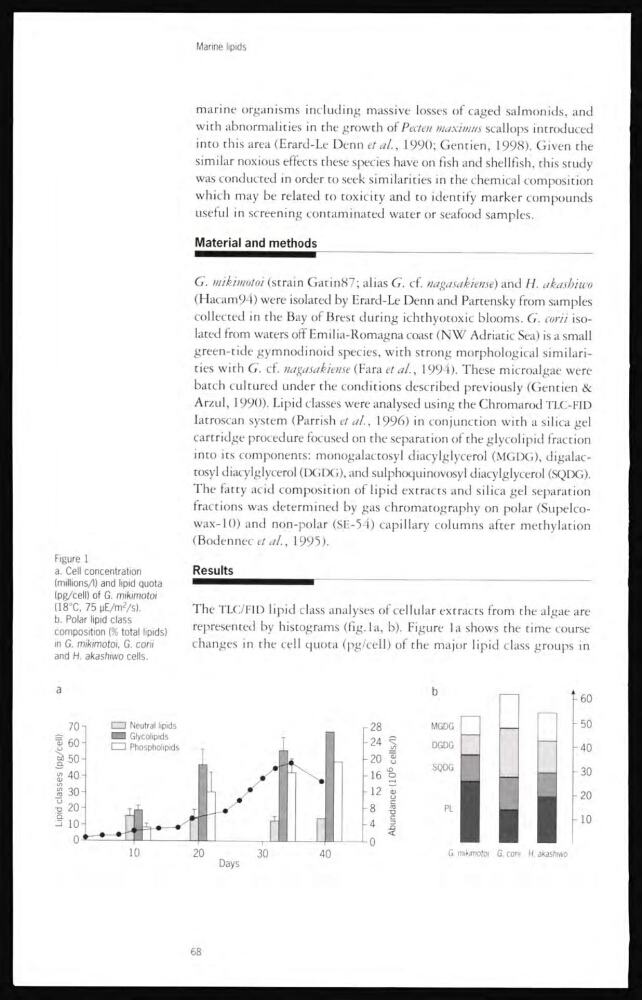
The TLC/FID lipid class analyses of cellular extracts from the algae are
represented by histograms (fig. 1a, b). Figure 1a shows the time course
changes in the cell quota (pg/cell) of the major lipid class groups in
Figure 1
a. Cell concentration
(millions/l) and lipid quota
(pg/cell) of G. mikimotoi
(18°C, 75 µE/m 2 /s).
b. Polar lipid class
composition (% total lipids)
in G. mikimotoi, G. corii
and H. akashiwo cells.
68
marine organisms including massive losses of caged salmonids, and
with abnormalities in the growth of Pecten maximus scallops introduced
into this area (Erard-Le Denn et al., 1990; Gentien, 1998). Given the
similar noxious effects these species have on fish and shellfish, this study
was conducted in order to seek similarities in the chemical composition
which may be related to toxicity and to identify marker compounds
useful in screening contaminated water or seafood samples.
Material and methods
G. mikimotoi (strain Gatin87; alias G. cf. nagasakiense) and H. akashiwo
(Hacam94) were isolated by Itrard-Le Denn and Partensky from samples
collected in the Bay of Brest during ichthyotoxic blooms. G. corii isolated from waters off Emilia-Romagna coast (NW Adriatic Sea) is a small
green-tide gymnodinoid species, with strong morphological similarities with G. cf. nagasakiense (Fara et al., 1994). These microalgae were
batch cultured under the conditions described previously (Gentien &
Arzul, 1990). Lipid classes were analysed using the Chromarod TLC-FID
Iatroscan system (Parrish et al., 1996) in conjunction with a silica gel
cartridge procedure focused on the separation of the glycolipid fraction
into its components: monogalactosyl diacylglycerol (MGDG), digalactosyl diacylglycerol (DGDG), and sulphoquinovosyl diacylglycerol (SQDG).
The fatty acid composition of lipid extracts and silica gel separation
fractions was determined by gas chromatography on polar (Supelcowax-10) and non-polar (SE-54) capillary columns after methylation
(Bodennec et al., 1995).
Results
The TLC/FID lipid class analyses of cellular extracts from the algae are
represented by histograms (fig. 1a, b). Figure 1a shows the time course
changes in the cell quota (pg/cell) of the major lipid class groups in
Figure 1
a. Cell concentration
(millions/l) and lipid quota
(pg/cell) of G. mikimotoi
(18°C, 75 µE/m 2 /s).
b. Polar lipid class
composition (% total lipids)
in G. mikimotoi, G. corii
and H. akashiwo cells.
68