

Marine lipids
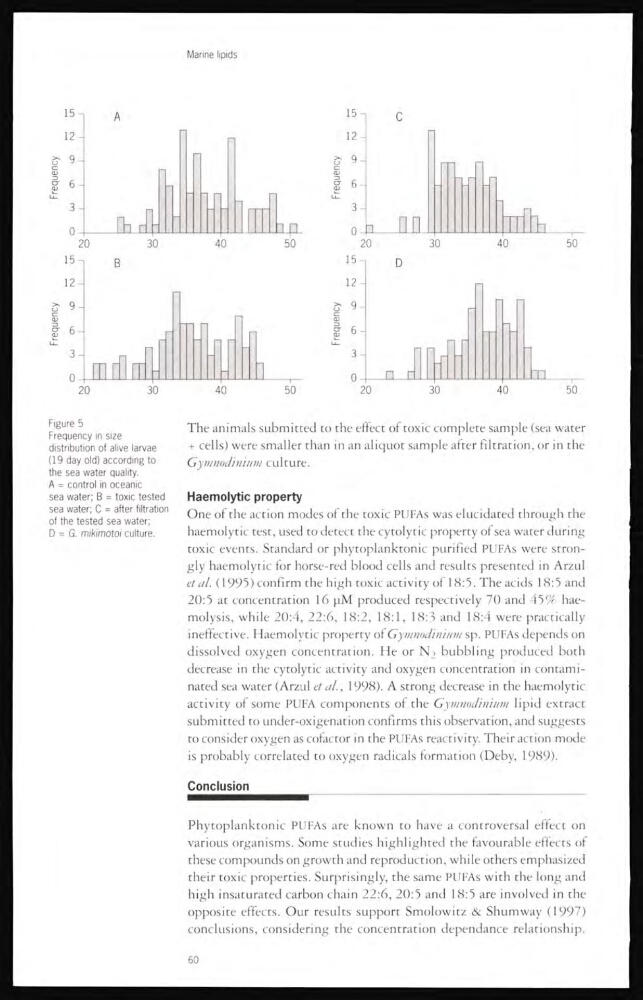
Figure 5
Frequency in size
distribution of alive larvae
(19 day old) according to
the sea water quality.
A = control in oceanic
sea water; B = toxic tested
sea water; C = after filtration
of the tested sea water;
D = G. mikimotoi culture.
The animals submitted to the effect of toxic complete sample (sea water
+ cells) were smaller than in an aliquot sample after filtration, or in the
Gymnodinium culture.
Haemolytic property
One of the action modes of the toxic PUFAs was elucidated through the
haemolytic test, used to detect the cytolytic property of sea water during
toxic events. Standard or phytoplanktonic purified PUFAs were strongly haemolytic for horse-red blood cells and results presented in Arzul
et al. ( 1995) confirm the high toxic activity of 18:5. The acids 18:5 and
20:5 at concentration 16 µM produced respectively 70 and 45% haemolysis, while 20:4, 22:6, 18:2, 18:1, 18:3 and 18:4 were practically
ineffective. Haemolytic property of Gymnodinium sp. PUFAs depends on
dissolved oxygen concentration. He or N 2 bubbling produced both
decrease in the cytolytic activity and oxygen concentration in contaminated sea water (Arzul et al., 1998). A strong decrease in the haemolytic
activity of some PUFA components of the Gymnodinium lipid extract
submitted to under-oxigenation confirms this observation, and suggests
to consider oxygen as cofactor in the PUFAs reactivity. Their action mode
is probably correlated to oxygen radicals formation (Deby, 1989).
Conclusion
Phytoplanktonic PUFAs are known to have a controversal effect on
various organisms. Some studies highlighted the favourable effects of
these compounds on growth and reproduction, while others emphasized
their toxic properties. Surprisingly, the same PUFAs with the long and
high insaturated carbon chain 22:6, 20:5 and 18:5 are involved in the
opposite effects. Our results support Smolowitz & Shumway (1997)
conclusions, considering the concentration dependance relationship.
60
Figure 5
Frequency in size
distribution of alive larvae
(19 day old) according to
the sea water quality.
A = control in oceanic
sea water; B = toxic tested
sea water; C = after filtration
of the tested sea water;
D = G. mikimotoi culture.
The animals submitted to the effect of toxic complete sample (sea water
+ cells) were smaller than in an aliquot sample after filtration, or in the
Gymnodinium culture.
Haemolytic property
One of the action modes of the toxic PUFAs was elucidated through the
haemolytic test, used to detect the cytolytic property of sea water during
toxic events. Standard or phytoplanktonic purified PUFAs were strongly haemolytic for horse-red blood cells and results presented in Arzul
et al. ( 1995) confirm the high toxic activity of 18:5. The acids 18:5 and
20:5 at concentration 16 µM produced respectively 70 and 45% haemolysis, while 20:4, 22:6, 18:2, 18:1, 18:3 and 18:4 were practically
ineffective. Haemolytic property of Gymnodinium sp. PUFAs depends on
dissolved oxygen concentration. He or N 2 bubbling produced both
decrease in the cytolytic activity and oxygen concentration in contaminated sea water (Arzul et al., 1998). A strong decrease in the haemolytic
activity of some PUFA components of the Gymnodinium lipid extract
submitted to under-oxigenation confirms this observation, and suggests
to consider oxygen as cofactor in the PUFAs reactivity. Their action mode
is probably correlated to oxygen radicals formation (Deby, 1989).
Conclusion
Phytoplanktonic PUFAs are known to have a controversal effect on
various organisms. Some studies highlighted the favourable effects of
these compounds on growth and reproduction, while others emphasized
their toxic properties. Surprisingly, the same PUFAs with the long and
high insaturated carbon chain 22:6, 20:5 and 18:5 are involved in the
opposite effects. Our results support Smolowitz & Shumway (1997)
conclusions, considering the concentration dependance relationship.
60