

Marine lipids
traces. The methodology applied in the test was an adaptation of Arzul
et al. (1994) to horse-red blood cells. The PUFAs were used in several
methanolic dissolutions, added at dilution 10 - 3 in the aqueous red blood
cells suspension. After 90 min the incubation was stopped by centrifugation and absorbance of the supernatant was measured at 540 nanometres. Results were compared to a control spiked with pure methanol
at the same dilution, ancl possibly quantified with saponine standard
haemolysis.
Results and discussion
Fatty acid composition of Gymnodinium mikimotoi
The major unsaturated fatty acids (> 1 % of total fatty acids) in a
hydrolyzed cellular extract used in this experiment are: 18:5 ω3 (25%),
22:6 ω3 (15.2%), 18:2 ω6 (3.6%), 18:1 ω9 (2.7%), 20:5 ω3 (1.5%)
and 18:4 ω3 (1.1%). Octadecapentaenoic acid (18:5 ω3) is an unusual
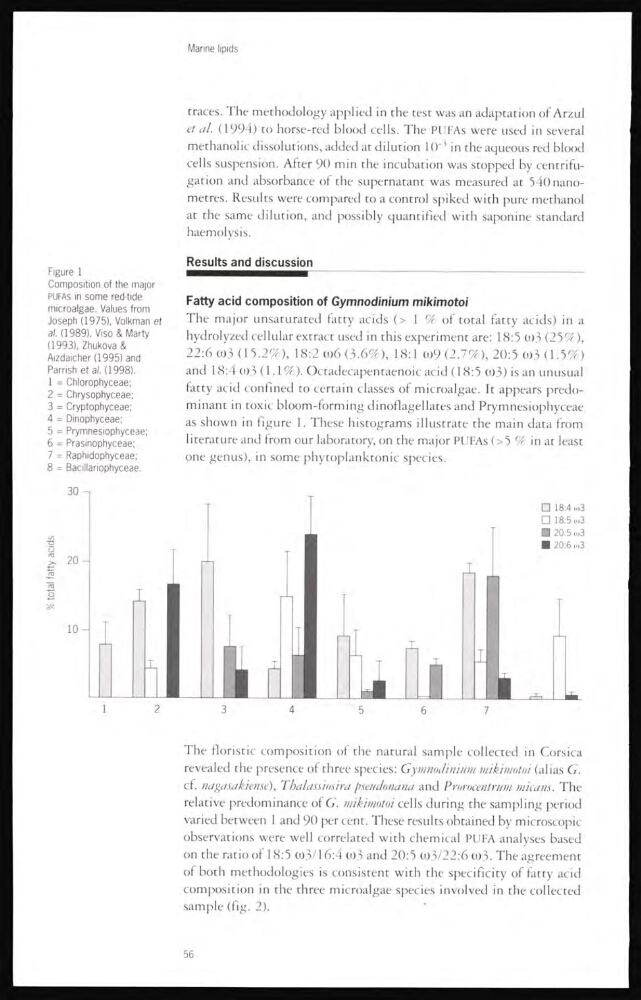
fatty acid confined to certain classes of microalgae. It appears predominant in toxic bloom-forming dinoflagellates and Prymnesiophyceae
as shown in figure 1. These histograms illustrate the main data from
literature and from our laboratory, on the major PUFAs (> 5 % in at least
one genus), in some phytoplanktonic species.
□ 18:4 ω3
□ 18:5 ω3
□ 20:5 ω3
■ 20:6 ω3
Figure 1
Composition of the maior
PUFAs in some red-tide
microalgae. Values from
Joseph (1975), Volkman et
al. (1989), Viso & Marty
(1993), Zhukova &
Aizdaicher (1995) and
Parrish et al. (1998).
1 = Chlorophyceae;
2 = Chrysophyceae;
3 = Cryptophyceae;
4 = Dinophyceae;
5 = Prymnesiophyceae;
6 = Prasinophyceae;
7 = Raphidophyceae;
8 = Bacillariophyceae.
The floristic composition of the natural sample collected in Corsica
revealed the presence of three species: Gymnodinium mikimotoi (alias G.
cf. nagasakieme), Thalassiosira pseudonana and Prorocentrum micans. The
relative predominance of G. mikimotoi cells during the sampling period
varied between 1 and 90 per cent. These results obtained by microscopic
observations were well correlated with chemical PUFA analyses based
on the ratio of 18:5 ω3/16:4 ω3 and 20:5 ω3/22:6 ω3. The agreement
of both methodologies is consistent with the specificity of fatty acid
composition in the three microalgae species involved in the collected
sample (fig. 2).
56
traces. The methodology applied in the test was an adaptation of Arzul
et al. (1994) to horse-red blood cells. The PUFAs were used in several
methanolic dissolutions, added at dilution 10 - 3 in the aqueous red blood
cells suspension. After 90 min the incubation was stopped by centrifugation and absorbance of the supernatant was measured at 540 nanometres. Results were compared to a control spiked with pure methanol
at the same dilution, ancl possibly quantified with saponine standard
haemolysis.
Results and discussion
Fatty acid composition of Gymnodinium mikimotoi
The major unsaturated fatty acids (> 1 % of total fatty acids) in a
hydrolyzed cellular extract used in this experiment are: 18:5 ω3 (25%),
22:6 ω3 (15.2%), 18:2 ω6 (3.6%), 18:1 ω9 (2.7%), 20:5 ω3 (1.5%)
and 18:4 ω3 (1.1%). Octadecapentaenoic acid (18:5 ω3) is an unusual
fatty acid confined to certain classes of microalgae. It appears predominant in toxic bloom-forming dinoflagellates and Prymnesiophyceae
as shown in figure 1. These histograms illustrate the main data from
literature and from our laboratory, on the major PUFAs (> 5 % in at least
one genus), in some phytoplanktonic species.
□ 18:4 ω3
□ 18:5 ω3
□ 20:5 ω3
■ 20:6 ω3
Figure 1
Composition of the maior
PUFAs in some red-tide
microalgae. Values from
Joseph (1975), Volkman et
al. (1989), Viso & Marty
(1993), Zhukova &
Aizdaicher (1995) and
Parrish et al. (1998).
1 = Chlorophyceae;
2 = Chrysophyceae;
3 = Cryptophyceae;
4 = Dinophyceae;
5 = Prymnesiophyceae;
6 = Prasinophyceae;
7 = Raphidophyceae;
8 = Bacillariophyceae.
The floristic composition of the natural sample collected in Corsica
revealed the presence of three species: Gymnodinium mikimotoi (alias G.
cf. nagasakieme), Thalassiosira pseudonana and Prorocentrum micans. The
relative predominance of G. mikimotoi cells during the sampling period
varied between 1 and 90 per cent. These results obtained by microscopic
observations were well correlated with chemical PUFA analyses based
on the ratio of 18:5 ω3/16:4 ω3 and 20:5 ω3/22:6 ω3. The agreement
of both methodologies is consistent with the specificity of fatty acid
composition in the three microalgae species involved in the collected
sample (fig. 2).
56