

Biotechnology
be a better explanation. The physical properties of the substrate-enzyme
interface affect lipase catalysis. Aoubala et al. (1995) have shown a
similar effect when free fatty acids were present in the intestine for
triacylglycerides hydrolysis by the pancreatic lipase. This effect was
ascribed to modifîcations of the emulsion quality. The electrostatic state
of the amino acids of the active site could also be affected by the presence of free fatty acids or esters in the reaction medium. Petersen
(1995) has shown that pH variations of the reaction medium had an
influence on the potential of amino acids located in the active site of
the lipase B from C. antarctica.
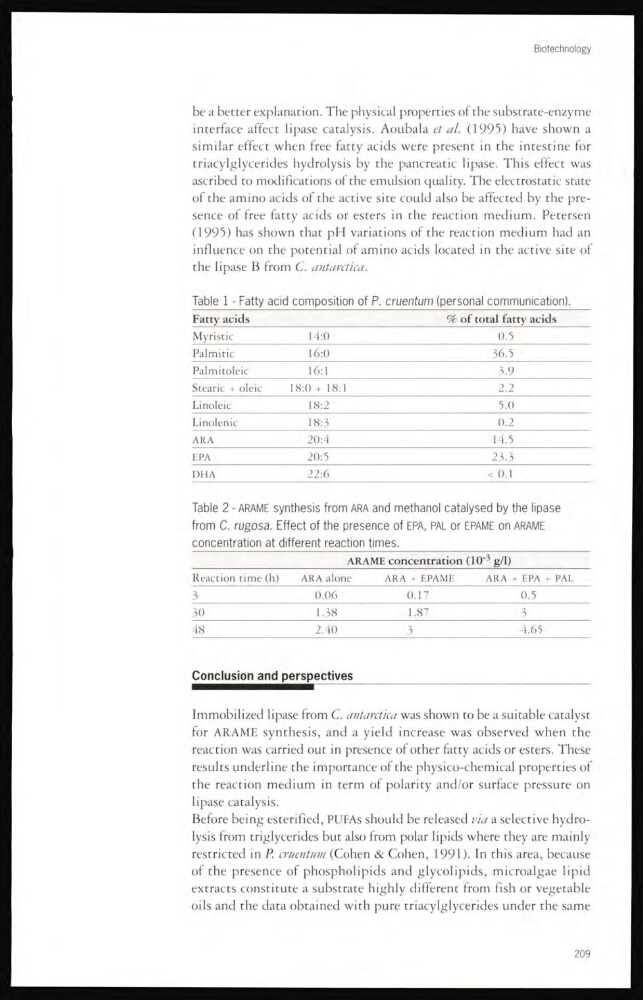
Table 1 - Fatty acid composition of P. cruentum (personal communication).
Fatty acids
% of total fatty acids
Myristic
14:0
0.5
Palmitic
16:0
36.5
Palmitoleic
16:1
3.9
Stearic + oleic
18:0 + 18:1
2.2
Linoleic
18:2
5.0
Linolenic
18:3
0.2
ARA
20:4
14.5
EPA
20:5
2.3.3
DHA
22:6
< 0.1
Table 2 - ARAME synthesis from ARA and methanol catalysed by the lipase
from C. rugosa. Effect of the presence of EPA, PAL or EPAME on ARAME
concentration at different reaction times.
ARAME concentration (10 -3 g/l)
Reaction time (h)
ARA alone
ARA + EPAME
ARA + EPA + PAL
3
0.06
0.17
0.5
30
1.38
1.87
3
48
2.40
3
4.65
Conclusion and perspectives
Immobilized lipase from C. antarctica was shown to be a suitable catalyst
for ARAME synthesis, and a yield increase was observed when the
reaction was carried out in presence of other fatty acids or esters. These
results underline the importance of the physico-chemical properties of
the reaction medium in term of polarity and/or surface pressure on
lipase catalysis.
Before being esterified, PUFAs should be released via a selective hydrolysis from triglycerides but also from polar lipids where they are mainly
restricted in P. cruentum (Cohen & Cohen, 1991). In this area, because
of the presence of phospholipids and glycolipids, microalgae lipid
extracts constitute a substrate highly different from fish or vegetable
oils and the data obtained with pure triacylglycerides under the same
209
be a better explanation. The physical properties of the substrate-enzyme
interface affect lipase catalysis. Aoubala et al. (1995) have shown a
similar effect when free fatty acids were present in the intestine for
triacylglycerides hydrolysis by the pancreatic lipase. This effect was
ascribed to modifîcations of the emulsion quality. The electrostatic state
of the amino acids of the active site could also be affected by the presence of free fatty acids or esters in the reaction medium. Petersen
(1995) has shown that pH variations of the reaction medium had an
influence on the potential of amino acids located in the active site of
the lipase B from C. antarctica.
Table 1 - Fatty acid composition of P. cruentum (personal communication).
Fatty acids
% of total fatty acids
Myristic
14:0
0.5
Palmitic
16:0
36.5
Palmitoleic
16:1
3.9
Stearic + oleic
18:0 + 18:1
2.2
Linoleic
18:2
5.0
Linolenic
18:3
0.2
ARA
20:4
14.5
EPA
20:5
2.3.3
DHA
22:6
< 0.1
Table 2 - ARAME synthesis from ARA and methanol catalysed by the lipase
from C. rugosa. Effect of the presence of EPA, PAL or EPAME on ARAME
concentration at different reaction times.
ARAME concentration (10 -3 g/l)
Reaction time (h)
ARA alone
ARA + EPAME
ARA + EPA + PAL
3
0.06
0.17
0.5
30
1.38
1.87
3
48
2.40
3
4.65
Conclusion and perspectives
Immobilized lipase from C. antarctica was shown to be a suitable catalyst
for ARAME synthesis, and a yield increase was observed when the
reaction was carried out in presence of other fatty acids or esters. These
results underline the importance of the physico-chemical properties of
the reaction medium in term of polarity and/or surface pressure on
lipase catalysis.
Before being esterified, PUFAs should be released via a selective hydrolysis from triglycerides but also from polar lipids where they are mainly
restricted in P. cruentum (Cohen & Cohen, 1991). In this area, because
of the presence of phospholipids and glycolipids, microalgae lipid
extracts constitute a substrate highly different from fish or vegetable
oils and the data obtained with pure triacylglycerides under the same
209