

Marine lipids
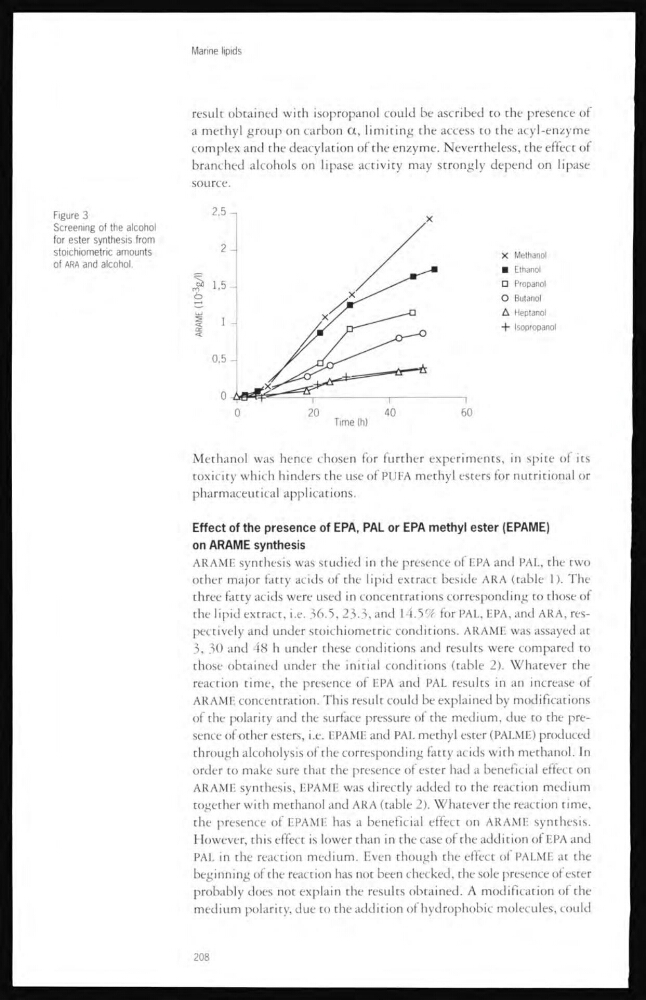
result obtained with isopropanol could be ascribed to the presence of
a methyl group on carbon a, limiting the access to the acyl-enzyme
complex and the deacylation of the enzyme. Nevertheless, the effect of
branched alcohols on lipase activity may strongly depend on lipase
source.
Figure 3
Screening of the alcohol
for ester synthesis from
stoichiometric amounts
of ARA and alcohol.
X Methanol
■ Ethanol
□ Propanol
O Butanol
Δ Heptanol
+ Isopropanol
Methanol was hence chosen for further experiments, in spite of its
toxicity which hinders the use of PUFA methyl esters for nutritional or
pharmaceutical applications.
Effect of the presence of EPA, PAL or EPA methyl ester (EPAME)
on ARAME synthesis
ARAME synthesis was studied in the presence of EPA and PAL, the two
other major fatty acids of the lipid extract beside ARA (table 1). The
three fatty acids were tised in concentrations corresponding to those of
the lipid extract, i.e. 36.5, 23.3, and 14.5% for PAL, EPA, and ARA, respectively and under stoichiometric conditions. ARAME was assayed at
3, 30 and 48 h under these conditions and results were compared to
those obtained under the initial conditions (table 2). Whatever the
reaction time, the presence of EPA and PAL results m an increase of
ARAME concentration. This result could be explained by modifications
of the polarity and the surface pressure of the medium, due to the presence of other esters, i.e. EPAME and PAL methyl ester (PALME) produced
through alcoholysis of the corresponding fatty acids with methanol. In
order to make sure that the presence of ester had a beneficial effect on
ARAME synthesis, EPAME was directly added to the reaction meclium
together with methanol and ARA (table 2). Whatever the reaction time,
the presence of EPAME has a beneficial effect on ARAME synthesis.
However, this effect is lower than in the case of the addition of EPA and
PAL in the reaction medium. Even though the effect of PALME at the
beginning of the reaction has not been checked, the sole presence of ester
probably does not explain the results obtained. A modification of the
medium polarity, due to the addition of hydrophobic molecules, could
208
result obtained with isopropanol could be ascribed to the presence of
a methyl group on carbon a, limiting the access to the acyl-enzyme
complex and the deacylation of the enzyme. Nevertheless, the effect of
branched alcohols on lipase activity may strongly depend on lipase
source.
Figure 3
Screening of the alcohol
for ester synthesis from
stoichiometric amounts
of ARA and alcohol.
X Methanol
■ Ethanol
□ Propanol
O Butanol
Δ Heptanol
+ Isopropanol
Methanol was hence chosen for further experiments, in spite of its
toxicity which hinders the use of PUFA methyl esters for nutritional or
pharmaceutical applications.
Effect of the presence of EPA, PAL or EPA methyl ester (EPAME)
on ARAME synthesis
ARAME synthesis was studied in the presence of EPA and PAL, the two
other major fatty acids of the lipid extract beside ARA (table 1). The
three fatty acids were tised in concentrations corresponding to those of
the lipid extract, i.e. 36.5, 23.3, and 14.5% for PAL, EPA, and ARA, respectively and under stoichiometric conditions. ARAME was assayed at
3, 30 and 48 h under these conditions and results were compared to
those obtained under the initial conditions (table 2). Whatever the
reaction time, the presence of EPA and PAL results m an increase of
ARAME concentration. This result could be explained by modifications
of the polarity and the surface pressure of the medium, due to the presence of other esters, i.e. EPAME and PAL methyl ester (PALME) produced
through alcoholysis of the corresponding fatty acids with methanol. In
order to make sure that the presence of ester had a beneficial effect on
ARAME synthesis, EPAME was directly added to the reaction meclium
together with methanol and ARA (table 2). Whatever the reaction time,
the presence of EPAME has a beneficial effect on ARAME synthesis.
However, this effect is lower than in the case of the addition of EPA and
PAL in the reaction medium. Even though the effect of PALME at the
beginning of the reaction has not been checked, the sole presence of ester
probably does not explain the results obtained. A modification of the
medium polarity, due to the addition of hydrophobic molecules, could
208