

Methodology
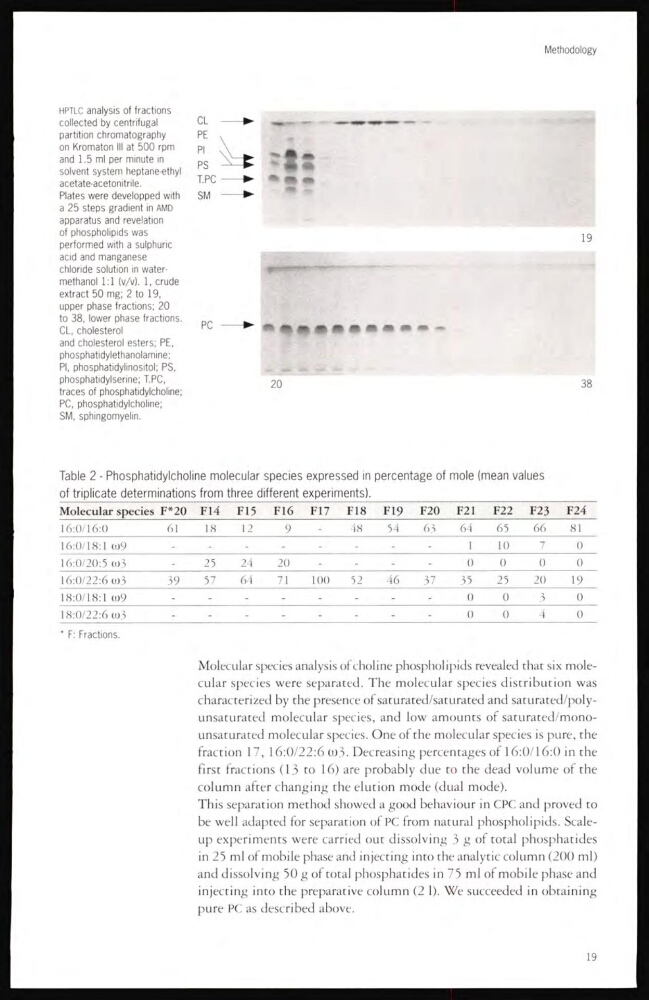
HPTLC analysis of fractions
collected by centrifugal
partition chromatography
on Kromaton III at 500 rpm
and 1.5 ml per minute in
solvent system heptane-ethyl
acetate-acetonitrile.
Plates were developped with
a 25 steps gradient in AMD
apparatus and revelation
of phospholipids was
performed with a sulphuric
acid and manganese
chloride solution in watermethanol 1:1 (v/v). 1, crude
extract 50 mg; 2 to 19,
upper phase fractions; 20
to 38, lower phase fractions.
CL, cholesterol
and cholesterol esters; PE,
phosphatidylethanolamine;
Pl, phosphatidylinositol; PS,
phosphatidylserine; T.PC,
traces of phosphatidylcholine;
PC, phosphatidylcholine;
SM, sphingomyelin.
Table 2 - Phosphatidylcholine molecular species expressed in percentage of mole (mean values
of triplicate determinations from three different experiments).
Molecular species F *20 F14 F15 F16 F17 F18 F19 F20 F21 F22 F23 F24
16:0/16:0
61
18
12
0
-
18
5 l
63
64
05
00
81
16:0/18:1 ω9
-
-
-
-
-
-
-
-
1
10
7
0
16:0/20:5 ω3
-
25
2 l
20
-
-
-
-
0
0
0
0
16:0/22:6 ω3
39
57
64
71
100
52
46
37
35
25
20
19
18:0/18:1
-
-
-
-
-
-
-
0
0
3
0
18:0/22:6 ω3
-
-
-
-
-
-
-
-
0
0
1
0
* F: Fractions.
Molecular species analysis of choline phospholipids revealed that six molecular species were separated. The molecular species distribution was
characterized by the presence of saturated/saturated and saturated/polyunsaturated molecular species, and low amounts of saturated/monounsaturated molecular species. One of the molecular species is pure, the
fraction 17, 16:0/22:6 ω3. Decreasing percentages of 16:0/16:0 in the
first fractions (13 to 16) are probably due to the dead volume of the
column after changing the elution mode (clual mode).
This separation method showed a good behaviour in CPC and proved to
be well adapted for separation of PC from natural phospholipids. Scaleup experiments were carried out dissolving 3 g of total phosphatides
in 25 ml of mobile phase and injecting into the analytic column (200 ml)
and dissolving 50 g of total phosphatides in 75 ml of mobile phase and
injecting into the preparative column (2 l). We succeeded in obtaining
pure PC as described above.
19
HPTLC analysis of fractions
collected by centrifugal
partition chromatography
on Kromaton III at 500 rpm
and 1.5 ml per minute in
solvent system heptane-ethyl
acetate-acetonitrile.
Plates were developped with
a 25 steps gradient in AMD
apparatus and revelation
of phospholipids was
performed with a sulphuric
acid and manganese
chloride solution in watermethanol 1:1 (v/v). 1, crude
extract 50 mg; 2 to 19,
upper phase fractions; 20
to 38, lower phase fractions.
CL, cholesterol
and cholesterol esters; PE,
phosphatidylethanolamine;
Pl, phosphatidylinositol; PS,
phosphatidylserine; T.PC,
traces of phosphatidylcholine;
PC, phosphatidylcholine;
SM, sphingomyelin.
Table 2 - Phosphatidylcholine molecular species expressed in percentage of mole (mean values
of triplicate determinations from three different experiments).
Molecular species F *20 F14 F15 F16 F17 F18 F19 F20 F21 F22 F23 F24
16:0/16:0
61
18
12
0
-
18
5 l
63
64
05
00
81
16:0/18:1 ω9
-
-
-
-
-
-
-
-
1
10
7
0
16:0/20:5 ω3
-
25
2 l
20
-
-
-
-
0
0
0
0
16:0/22:6 ω3
39
57
64
71
100
52
46
37
35
25
20
19
18:0/18:1
-
-
-
-
-
-
-
0
0
3
0
18:0/22:6 ω3
-
-
-
-
-
-
-
-
0
0
1
0
* F: Fractions.
Molecular species analysis of choline phospholipids revealed that six molecular species were separated. The molecular species distribution was
characterized by the presence of saturated/saturated and saturated/polyunsaturated molecular species, and low amounts of saturated/monounsaturated molecular species. One of the molecular species is pure, the
fraction 17, 16:0/22:6 ω3. Decreasing percentages of 16:0/16:0 in the
first fractions (13 to 16) are probably due to the dead volume of the
column after changing the elution mode (clual mode).
This separation method showed a good behaviour in CPC and proved to
be well adapted for separation of PC from natural phospholipids. Scaleup experiments were carried out dissolving 3 g of total phosphatides
in 25 ml of mobile phase and injecting into the analytic column (200 ml)
and dissolving 50 g of total phosphatides in 75 ml of mobile phase and
injecting into the preparative column (2 l). We succeeded in obtaining
pure PC as described above.
19