

Function and metabolism
PE (n=4). Kinetics of incorporation into PC and into PE remained different since PC/PE ratio was 1.48 at 24 h and reached 1.92 at 48 hours.
Effects of alkyl-Gro incorporation on albumin permeability
The endothelial cell monolayers were or were not incubated with
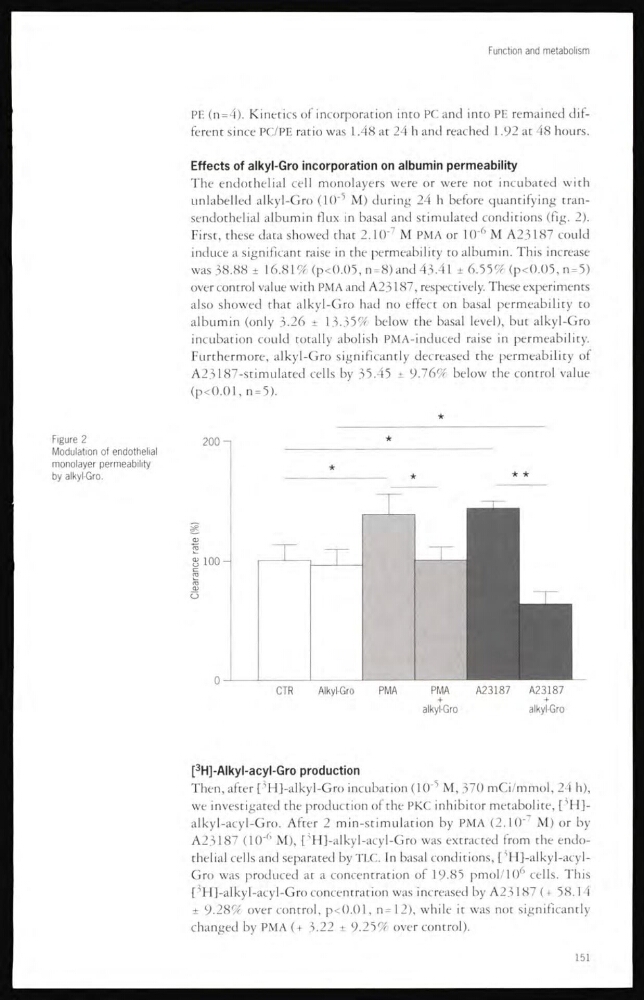
unlabelled alkyl-Gro (10 -5 M) during 24 h before quantifying transendothelial albumin flux in basal and stimulated conditions (fig. 2).
First, these data showed that 2.10 - 7 M PMA or 10 M A23187 could
induce a significant raise in the permeability to albumin. This increase
was 38.88 ± 16.81% (p<0.05, n = 8) and 43.41 ±6.55% (p<0.05, n = 5)
over control value with PMA and A23187, respectively. These experiments
also showed that alkyl-Gro had no effect on basal permeability to
albumin (only 3.26 ± 13.35% below the basal level), but alkyl-Gro
incubation could totally abolish PMA-induced raise in permeability.
Furthermore, alkyl-Gro significantly decreased the permeability of
A23187-stimulated cells by 35.45 ± 9.76(7 below the control value
(p<0.01, n = 5).
Figure 2
Modulation of endothelial
monolayer permeability
by alkyl-Gro.
[ 3 H]-Alkyl-acyl-Gro production
Then, after {
3 H]-alkyl-Gro incubation (10 -5 M, 370 mCi/mmol, 24 h),
we investigated the production of the PKC inhibitor metabolite, [ 3 H]alkyl-acyl-Gro. After 2 min-stimulation by PMA (2.10 -7 M) or by
A23187 (10 - 6 M), pH]-alkyl-acyl-Gro was extracted from the endothelial cells and separated by TLC. In basal conditions, {
3 H]-alkyl-acylGro was produced at a concentration of 19.85 pmol/10 6 cells. This
{
3 H]-alkyl-acyl-Gro concentration was increased by A23187 (+ 58.14
± 9.28% over control, p<0.01, n=12), while it was not significantly
changed by PMA(+3.22 ± 9.25% over control).
151
PE (n=4). Kinetics of incorporation into PC and into PE remained different since PC/PE ratio was 1.48 at 24 h and reached 1.92 at 48 hours.
Effects of alkyl-Gro incorporation on albumin permeability
The endothelial cell monolayers were or were not incubated with
unlabelled alkyl-Gro (10 -5 M) during 24 h before quantifying transendothelial albumin flux in basal and stimulated conditions (fig. 2).
First, these data showed that 2.10 - 7 M PMA or 10 M A23187 could
induce a significant raise in the permeability to albumin. This increase
was 38.88 ± 16.81% (p<0.05, n = 8) and 43.41 ±6.55% (p<0.05, n = 5)
over control value with PMA and A23187, respectively. These experiments
also showed that alkyl-Gro had no effect on basal permeability to
albumin (only 3.26 ± 13.35% below the basal level), but alkyl-Gro
incubation could totally abolish PMA-induced raise in permeability.
Furthermore, alkyl-Gro significantly decreased the permeability of
A23187-stimulated cells by 35.45 ± 9.76(7 below the control value
(p<0.01, n = 5).
Figure 2
Modulation of endothelial
monolayer permeability
by alkyl-Gro.
[ 3 H]-Alkyl-acyl-Gro production
Then, after {
3 H]-alkyl-Gro incubation (10 -5 M, 370 mCi/mmol, 24 h),
we investigated the production of the PKC inhibitor metabolite, [ 3 H]alkyl-acyl-Gro. After 2 min-stimulation by PMA (2.10 -7 M) or by
A23187 (10 - 6 M), pH]-alkyl-acyl-Gro was extracted from the endothelial cells and separated by TLC. In basal conditions, {
3 H]-alkyl-acylGro was produced at a concentration of 19.85 pmol/10 6 cells. This
{
3 H]-alkyl-acyl-Gro concentration was increased by A23187 (+ 58.14
± 9.28% over control, p<0.01, n=12), while it was not significantly
changed by PMA(+3.22 ± 9.25% over control).
151