

Marine lipids
Stimulation was stopped by replacing supernatant by cold methanol.
Neutral lipids were then extracted with heptane and l-O-{
3 H]-alkyl2-acyl-sn-glycerol ([
3 H]-alkyl-acyl-Gro) were separated from [
3 H]-alkylGro on silica gel TLC (diethyl ether-hexane-acetic acid, 35: 15:0.5, v/v, v).
[
3 H]-l-O-alkyl-2-arachidonyl-Gro standard was synthetized from
enzymatic acylation of tritied lyso-platelet activating factor ([
3 H]-1O-hexadecyl-2-lysoPAF) followed by phospholipase C (PLC) hydrolysis
as described previously (Legrand et al., 1996). Radioactive material
was visualized on the radiochromatogram scanner and [
3 H]-alkyl-acylGro was scrapped off, and radioactivity was measured in the liquid
scintillation counter.
Statistics
Data are presented as means ± SD of the indicated number of experiments. The results were analysed by a two way-ANOVA, and significance
of the differences between treatments was further assessed by a Duncan’s
mtiltiple range test or a Student’s /-test.
Results
Incorporation of alkyl-Gro into phosphatidylcholine
First, using a [
3 H]-labelled mixture of natural alkyl-Gro obtained from
shark liver oil, we investigated the kinetics of incorporation of [
3 H]alkyl-Gro into PL of PAEC. Our data showed that [
3 H]-alkyl-Gro were
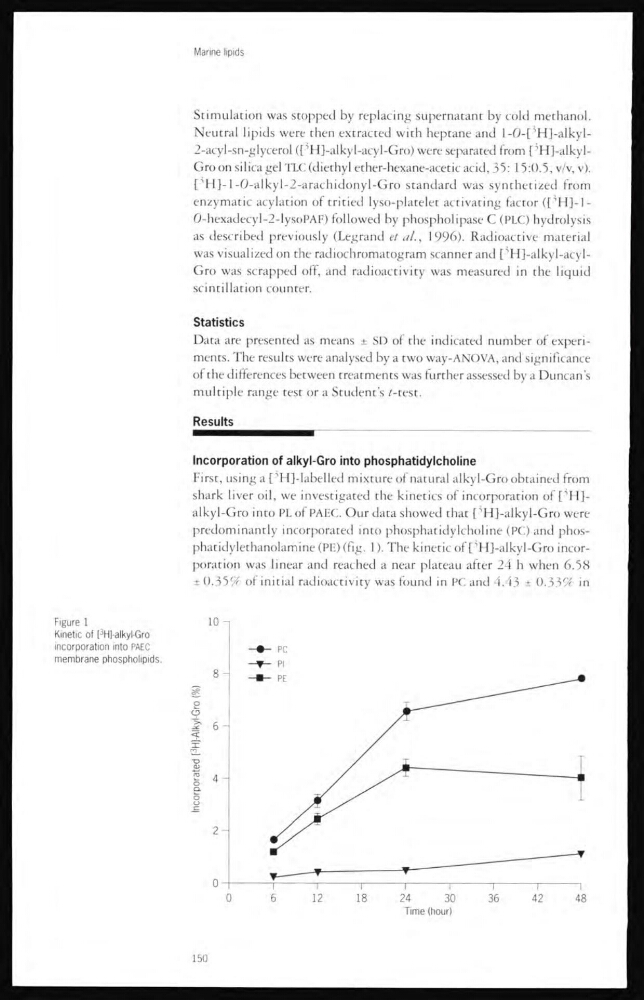
predominantly incorporated into phosphatidylcholine (PC) and phosphatidylethanolamine (PE) (fig. 1). The kinetic of [
3 H]-alkyl-Gro incorporation was linear and reached a near plateau after 24 h when 6.58
± 0.35% of initial radioactivity was found in PC and 4.43 ± 0.33% m
Figure 1
Kinetic of [
3 H] alkyl-Gro
incorporation into PAEC
membrane phospholipids.
150
Stimulation was stopped by replacing supernatant by cold methanol.
Neutral lipids were then extracted with heptane and l-O-{
3 H]-alkyl2-acyl-sn-glycerol ([
3 H]-alkyl-acyl-Gro) were separated from [
3 H]-alkylGro on silica gel TLC (diethyl ether-hexane-acetic acid, 35: 15:0.5, v/v, v).
[
3 H]-l-O-alkyl-2-arachidonyl-Gro standard was synthetized from
enzymatic acylation of tritied lyso-platelet activating factor ([
3 H]-1O-hexadecyl-2-lysoPAF) followed by phospholipase C (PLC) hydrolysis
as described previously (Legrand et al., 1996). Radioactive material
was visualized on the radiochromatogram scanner and [
3 H]-alkyl-acylGro was scrapped off, and radioactivity was measured in the liquid
scintillation counter.
Statistics
Data are presented as means ± SD of the indicated number of experiments. The results were analysed by a two way-ANOVA, and significance
of the differences between treatments was further assessed by a Duncan’s
mtiltiple range test or a Student’s /-test.
Results
Incorporation of alkyl-Gro into phosphatidylcholine
First, using a [
3 H]-labelled mixture of natural alkyl-Gro obtained from
shark liver oil, we investigated the kinetics of incorporation of [
3 H]alkyl-Gro into PL of PAEC. Our data showed that [
3 H]-alkyl-Gro were
predominantly incorporated into phosphatidylcholine (PC) and phosphatidylethanolamine (PE) (fig. 1). The kinetic of [
3 H]-alkyl-Gro incorporation was linear and reached a near plateau after 24 h when 6.58
± 0.35% of initial radioactivity was found in PC and 4.43 ± 0.33% m
Figure 1
Kinetic of [
3 H] alkyl-Gro
incorporation into PAEC
membrane phospholipids.
150