

survival, forwhich both food availability through primary production
and larval retention within closed structures are postulated bottlenecks
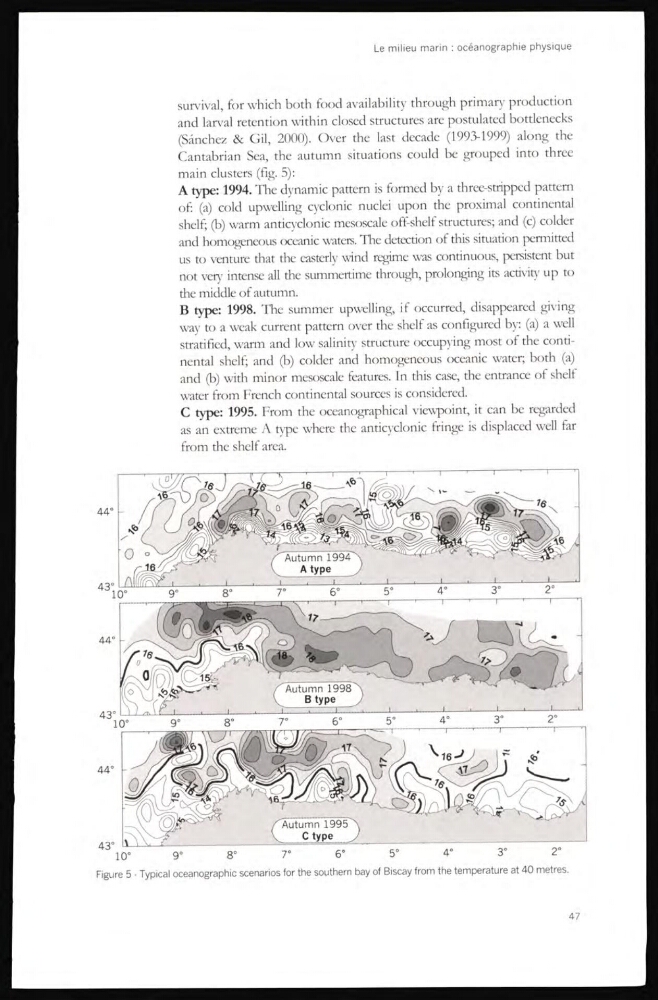
(Sánchez & Gil, 2000). Over the last decade (1993-1999) along the
Cantabrian Sea, the autumn situations could be grouped into three
main clusters (fig. 5):
A type: 1994. The dynamic pattern is formed by a three-stripped pattem
of: (a) cold upwelling cyclonic nuclei upon the proximal continental
shelf; (b) warm anticyclonic mesoscale off-shelf structures; and (c) colder
and homogeneous oceanic waters. The detection of this situation permitted
us to venture that the easterly wind regime was continuous, persistent but
not very intense all the summertime through, prolonging its activity up to
the middle of autumn.
B type: 1998. The summer upwelling, if occurred, disappeared giving
way to a weak current pattern over the shelf as configured by: (a) a well
stratified, warm and low salinity structure occupying most of the continental shelf; and (b) colder and homogeneous oceanic water; both (a)
and (b) with minor mesoscale features. In this case, the entrance of shelf
water front French continental sources is considered.
C type: 1995. From the oceanographical viewpoint, it can be regarded
as an extreme A type where the anticyclonic fringe is displaced well far
from the shelf area.
Figure 5 - Typical oceanographic scenarios for the southern bay of Biscay from the temperature at 40 metres.
47
and larval retention within closed structures are postulated bottlenecks
(Sánchez & Gil, 2000). Over the last decade (1993-1999) along the
Cantabrian Sea, the autumn situations could be grouped into three
main clusters (fig. 5):
A type: 1994. The dynamic pattern is formed by a three-stripped pattem
of: (a) cold upwelling cyclonic nuclei upon the proximal continental
shelf; (b) warm anticyclonic mesoscale off-shelf structures; and (c) colder
and homogeneous oceanic waters. The detection of this situation permitted
us to venture that the easterly wind regime was continuous, persistent but
not very intense all the summertime through, prolonging its activity up to
the middle of autumn.
B type: 1998. The summer upwelling, if occurred, disappeared giving
way to a weak current pattern over the shelf as configured by: (a) a well
stratified, warm and low salinity structure occupying most of the continental shelf; and (b) colder and homogeneous oceanic water; both (a)
and (b) with minor mesoscale features. In this case, the entrance of shelf
water front French continental sources is considered.
C type: 1995. From the oceanographical viewpoint, it can be regarded
as an extreme A type where the anticyclonic fringe is displaced well far
from the shelf area.
Figure 5 - Typical oceanographic scenarios for the southern bay of Biscay from the temperature at 40 metres.
47