

Riverine run-off have maximum intensitics during late winter and early
spring, pardcularly after peak discharges from French Adour and Ciironde
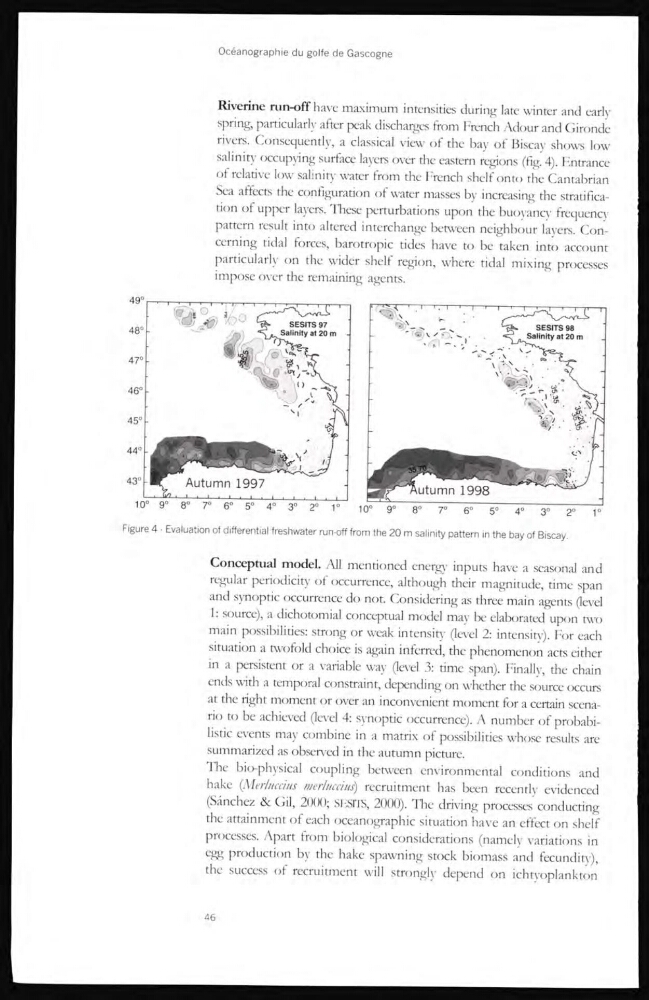
rivets. Consequently, a classical v iew of the bay of Biscay shows low
saltmty occupting surface layers over the eastern regions (fig. 4). Fntrance
oi relative low salinity water from the French shelf onto the Cantabrian
Sea affects the configuration ot water masses by incresising the stratification of upper lavers. These perturbations upon the buoyancy frequency
pattern result into altered interchange between neighbour layers. Concerning tidal forces, barotropic tides have to be taken into account
particularly on the widet shelt region, where tidal mixing processes
impose over the remaining agents.
ngure 4 - Evaluation of differential freshwater run-off from the 20 m salinity pattern in the bay of Biscay.
Conceptual model. All mentioned energy inputs have a seasonal and
regular periodicity of occurrence, although their magnitude, time span
and synoptic occurrence do not. Considering as three main agents (level
1: source), a dichotomial conceptual model may be elaborated upon two
main possibilities: strong or weak intensity (level 2: intensity). For each
situation a twofold choice is again inferred, the phenomenon acts cither
in a persistent or a variable way (level 3: time span). Finally, the chain
ends with a temporal constraint, depending on whether the source occurs
at the right moment or over an inconvenient moment for a certain scenario to be achieved (level 4: synoptic occurrence). A number of probabilistic ev ents may combine in a matrix of possibilities whose results are
summarized as observed in thc autumn picture.
The bio-physical coupling between en\ ironmental conditions and
hake (Merluccins mer/uccius) recruitment has been recently evidenced
(Sánchez & Gil, 2000; M SI'IS, 2000). The driving proccsses conducting
the attainment of each oceanographic situation have an effect on shelf
processes. Apart from biological considerations (namely variations in
egg production by the hake spawning stock biomass and fecundity),
the success of recruitment will strongly depend on ichtyoplankton
46
spring, pardcularly after peak discharges from French Adour and Ciironde
rivets. Consequently, a classical v iew of the bay of Biscay shows low
saltmty occupting surface layers over the eastern regions (fig. 4). Fntrance
oi relative low salinity water from the French shelf onto the Cantabrian
Sea affects the configuration ot water masses by incresising the stratification of upper lavers. These perturbations upon the buoyancy frequency
pattern result into altered interchange between neighbour layers. Concerning tidal forces, barotropic tides have to be taken into account
particularly on the widet shelt region, where tidal mixing processes
impose over the remaining agents.
ngure 4 - Evaluation of differential freshwater run-off from the 20 m salinity pattern in the bay of Biscay.
Conceptual model. All mentioned energy inputs have a seasonal and
regular periodicity of occurrence, although their magnitude, time span
and synoptic occurrence do not. Considering as three main agents (level
1: source), a dichotomial conceptual model may be elaborated upon two
main possibilities: strong or weak intensity (level 2: intensity). For each
situation a twofold choice is again inferred, the phenomenon acts cither
in a persistent or a variable way (level 3: time span). Finally, the chain
ends with a temporal constraint, depending on whether the source occurs
at the right moment or over an inconvenient moment for a certain scenario to be achieved (level 4: synoptic occurrence). A number of probabilistic ev ents may combine in a matrix of possibilities whose results are
summarized as observed in thc autumn picture.
The bio-physical coupling between en\ ironmental conditions and
hake (Merluccins mer/uccius) recruitment has been recently evidenced
(Sánchez & Gil, 2000; M SI'IS, 2000). The driving proccsses conducting
the attainment of each oceanographic situation have an effect on shelf
processes. Apart from biological considerations (namely variations in
egg production by the hake spawning stock biomass and fecundity),
the success of recruitment will strongly depend on ichtyoplankton
46