

(narrow and elongated), the transversal component of the currents was
observed to be negligible.
Winter situation
The cruises carried out on Februarv 10-11, 24-25, March 10-11 and 24-25
show the same characteristic current behaviour. The current on the surface layer is controlled by the wind while the current on bottom layers
is controlled by tide. The wind regime measured during these days has
an E direction with an average wind speed of 5-7 m.s Due to this wind
strength, the surface water leaves the ria during the whole night. As an
example of this typical situation, the February 10-11 cmise is shown in
more detail. The environmental situation observed in February 1998 is
abnormal. A high pressure is present during this month and the river
discharge is much smaller than the one observed in tigure 2 for a
twelve-year period. The wind on the shelf was observed to have an
easterly component.
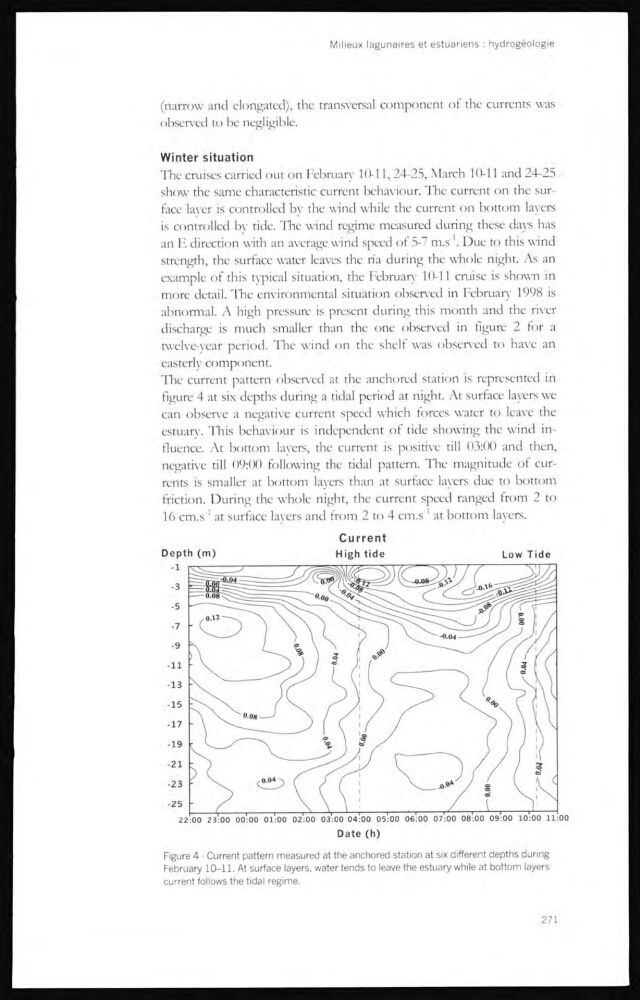
The current pattern observed at the anchored station is represented in
figure 4 at six depths during a tidal period at night. At surface layers we
can observe a negative current speed which forces water to leave the
estuary. This behaviour is independent of tide showing the wind influence. At bottom layers, the current is positive till 03:00 and then,
negative till 09:00 following the tidal pattern. The magnitude of currents is smaller at bottom layers than at surface layers due to bottom
friction. During the whole night, the current speed ranged from 2 to
16 cm.s
1 at surface layers and from 2 to 4 cm.s 1 at bottom layers.
Figure 4 - Current pattern measured at the anchored station at six different depths during
February 10-11. At surface iayers, water tends to leave the estuary while at bottom layers
current follows the tidal regime.
271
observed to be negligible.
Winter situation
The cruises carried out on Februarv 10-11, 24-25, March 10-11 and 24-25
show the same characteristic current behaviour. The current on the surface layer is controlled by the wind while the current on bottom layers
is controlled by tide. The wind regime measured during these days has
an E direction with an average wind speed of 5-7 m.s Due to this wind
strength, the surface water leaves the ria during the whole night. As an
example of this typical situation, the February 10-11 cmise is shown in
more detail. The environmental situation observed in February 1998 is
abnormal. A high pressure is present during this month and the river
discharge is much smaller than the one observed in tigure 2 for a
twelve-year period. The wind on the shelf was observed to have an
easterly component.
The current pattern observed at the anchored station is represented in
figure 4 at six depths during a tidal period at night. At surface layers we
can observe a negative current speed which forces water to leave the
estuary. This behaviour is independent of tide showing the wind influence. At bottom layers, the current is positive till 03:00 and then,
negative till 09:00 following the tidal pattern. The magnitude of currents is smaller at bottom layers than at surface layers due to bottom
friction. During the whole night, the current speed ranged from 2 to
16 cm.s
1 at surface layers and from 2 to 4 cm.s 1 at bottom layers.
Figure 4 - Current pattern measured at the anchored station at six different depths during
February 10-11. At surface iayers, water tends to leave the estuary while at bottom layers
current follows the tidal regime.
271