

These estuaries are surrounded by steep hills that rise to over 300 m
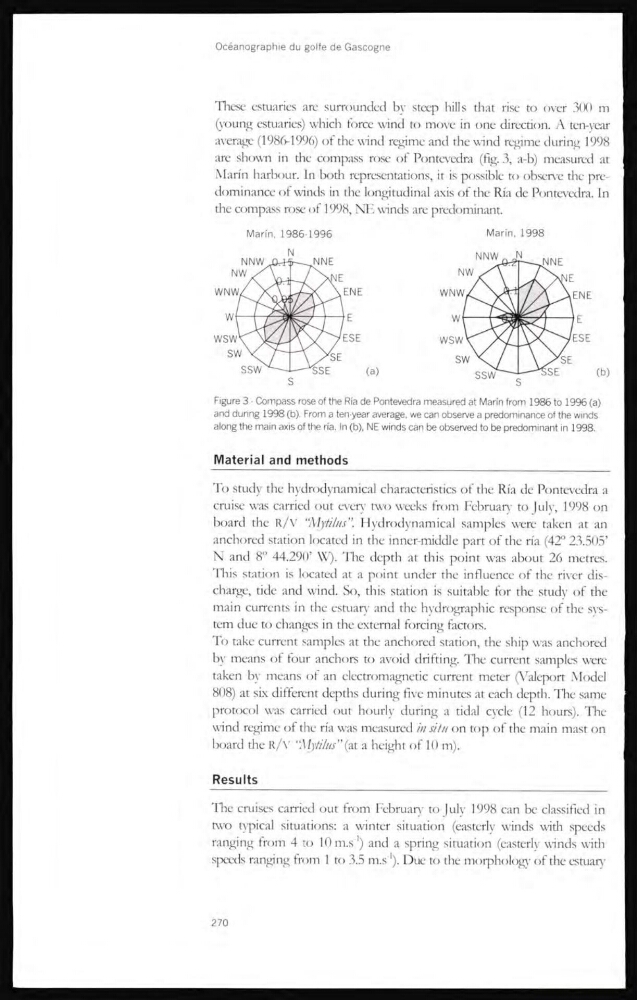
(vouny estuaries) which force wind to move in one direction. A ten-year
average (1986-1996) of the wind regime and the wind regime during 1998
are shown in the compass rose of Pontevedra (fig. 3, a-b) measured at
Marin harbour. In both representations, it is possible to observe the predominance of winds in the longitudinal axis of the Ria de Pontevedra. In
the compass rose of 1998, NE winds are predominant.
Figure 3 - Compass rose of the Ria de Pontevedra measured at Marin from 1986 to 1996 (a)
and during 1998 (b). From a ten-year average, we can observe a predominance of the winds
alongthe main axis of the rîa. In (b), NE winds can be observed to be predominant in 1998.
Material and methods
To study the hydrodynamical characteristics of the Ria de Pontevedra a
cmise was carried out everyr two weeks from Febmary to July, 1998 on
board the R/v “Mytihts". Hydrodynamical samples were taken al an
anchored station located in the inner-middle part of the ria (42° 23.505’
N and 8° 44.290’ W). The depth at this point was about 26 metres.
This station is located at a point under the influence of the river discharge, tide and wind. So, this station is suitable for the study of the
main currents in the estuary and the hydrographic response of the system due to changes in the external forcing factors.
To take current samples at the anchored station, the ship was anchored
by means ot four anchors to avoid drifting. The current samples were
taken by means of an electromagnetic current meter (Valeport Model
808) at six different depths during five minutes at each depth. The same
protocol was carried out hourly during a tidal cycle (12 hours). The
wind regime of the ría was measured in situ on top of the main mast on
board the R/v “Nlytilus” (at a height of 10 m).
Results
The cmises carried out from Febmary' to July 1998 can be classified in
two typical situations: a winter situation (easterly winds with speeds
ranging from 4 to 10 m.s
4 ) and a spring situation (easterly winds with
speeds ranging from 1 to 3.5 m.s
4 ). Due to the morphology of the estuary
270
(vouny estuaries) which force wind to move in one direction. A ten-year
average (1986-1996) of the wind regime and the wind regime during 1998
are shown in the compass rose of Pontevedra (fig. 3, a-b) measured at
Marin harbour. In both representations, it is possible to observe the predominance of winds in the longitudinal axis of the Ria de Pontevedra. In
the compass rose of 1998, NE winds are predominant.
Figure 3 - Compass rose of the Ria de Pontevedra measured at Marin from 1986 to 1996 (a)
and during 1998 (b). From a ten-year average, we can observe a predominance of the winds
alongthe main axis of the rîa. In (b), NE winds can be observed to be predominant in 1998.
Material and methods
To study the hydrodynamical characteristics of the Ria de Pontevedra a
cmise was carried out everyr two weeks from Febmary to July, 1998 on
board the R/v “Mytihts". Hydrodynamical samples were taken al an
anchored station located in the inner-middle part of the ria (42° 23.505’
N and 8° 44.290’ W). The depth at this point was about 26 metres.
This station is located at a point under the influence of the river discharge, tide and wind. So, this station is suitable for the study of the
main currents in the estuary and the hydrographic response of the system due to changes in the external forcing factors.
To take current samples at the anchored station, the ship was anchored
by means ot four anchors to avoid drifting. The current samples were
taken by means of an electromagnetic current meter (Valeport Model
808) at six different depths during five minutes at each depth. The same
protocol was carried out hourly during a tidal cycle (12 hours). The
wind regime of the ría was measured in situ on top of the main mast on
board the R/v “Nlytilus” (at a height of 10 m).
Results
The cmises carried out from Febmary' to July 1998 can be classified in
two typical situations: a winter situation (easterly winds with speeds
ranging from 4 to 10 m.s
4 ) and a spring situation (easterly winds with
speeds ranging from 1 to 3.5 m.s
4 ). Due to the morphology of the estuary
270